Contenido del curso
Grammar structures in the News and on TV
- 2

Estructuras Paralelas en Gramática de Noticias y Televisión
07:15 min - 3

Omisión de Palabras en Estructuras Paralelas
03:25 min - 4

Uso del Reported Speech en Inglés: Cambios en Tiempos Verbales
04:55 min - 5

Análisis de un Discurso Histórico Importante
01:31 min - 6

Oraciones de Relativo con Infinitivos en Inglés
03:17 min - 7

Uso de Gerundios para Transformar Oraciones Relativas
02:42 min - 8

Uso de Cláusulas Complementarias con Gerundios
03:23 min
Recommendations, Expectations, and Negative Questions
- 9

Uso de "Advise", "Recommend" y "Suggest" en Inglés
05:23 min - 10

Uso de Preguntas Negativas en Inglés para Sorpresa y Sugerencias
03:37 min - 11

Corrección de errores con "Thought" en inglés
03:08 min - 12

Uso del Gerundio para Expresar Disgusto en Inglés
02:26 min - 13

Práctica de conversación en inglés (contexto profesional)
00:00 min
Adverbs and Prepositions
- 14

Uso de "So" y "Therefore" en Causa y Efecto
02:45 min - 15

Uso de "So" como Sustituto en Inglés
03:03 min - 16

Uso de "Beforehand" y "Afterwards" en Frases Temporales
Viendo ahora - 17

Uso correcto de "between" y "among" en inglés
03:54 min - 18

Uso del adjetivo y adverbio "only" en inglés
01:39 min - 19

Estructura "For + Sustantivo/Pronombre + Infinitivo" en Inglés
03:42 min - 20

Cuidados de la Voz para Músicos Emergentes
02:17 min
See you next time!
Uso de "Beforehand" y "Afterwards" en Frases Temporales

Resumen
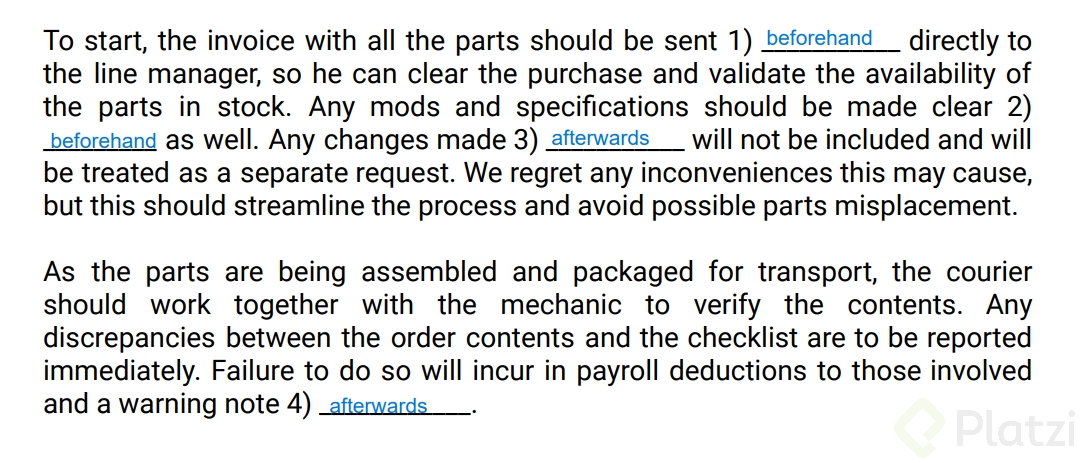
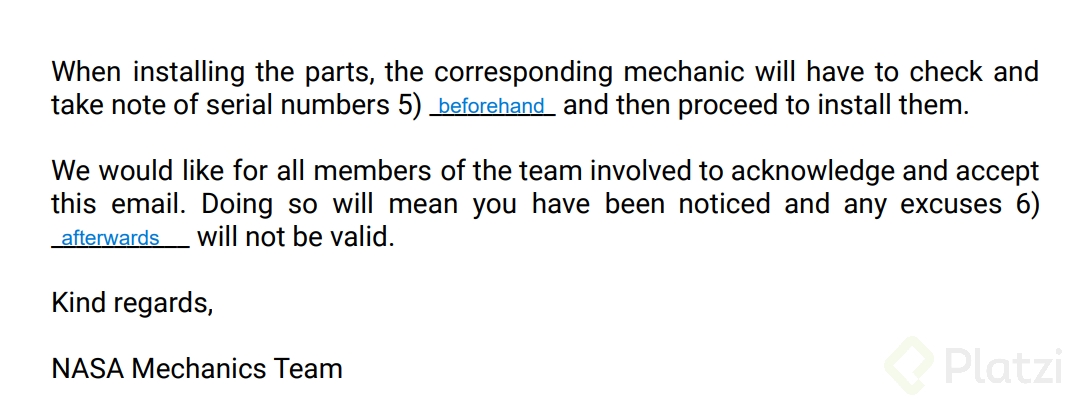
Understanding how to talk about the order of events is essential for clear communication in English. Two powerful adverbs that help you do exactly that are beforehand and afterwards. These words indicate whether something happened earlier or later in relation to another event, and mastering them will make your spoken and written English more precise and natural.
What do beforehand and afterwards mean?
These two words are antonyms, meaning they express opposite ideas. Both are used to talk about a moment in time, not a place [01:00].
- Beforehand means at an earlier or preceding time.
- Afterwards means at a later or succeeding time.
A helpful way to remember: beforehand points backward in time, while afterwards points forward. Neither word needs an object after it — they work perfectly on their own at the end of a sentence or clause.
How are they used in real sentences?
Consider this sports example [01:22]: The players warmed up beforehand. During the first half, they scored a goal. Two more goals followed afterwards. Here, beforehand tells us the warm-up happened before the game started, and afterwards tells us the two additional goals came after halftime.
More examples from the lesson [01:50]:
- He broke the chair. I found him sitting down on the floor afterwards. — He was on the floor at a later time, after breaking the chair.
- The journalist knew about the announcement beforehand, and that is why she was first to the store. — She had the information at an earlier time, which gave her an advantage.
How can you identify the correct time reference?
Practice exercises help reinforce the meaning of each word. Look at this passage [02:12]: The doctors worked hard on the research until they had a breakthrough. The vaccine was made afterwards. Too many lives were lost beforehand.
The question is: what happened before? The answer is that many lives were lost. The word beforehand signals this event occurred at an earlier point in the timeline — before the breakthrough and the vaccine.
What does afterwards tell us in context?
Here is another exercise [02:42]: The apartment building was completed in January. Then the earthquake damaged the structure. People couldn't use it afterwards.
The word afterwards makes it clear that people were unable to use the building after the earthquake. The sequence is: completion, then earthquake, then inability to use the building. Recognizing the order of events through these adverbs is a skill that improves both reading comprehension and writing clarity.
How can you practice using these words?
A great strategy is to think of a sequence of events from your own life and describe them using beforehand and afterwards. For instance:
- I studied for weeks beforehand. The exam went well. I celebrated with friends afterwards.
Notice how each sentence flows naturally into the next, creating a clear timeline. Try building your own sentences following this pattern, and pay attention to how native speakers use these adverbs in conversations, news reports, and written texts.
What real-life situations can you describe using beforehand and afterwards? Share your examples and keep practicing!