Uso del Reported Speech en Inglés: Cambios en Tiempos Verbales

Clase 4 de 20Curso de Inglés Intermedio B1: Preguntas Negativas y Recomendaciones

Resumen

Understanding how to transform direct quotes into reported speech is one of the most practical skills in English communication. Whether you're summarizing a meeting, retelling a conversation, or writing a news report, mastering reported speech allows you to convey what someone else said with accuracy and confidence.

How does reported speech change the tense?

The fundamental rule of reported speech is straightforward: the tense moves one step back in time from the original direct speech [0:52]. This shift is sometimes called backshifting, and it applies consistently across all major tenses.

Consider this example [0:10]: a spokeswoman says, "We're thinking of a way to reduce the financial deficit that this situation put us in. We have come up with three alternatives." When someone reports her words, it becomes: "The spokeswoman said they were thinking of a way to reduce the financial deficit that the situation had put them in. She said they had come up with three alternatives."

Notice two important changes:

  • Tenses shift back — present continuous becomes past continuous, present perfect becomes past perfect.
  • Pronouns changewe becomes they, us becomes them [0:43].

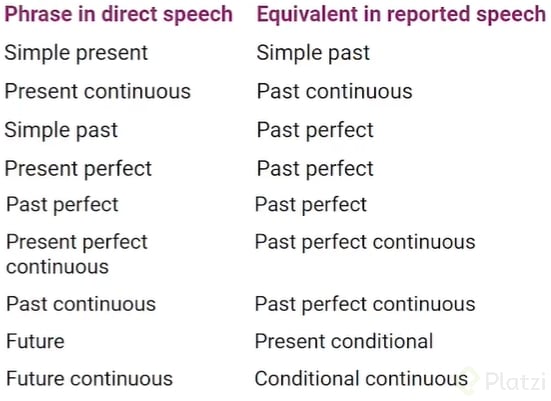
What are the tense equivalences in reported speech?

Here is how each tense transforms when moving from direct to reported speech [1:02]:

  • Simple present → simple past. Direct: "I always drink coffee." Reported: "She said she always drank coffee" [1:24].
  • Simple past → past perfect. Direct: "Walter arrived on Tuesday." Reported: "He said Walter had arrived on Tuesday" [1:35].
  • Past continuous → past perfect continuous. Direct: "We have been waiting for a long time." Reported: "They complained they had been waiting for a long time" [1:47].
  • Will → would. Direct: "I will be in Berlin on Friday." Reported: "She told me she would be in Berlin on Friday" [1:58].

The pattern is consistent: identify the tense in the original quote, then move it one step into the past.

How to practice reported speech with real examples?

Putting this into practice with news-style sentences makes the concept feel natural. Imagine a reporter on TV sharing these statements [2:10]:

  • Direct: "The President will travel there next month." Reported: "She said the President would travel there next month" [2:28].
  • Direct: "The summit meeting was scheduled to take place during the weekend." Reported: "She explained that the summit meeting had been scheduled to take place during the weekend" [2:48].
  • Direct: "I am expecting the leaders to arrive soon." Reported: "She told us that she was expecting the leaders to arrive soon" [3:09].

A few details worth noting in these examples:

  • Reporting verbs vary — said, explained, told us — and each adds a slightly different nuance.
  • The word that is optional after the reporting verb but helps clarity in longer sentences.
  • When using told, you always need an object (told us, told me), unlike said, which stands alone.

Practicing with real-world contexts like news reports, meetings, or everyday conversations will solidify this structure quickly. Try picking any quote you hear today and transforming it into reported speech — it's the fastest way to internalize the backshifting pattern.

What sentences did you find most challenging to transform? Share your own examples and keep practicing.