Contenido del curso
Grammar structures in the News and on TV
- 2

Estructuras Paralelas en Gramática de Noticias y Televisión
07:15 min - 3

Omisión de Palabras en Estructuras Paralelas
03:25 min - 4

Uso del Reported Speech en Inglés: Cambios en Tiempos Verbales
04:55 min - 5

Análisis de un Discurso Histórico Importante
01:31 min - 6

Oraciones de Relativo con Infinitivos en Inglés
03:17 min - 7

Uso de Gerundios para Transformar Oraciones Relativas
02:42 min - 8

Uso de Cláusulas Complementarias con Gerundios
03:23 min
Recommendations, Expectations, and Negative Questions
- 9

Uso de "Advise", "Recommend" y "Suggest" en Inglés
05:23 min - 10

Uso de Preguntas Negativas en Inglés para Sorpresa y Sugerencias
03:37 min - 11

Corrección de errores con "Thought" en inglés
03:08 min - 12

Uso del Gerundio para Expresar Disgusto en Inglés
Viendo ahora - 13

Práctica de conversación en inglés (contexto profesional)
00:00 min
Adverbs and Prepositions
- 14

Uso de "So" y "Therefore" en Causa y Efecto
02:45 min - 15

Uso de "So" como Sustituto en Inglés
03:03 min - 16

Uso de "Beforehand" y "Afterwards" en Frases Temporales
02:48 min - 17

Uso correcto de "between" y "among" en inglés
03:54 min - 18

Uso del adjetivo y adverbio "only" en inglés
01:39 min - 19

Estructura "For + Sustantivo/Pronombre + Infinitivo" en Inglés
03:42 min - 20

Cuidados de la Voz para Músicos Emergentes
02:17 min
See you next time!
Uso del Gerundio para Expresar Disgusto en Inglés

Resumen
Expressing disgust or strong dislike in English goes beyond simple phrases like "I don't like." When you combine not with a gerund, you create powerful structures that communicate frustration, annoyance, and rejection toward specific situations. This lesson focuses on mastering that combination to make your spoken and written English more expressive and natural.
¿Qué significa usar not con gerunds?
A gerund is a verb form ending in -ing that functions as a noun. When you place not before a gerund, you refer to the opposite of that action [0:39]. This structure lets you emphasize what bothers you by highlighting the absence of something desirable.
Consider these examples:
- I hate not knowing the surprise. This means you dislike being uninformed about the surprise [0:14].
- Not drinking coffee is unacceptable. Here, the speaker expresses strong rejection toward the idea of going without coffee [0:18].
The key pattern is: subject + verb of dislike + not + gerund (+ complement).
¿Cómo se transforma una frase con not + gerund en otra equivalente?
One useful skill is recognizing that a sentence with not + gerund can be rephrased. This helps you understand meaning from different angles [0:46]:
- They dislike not having money = They dislike being poor.
- I hate not arriving on time = I hate arriving late.
- I hate not knowing the surprise = I don't like being uninformed [0:26].
Notice how the version with not + gerund sounds more specific and emotionally charged, while the alternative version uses a direct adjective or opposite verb.
¿Qué verbos expresan disgusto con not + gerund?
English offers several verbs to express different levels of dislike. Each one carries a distinct intensity:
- Dislike: mild rejection.
- Hate: strong emotional rejection.
- Detest: very strong, almost visceral rejection.
- Loathe: the most intense form of disgust.
All of these verbs work naturally before not + gerund phrases.
¿Cómo se aplican en oraciones completas?
Here are practice sentences from the lesson that show these verbs in action [1:08]:
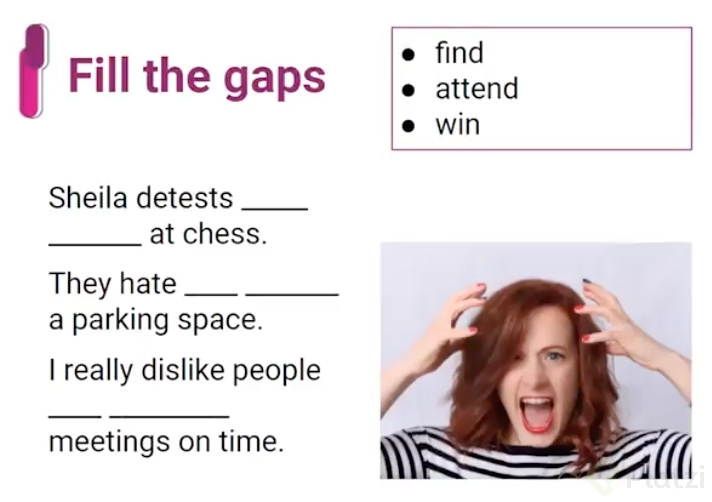
- Sheila detests not winning at chess. The verb detest shows extreme frustration about losing.
- They hate not finding a parking space. A common everyday complaint.
- I really dislike people not attending meetings on time. Notice that the subject of the gerund can be another person — here, "people."
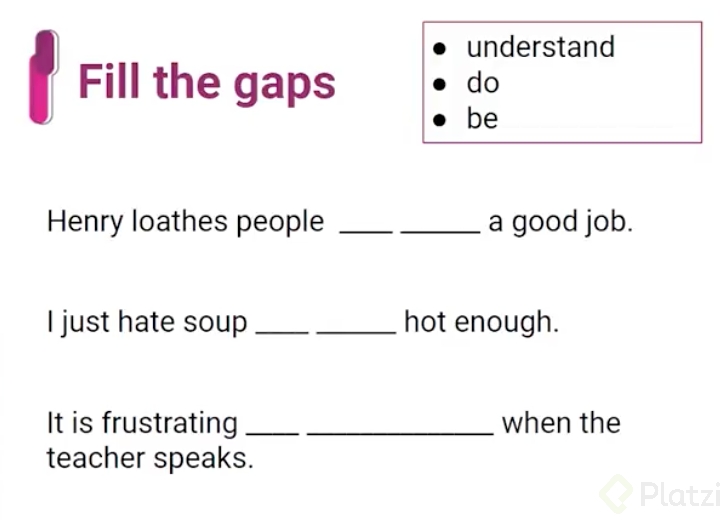
- Henry loathes people not doing a good job. The verb loathe makes this the strongest expression of disgust.
- I just hate soup not being hot enough. Even non-human subjects can appear before not + gerund.
- It is frustrating not understanding when the teacher speaks. Here the structure uses an adjective (frustrating) instead of a verb, but the not + gerund pattern remains the same.
¿Cómo practicar esta estructura en la vida real?
A great way to internalize this pattern is to think about three categories that affect you personally [1:42]:
- Your city: what frustrates you about where you live. Example: I hate not having enough public parks.
- Other people: behaviors that bother you. Example: I detest people not being honest.
- The world: global issues that concern you. Example: I loathe governments not protecting the environment.
By creating your own sentences using verbs of different intensity — dislike, hate, detest, loathe — combined with not + a gerund phrase, you build fluency and emotional range in English. Try writing at least three sentences for each category and share them with a classmate or tutor to get feedback on your usage.