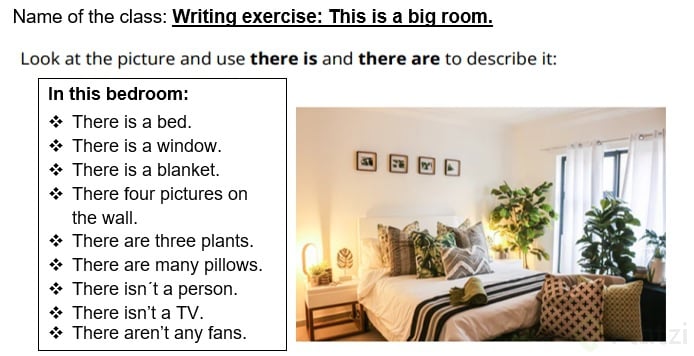


There are five pillows on the bed There are two pollows in front of the bed There aren't chairs There aren't people
There is one lamp on the table There is one plant on the desk There isn't a TV There isn't a girl
Describir una imagen en inglés es uno de los ejercicios más efectivos para fijar vocabulario y practicar estructuras básicas. Con there is y there are, puedes hablar de lo que existe (o no existe) en una escena de forma natural, clara y útil para conversaciones reales.
Por qué practicar writing con descripciones visuales
Observar una imagen y escribir sobre ella te obliga a conectar vocabulario con estructura. No es solo memorizar palabras: es construir oraciones completas usando lo que ves.
Este tipo de práctica activa dos habilidades al mismo tiempo. Por un lado, refuerzas el uso de there is y there are en afirmativo y negativo. Por el otro, expandes tu vocabulario de objetos cotidianos como muebles, electrodomésticos y elementos de una habitación.
¿Para qué sirve describir imágenes en inglés? Sirve para practicar writing real, fijar vocabulario nuevo y aprender a usar estructuras gramaticales como there is y there are en contextos cotidianos.
Cómo escribir oraciones con there is y there are
La lógica es sencilla y depende solo de la cantidad. Si hablas de un objeto en singular, usas there is. Si hablas de dos o más, usas there are.
Mira este ejemplo aplicado a una cocina [00:30]:
Fíjate en algo importante: no solo describes lo que existe, también lo que no existe. Esa combinación entre afirmativo y negativo hace que tu descripción sea más rica y precisa.
¿Cuál es la diferencia entre there is y there are? Usas there is para un solo objeto y there are para dos o más. En negativo, se convierten en there isn't y there aren't.
Cuántas ideas debes escribir en el ejercicio
El reto es escribir entre cuatro y cinco oraciones sobre la imagen del worksheet. No necesitas párrafos largos ni vocabulario complicado. Necesitas claridad.
Una buena descripción mezcla ambos tipos de oración:
Cómo aprovechar el worksheet y consolidar tu progreso
Descarga el worksheet desde la sección de recursos y observa la imagen con calma antes de escribir. Identifica primero los objetos principales: cuántos hay, qué tamaño tienen, qué falta respecto a una habitación normal.
Después escribe tus oraciones siguiendo el modelo de la cocina. Y aquí viene la parte clave: consolida tus respuestas en tu workbook, porque ese cuaderno es la evidencia final de tu trabajo en el curso [01:05].
Escribir a mano o pasar tus respuestas al workbook no es un trámite. Es la forma de tener un registro tangible de tu avance, revisarlo después y notar cómo tu writing mejora clase tras clase.
¿Listo para describir tu imagen? Comparte tus oraciones en los comentarios y cuéntame qué objetos aparecieron en tu worksheet.

Describir una imagen en inglés es uno de los ejercicios más efectivos para fijar vocabulario y practicar estructuras básicas. Con there is y there are, puedes hablar de lo que existe (o no existe) en una escena de forma natural, clara y útil para conversaciones reales.
Observar una imagen y escribir sobre ella te obliga a conectar vocabulario con estructura. No es solo memorizar palabras: es construir oraciones completas usando lo que ves.
Este tipo de práctica activa dos habilidades al mismo tiempo. Por un lado, refuerzas el uso de there is y there are en afirmativo y negativo. Por el otro, expandes tu vocabulario de objetos cotidianos como muebles, electrodomésticos y elementos de una habitación.
¿Para qué sirve describir imágenes en inglés? Sirve para practicar writing real, fijar vocabulario nuevo y aprender a usar estructuras gramaticales como there is y there are en contextos cotidianos.
La lógica es sencilla y depende solo de la cantidad. Si hablas de un objeto en singular, usas there is. Si hablas de dos o más, usas there are.
Mira este ejemplo aplicado a una cocina [00:30]:
Fíjate en algo importante: no solo describes lo que existe, también lo que no existe. Esa combinación entre afirmativo y negativo hace que tu descripción sea más rica y precisa.
¿Cuál es la diferencia entre there is y there are? Usas there is para un solo objeto y there are para dos o más. En negativo, se convierten en there isn't y there aren't.
El reto es escribir entre cuatro y cinco oraciones sobre la imagen del worksheet. No necesitas párrafos largos ni vocabulario complicado. Necesitas claridad.
Una buena descripción mezcla ambos tipos de oración:
Descarga el worksheet desde la sección de recursos y observa la imagen con calma antes de escribir. Identifica primero los objetos principales: cuántos hay, qué tamaño tienen, qué falta respecto a una habitación normal.
Después escribe tus oraciones siguiendo el modelo de la cocina. Y aquí viene la parte clave: consolida tus respuestas en tu workbook, porque ese cuaderno es la evidencia final de tu trabajo en el curso [01:05].
Escribir a mano o pasar tus respuestas al workbook no es un trámite. Es la forma de tener un registro tangible de tu avance, revisarlo después y notar cómo tu writing mejora clase tras clase.
¿Listo para describir tu imagen? Comparte tus oraciones en los comentarios y cuéntame qué objetos aparecieron en tu worksheet.
There are five pillows on the bed There are two pollows in front of the bed There aren't chairs There aren't people
There is one lamp on the table There is one plant on the desk There isn't a TV There isn't a girl
In this kitchen... There are 5 chairs There are two lamps There aren´t five plants There is a window There isn´t a TV
In this room...
There is a blanket There are three or four plants There is a window There are four pictures There isn´t three lamps.
In this kitchen:
There are five chairs, but there ins´t a tv.
There are two lamps, but there isn´t a dog.
There is a big window, but there ins´t an aquarium.
Outside the kitchen there are plants, but there isn´t a car.
On the table there are many cups, but on the table there isn´t food.
In the room:
In front the window there is a bed, but there aren´t people. On the bed there are five pillows, but there isn´t a cat. on the wall there are four picturs, but there aren´t lamps. In front the bed there ins´t a table, but there are two pillows. Under the bed there are something, but under the bed there isn´t a PS5.
In this kitchen:
There are 5 chairs
There isn´t a coffee bar
There are two lamps
There isn´t a carpet
There is a refrigireitor
There is a stove
Look at the picture and use there is and there are to describe it.
muy bueno
There are five pillows on the bed There are two pollows in front of the bed There aren’t chairs There aren’t people
There is one lamp on the table There is one plant on the desk There isn’t a TV There isn’t a girl
There are five pillows on the bed There are two pollows in front of the bed There aren’t chairs There aren’t people
There is one lamp on the table There is one plant on the desk There isn’t a TV There isn’t a girl