Contenido del curso



Manuel Rodríguez
student•
hace 4 años

Celeste Yamile
student•
hace 4 años
Arelly Rosa
student•
hace 3 años
Contenido del curso
Manuel Rodríguez
Celeste Yamile
Arelly Rosa
David Ferney Plata Briceño

Gerardo Soto

Chris Edenfield
Carlos Rodríguez
Chris Edenfield

Daniel Ramírez Ahumada
Natalia Neira
Chris Edenfield

Freddy Peñate Goberna
Chris Edenfield
Arelly Rosa
Chris Edenfield

Denis Picén
Chris Edenfield

Giuliana Giangioppo
Chris Edenfield
Giuliana Giangioppo

Luis Francisco Montero
Celeste Yamile

Roberto Bolivar
Chris Edenfield
Angelica Sarai Alfaro Rodriguez

Ada Nicol Lloret Rey
César Augusto López González

Deymi Zelaya

Luis Renato Cabañas Rodríguez

Daniel Burgos

ESNEYDI VANESA RODRIGUEZ BARRETO
ESNEYDI VANESA RODRIGUEZ BARRETO
Nelson Isaí Duarte Gutiérrez
Don't talk like teacher Yoda
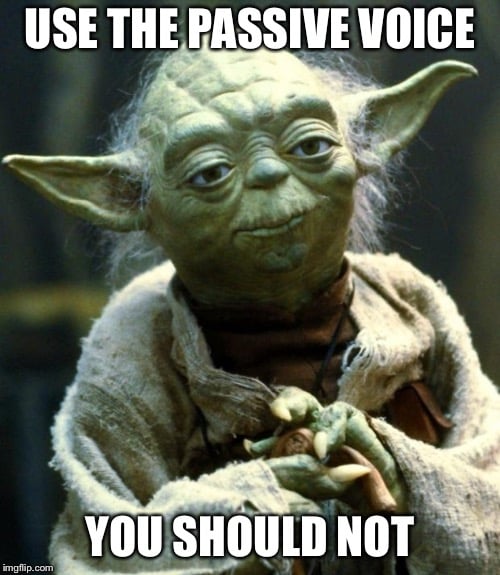
🤣🤣🤣
Yes. I was thinking the same. Yoda Lessons
Exercises
1.- having been fired the previous week, He was looking for a new job
2.-Not being promote well, the book didn’t sell a lot of copies
3.-Having been awarded the prize money, she took a trip around the world
4.-Having been warned countless times already, the director chose to hold her tongue
5.-Having been kept in a cage, the tiger began to show signs of depression
Great responses Gerardo!
I DONT UNDERSTAND THE DIFERENCE BETWEEN PRESENT AND PERFECT PARTICIPLE PASSIVE .... I THINK I CAN CHANGE " HAVING BEEN" PER " BEING + PARTICIPLE" AND IT MEANS THE SAME
Thanks for the question Carlos - it's a good one too! The main difference between the two types is with respect to timing. Let's take a look at the two types below.
PERFECT PARTICIPLE The perfect participle (both active and passive) communicatates the idea that the action being described by the participial clause finishes before the action in the main clause. In the example below, the participial phrase is in bold and the main clause is in italics.
Having been scared by the pandemic, John didn't leave his house unless it was necessary. In this example it is evident that John was scared by the pandemic first and then he developed a habit of not leaving his house unless it was necessary.
PRESENT PARTICIPLE The present participle communicates the idea that the action described by the participial clause and the action in the main clause happen (or happened) at the same time. This means they can both happen at the same time in the past or at the same time in the present. Take a look at the examples below (the participial clauses are shown in bold and the main clauses in italics):
Being scared, John decided not to go out on Halloween night. In the above example both actions occurred in the past. In other words, John was scared so he decided not to go out on Halloween.
Being scared of lightning, the dog always hides under the bed when it rains. In this example both actions occur in the present. In other words, the dog is scared of lightning so he always hides under the bed when it rains.
I hope this helps to clarify that although they are similar their is a slight distinction in meaning. Please let me know if this explanation is clear.
Good to know that PRESENT PARTICIPLE can be used both in past and present sentences.
Nice job Natalia! Just one quick thing to point out - in #3 it's not necessary to use the word again. The reason is because using a perfect participle phrase (in this case having been awarded ) indicates that that action happened before the other one, and is also the reason why the later action takes place.
Excellent work here! The last one is missing the word been but seeing as you used it in the other sentences I'm guessing it just slipped your mind!
Being afraid, he couldn't reach his goals in life. Being seductive, she broke up with his husband. Being sensitive, she could speak with others
Great work Arelly!
Great responses, nice job!
I have to admit that doing these sentences wasn´t very easy, I´m a little confused about the tense of the sentences and when to use the “present participle” or the “perfect participle”, but I hope it is ok. 😃
If you´d be so kind as to, I´d like some feedback.
He was looking for a new job because he had been fired the previous week. Having been fired the previous week, he was looking for a new job.
Since the book wasn’t promoted well it didn’t sell a lot of copies. Not being promoted well, the book didn´t sell a lot of copies.
She took a trip around the world after she had been awarded the prize money. Having been awarded the prize money, she took a trip around the world.
As they had been warned countless times already, the director chose to hold her tongue. Having been warned countless times already, the director chose to hold her tongue.
The tiger began to show signs of depression because it was kept in a cage. Being kept in a cage, the tiger began to show signs of depression.
Thank you for your honesty and the question, Giuliana. The difference isn't always very evident so this can be a tricky topic.
The perfect participle is used to show that the action in the participial clause was finished by the time the main action happened.
"Having been picked to lead the committee, she wrote letters of thanks to her supporters." The first clause is the participial clause and because it uses the perfect participle we can be sure that she was selected to the lead the committee first, and then she wrote the letters.
In contrast, one common use for the present participle is to show that two actions were or are happening at the same time. However, it can also be used for a variety of other reasons, including showing the result or purpose of an action, as well as to simply add extra information about the subject of the main clause.
Here are two examples that show how the present participle can be used to talk about present actions or states, but also past ones. To determine which tense, look at the verb in the main clause:
"Not being promoted well, the book didn't sell well."
Verb is in the past = these are both past actions
"The art museum doesn't get a lot of visitors, not being located in a popular neighborhood."
Verb is in the present = these are both present states
Regarding feedback on your sentences, they all use participles correctly. #1, #3 and #4 - in each sentence the perfect participle shows that the action in the participial clause (having been fired, having been awarded, having been warned) was finished before the action in the main verb (was looking, took a trip, chose to hold her tongue). #2 and #5 - in both sentences the present participle shows that the action in the participial clause and the action in the main clause were both happening at the same time in the past, one being a result of the other.
Excellent work!
I see it clear now! Thank you so much, Chris! :)
Why use the passive voice?
Thanks :)
Having been fired the previous week, he was looking for a new job. Being not promoted well, the book didn't sell a lot of copies. Having been awarded the prize money, she took a trip around the world. Having been warned countless times already, the director cose to hold her tongue. Being kept in a cage, the tiger began to show signs of depression.
Great responses Roberto! Take a look at #2:
With the negative form it's better to put the 'not' first: "Not being promoted well, the book didn't sell a lot of copies."
Why is it better to use passive voice?
You should use the passive voice when the receiver of an action is more important than the person or thing performing it. Think of it like a spotlight on a stage. In the active voice, the spotlight shines on the actor doing the work (e.g., "The mechanic fixed the car"). But sometimes, the audience only cares about the result. By shifting to the passive voice, you move the spotlight to the object that experienced the action (e.g., "The car was fixed"). This is incredibly useful in professional settings, journalism, or scientific writing where the focus needs to remain on the project, the product, or the event itself, rather than who specifically handled it. It allows you to emphasize the impact and outcome seamlessly.
Having been fired, he was looking for a new job.
Having sold very few copies, the book's lack of promotion became evident. Having been awarded the prize money, she took a trip around the world.
Having been kept in a cage, the tiger began to show signs of depression.
1- Being that he had been fired the previous week, he was looking for a new job.
2- Not being well promoted the book didn´t sell a lot of copies.
3- having been awarded the prize money, she took a trip around the world after.
4- Being warned countless times already by them, the director chose to hold her tongue.
5- The tiger began to show signs of depression, having been kept in a cage.
4-
Having been unable to fulfill the program, the mission ended early
Being blamed for the disaster, the mayor felt awful
i like his class and im improving a lot