Contenido del curso
Música y eventos en vivo en inglés
Cómo hablar de cine en inglés
Creatividad y arte en inglés
Practica inglés frente y detrás del escenario
Continúa practicando tu inglés para música, arte y cine
De dónde viene el blues moderno

Resumen
Modern music genres like rock, jazz, soul, funk and R&B share one common root: the blues. Understanding where this style comes from helps you talk about music in English while practicing articles (a, an, the) and prepositions (by, to) in real contexts.
This lesson connects musical history with practical grammar, so you can describe instruments, genres and influential artists with accuracy.
Where does modern music come from in English class?
Before jumping into grammar, it helps to anchor the vocabulary in a real story. The blues is the foundation of most modern Western popular music, and its history gives you natural sentences to practice English structures.
What is the origin of the blues?
The blues comes from the US. Former slaves used to sing songs to cope with daily struggles caused by poverty and racism. The first form was the Delta blues, named after the region where it emerged, and it featured three core elements:
- A singer.
- The harmonica.
- An acoustic guitar.
In the 1900s, blues artists moved from the rural South to the urban North in what is known as the Great Migration [01:08]. The sound became more energetic and gave birth to the Chicago blues, which added the electric guitar, the bass guitar, the piano and the drums.
What is the difference between Delta blues and Chicago blues? Delta blues is acoustic and intimate, with singer, harmonica and acoustic guitar. Chicago blues is electric and energetic, adding electric guitar, bass, piano and drums.
How did the blues influence other genres?
As musicians traveled across the country, the blues mixed with other styles and inspired new genres like rock and roll, jazz, soul, funk and R&B [00:35]. Two iconic examples show this influence clearly:
- The rock and roll classic Hound Dog was covered by Elvis Presley, but the original was recorded by Big Mama Thornton.
- The Rolling Stones took their name from a Muddy Waters song called Rolling Stone, and the Beatles also used blues as inspiration.
How do you use by and to when talking about music?
Once you know the story, the grammar fits naturally. Two prepositions appear constantly when discussing artists and movements: by for agency and to for direction.
When should I use by in English?
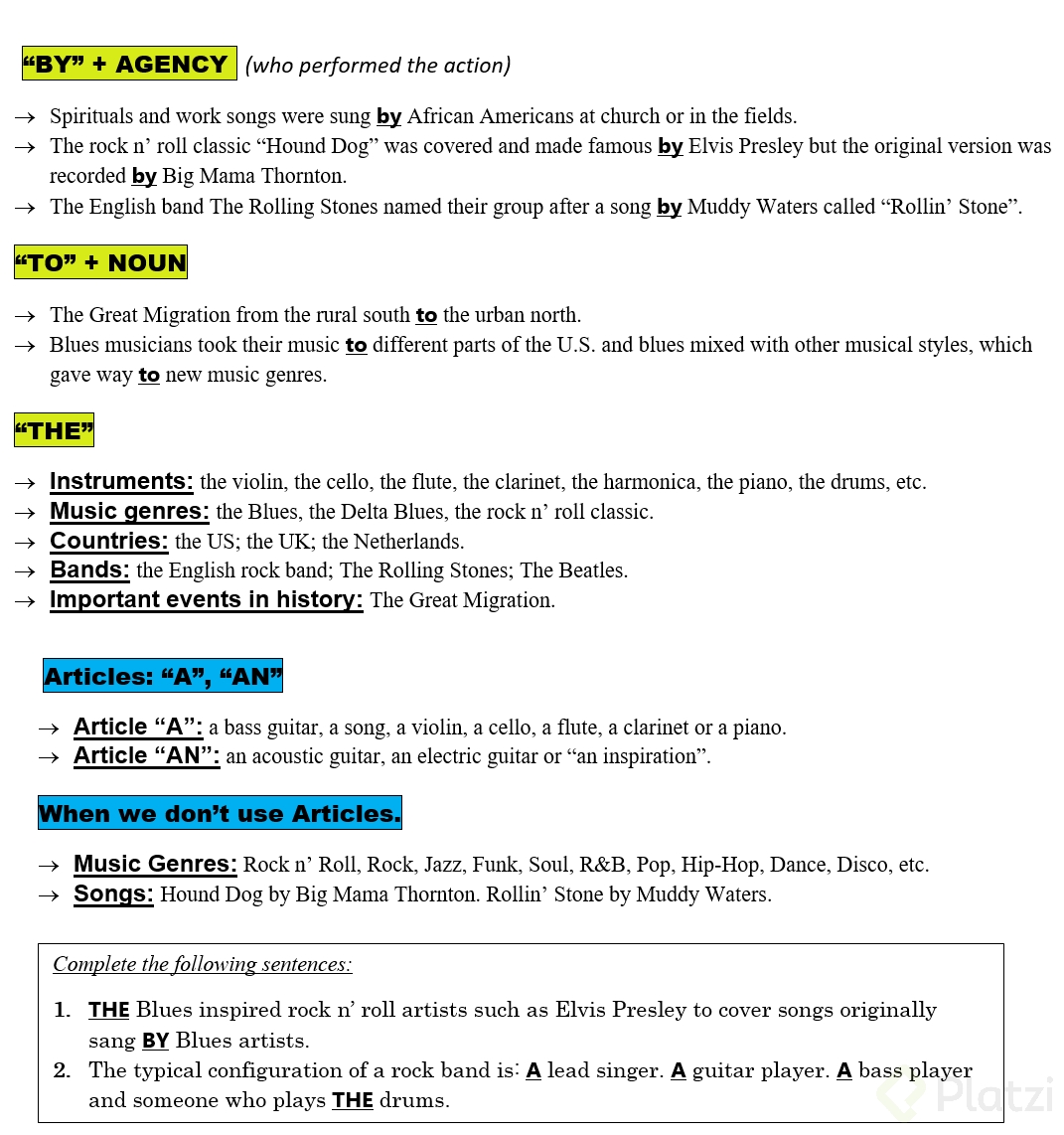
You use by + agent to say who performed an action, especially in passive voice. The blues lesson gives you clear models:
- Spirituals and work songs were sung by African Americans at church or in fields.
- Hound Dog was made famous by Elvis Presley, but the original was recorded by Big Mama Thornton.
- The Rolling Stones named their group after a song by Muddy Waters.
When should I use to with nouns?
You use to + noun to express movement or direction. In the context of music history, it appears when describing how the blues traveled:
- The Great Migration from rural South to urban North.
- Blues musicians took their music to different parts of the US.
What does by mean in a sentence like "a song by Muddy Waters"? It means Muddy Waters is the author or performer. By introduces the person responsible for creating or doing something.
When do I use the, a or an with instruments and genres?
Articles are tricky in English, but musical vocabulary gives you a clean framework to remember the rules.
Why do we say the violin but not the rock and roll?
Use the with specific or unique things, including most musical instruments and certain proper categories:
- Instruments: the violin, the flute, the harmonica, the drums, the piano.
- Countries with plural or descriptive names: the US.
- Music genres treated as a movement: the blues.
- Major historical events: the Great Migration.
Use a or an when introducing something for the first time or talking about one item among many. The choice depends on the sound that follows:
- An before vowel sounds: an acoustic guitar, an inspiration.
- A before consonant sounds: a bass guitar, a song, a piano, a violin, a flute.
When should I omit the article in English?
Sometimes no article is needed. You drop the article in two common cases related to music:
- Naming music genres in general: rock and roll, rock, soul, R&B, jazz, funk.
- Mentioning song titles directly: say "Hound Dog" by Big Mama Thornton, not "the Hound Dog".
Do I say "the rock and roll" or just "rock and roll"? Just rock and roll. Music genres go without an article when you talk about them in general. The exception is the blues, which keeps the article by tradition.
How can I practice articles and prepositions in real sentences?
Try completing these examples from the lesson and check your reasoning:
- The blues inspired rock and roll artists such as Elvis Presley to cover songs originally sung by blues artists.
- The typical configuration of a rock band is a lead singer, a guitar player, a bass player, and someone who plays the drums.
Notice how a introduces each role for the first time, while the appears with the drums because it is treated as a specific instrument set. The preposition by signals the agent of the action.
Which artist or band would you describe using by and articles? Share your sentence in the comments and keep practicing.