
CBO vs ABO: Scale Meta Ads Without Breaking Them
Contenido del curso


Audiencias y targeting


Anuncios que si funcionan


Implementación inteligente


Métricas, optimización y escala


Aprovecha el sistema y vence


CBO vs ABO: Scale Meta Ads Without Breaking Them
Resumen
Scaling Meta campaigns is not about duplicating them or pumping the budget overnight. It is about feeding the system the right way so the learning phase you already earned does not break. If you want to scale Meta ads without losing performance, the first lever you need to master is how you manage your budget at the campaign or ad set level.
What is the difference between CBO and ABO in Meta Ads?
Meta gives you two ways to handle money inside a campaign, and each one talks to the algorithm in a very different language.
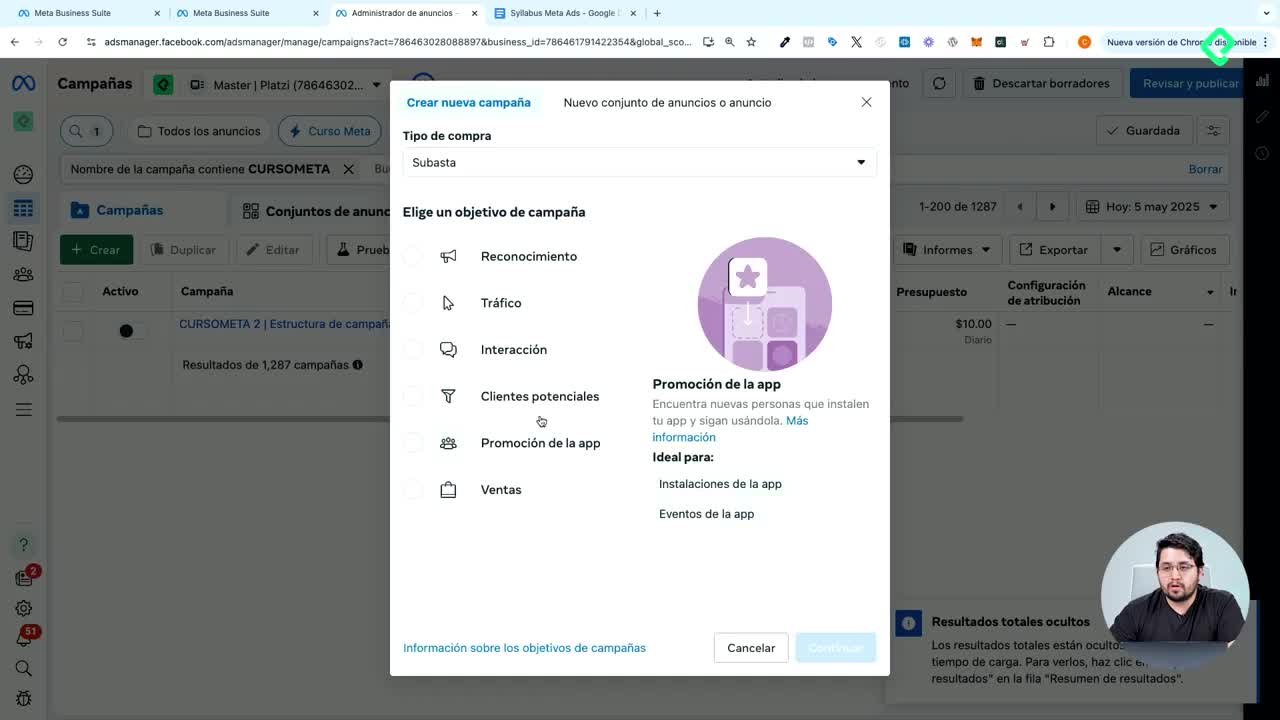
The first one is Campaign Budget Optimization (CBO). You set the budget at the top of the campaign and let the algorithm distribute it across your ad sets in real time, sending more money to whatever is performing better. The second one is Asset Budget Optimization (ABO), where you decide exactly how much each ad set will spend, no matter how each one performs [01:05].
What is CBO in Meta Ads? It is a setting where you assign the budget at the campaign level and Meta automatically distributes it to the ad set that is generating the best results in real time.
When should I use a daily budget vs a lifetime budget?
Inside CBO you still have to choose between two flavors of budget, and the rule is simple.
- Use lifetime budget when your campaign has a clear start and end date, so the algorithm can decide how to spread the money across those days.
- Use daily budget when the campaign runs without an end date and you need flexibility to adjust on the fly.
- Once a campaign is published, you cannot freely switch the budget management type, so plan it before launching [02:10].
When should you use ABO instead of CBO?
ABO exists for one main reason: fair competition. If you want clean data, you need every contender to receive the same amount of budget.
Use ABO only when you are experimenting. It shines in three specific scenarios where you need to isolate variables and read results without bias.
- Cold audience testing, for example pitting one lookalike against another to see which one wins on equal terms.
- Remarketing audience testing, like comparing a 7 day abandoned cart audience against a 15 day one.
- Creative testing, splitting 10 ads into two ad sets of 5 ads each, with the same budget, so the comparison is honest [05:30].
When should I use ABO? Use it only for experimentation: cold audiences, remarketing windows, or creative tests where each ad set must receive the exact same budget.
Why CBO is better for scaling winning campaigns
Once the experiment is over and you already know what works, CBO becomes your best friend. You use it to consolidate learnings, not to discover them.
It works in three concrete moments. First, when you already have two winning audiences and a winning ad set, and you want the budget to flow to whatever performs best in real time. Second, when you want to scale a campaign that is already profitable and you need to control a single variable: the budget. Third, to squeeze your remarketing, increasing investment on your best retargeting audience without micromanaging each ad set [07:15].
How does financial liquidity affect Meta campaigns?
The algorithm needs something called financial liquidity. In plain words, it needs enough budget concentrated in few enough places to learn fast and optimize well.
Fragmenting your money across dozens of campaigns and ad sets is the fastest way to starve the system. When you consolidate, you get more attributed events per placement, faster learning, and simpler control. Fewer campaigns means easier management and a fatter budget per unit.
There are three concrete ways to build that liquidity:
- Reduce your campaign structure. Fewer campaigns means more budget per campaign.
- Fewer ad sets per campaign, so each ad set gets a more robust slice of the pie.
- Geographic concentration. If you advertise in several countries, group them inside a single campaign and let the algorithm push impressions where results are best.
How do you scale Meta campaigns without breaking them?
There are two ways to scale, and they are not interchangeable. One is safe, the other is risky.
Vertical scaling: the 30% rule
This is the method I recommend first. You take a campaign that is already working and you increase its budget by no more than 30% at a time.
If you push it harder than that, you send the campaign back to Meta's learning phase, as if it were brand new. The trick is to follow a rhythm: scale, let it stabilize, then scale again. Stacking increases on top of each other without letting the campaign breathe is the fastest way to break it [10:20].
What is the 30% rule in Meta Ads? It is the maximum budget increase you can apply to a working campaign without sending it back to the learning phase.
Horizontal scaling and audience overlap
The second option is horizontal scaling: duplicating a winning campaign and raising the budget on the new copy. It used to work better than it does today.
The problem is audience overlap. When you run two campaigns targeting the same people, you end up bidding against yourself in the auction, which inflates your own costs. Use horizontal scaling only when vertical scaling has stopped delivering [11:40].
Which of these two budget management methods were you already using? Drop your experience in the comments and tell me whether CBO or ABO has worked better for your accounts.