
Choosing Meta Ads Objectives That Drive Sales
Contenido del curso


Audiencias y targeting


Anuncios que si funcionan


Implementación inteligente


Métricas, optimización y escala


Aprovecha el sistema y vence


Choosing Meta Ads Objectives That Drive Sales
Resumen
Choosing the right Meta Ads campaign objective is the single most important decision you make when launching a campaign. It defines how the algorithm optimizes your budget, finds your audience, and ultimately delivers the business result you are after. If you get this first step right, everything downstream becomes easier.
What are the six Meta Ads objectives and when should you use each?
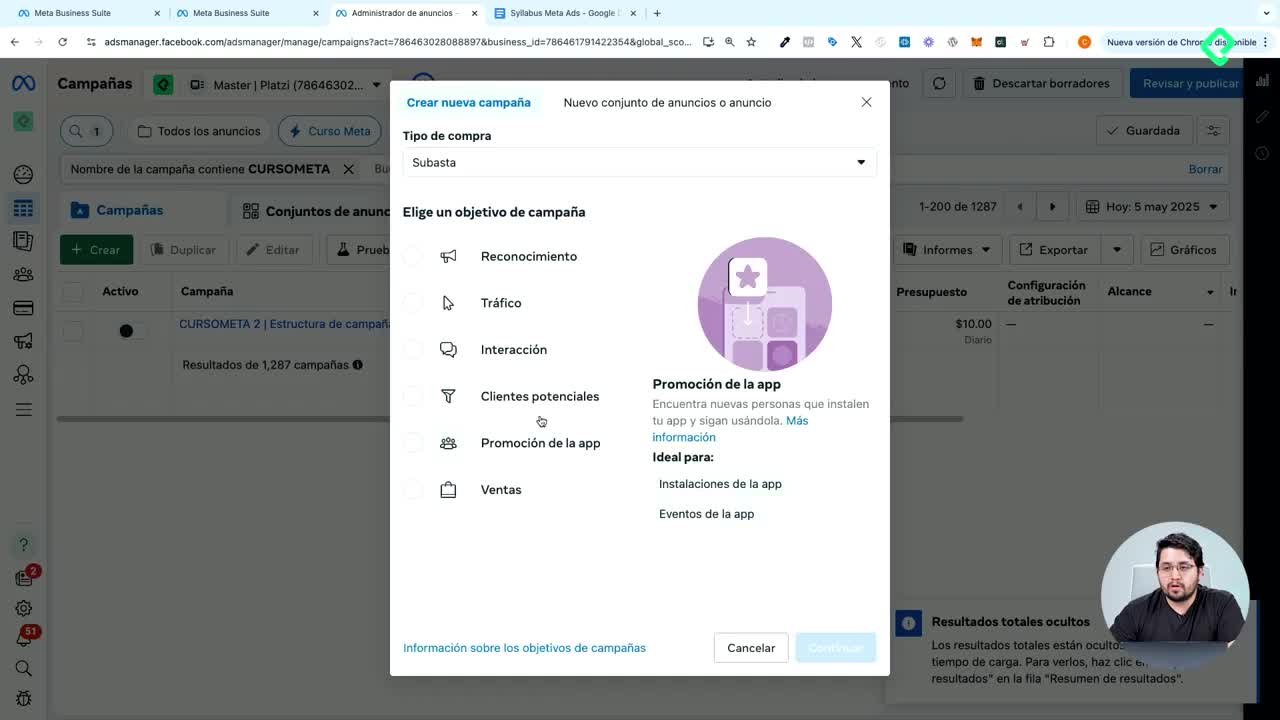
Meta simplified its campaign structure and now you only see six objectives, all aligned to the marketing funnel: from awareness at the top to sales at the bottom. The general rule is simple: pick the objective that matches the real business outcome you want, not a proxy for it.
Awareness, traffic and engagement: top and mid funnel
These three objectives are useful when your brand is still building recognition or when you want people to interact with your content.
- Awareness: optimizes for reach, brand recall, video views or store location awareness. Big brands use it to push content to massive audiences. If you are chasing direct sales, skip it for now [02:00].
- Traffic: sends users from Meta platforms to a website, profile or chat. Avoid optimizing for link clicks, since you will get low quality traffic. Use landing page views so Meta only counts users who actually loaded your site [03:30].
- Engagement: targets people who already understand your brand and are likely to react, comment or watch a video. The audience is smaller but more intentional than in traffic [04:45].
What is the difference between traffic and engagement on Meta Ads? Traffic prioritizes volume of clicks or visits, while engagement prioritizes quality of interaction with users who already know your brand.
Leads, app promotion and sales: bottom funnel
When you want measurable business results, these three objectives do the heavy lifting.
- Leads: captures potential clients through instant forms inside Meta, qualified conversations on Messenger, Instagram or WhatsApp, website conversions or calls [06:00].
- App promotion: requires the Meta SDK integrated in your app and lets you optimize for installs or specific in app events, like a purchase made inside the app [07:15].
- Sales: the most relevant for most businesses. You can optimize for website conversions measured by your pixel and Conversions API, for catalog sales that personalize ads based on products a user already viewed, or for sales focused conversations and calls [08:00].
How does Meta's learning phase work?
Meta uses a process called learning phase to figure out who your ideal user is and how to reach them. This phase does not end with time, it ends with conversion events.
You need at least 50 attributed events per week for Meta to exit the learning phase and start scaling efficiently. Fewer than that, and the algorithm keeps exploring without enough signal to commit to a pattern.
How many conversions does Meta need to exit the learning phase? Around 50 attributed conversion events per week per ad set. Below that, performance stays unstable.
The key word here is attributed. Meta only counts events that it can directly tie back to your ads, which is why attribution settings matter so much.
What is the attribution window in Meta Ads and how should you configure it?
The attribution window defines how many days Meta has to claim credit for a conversion after a user interacts with your ad. You set it inside the ad set, under Show more options in the performance settings [10:30].
Standard attribution windows: clicks vs views
Meta gives you two interaction types to attribute, each with its own logic.
- 7 days after click, 1 day after view: the default and recommended setting for most businesses.
- 1 day after click: more aggressive, useful only for impulse buys or mass consumption products. It pushes the algorithm to optimize faster but punishes longer sales cycles.
- View attribution capped at 1 day: because seeing an ad requires no intent, Meta keeps this strict to avoid over attribution.
There is also a distinction between view and active view. An active view applies only to videos and means the user watched at least 10 seconds, or 97% of the video if it lasts less than 10 seconds. A regular view simply means the ad was shown, without confirming if anyone actually looked at it.
Standard vs incremental attribution: which one to choose
Meta offers two attribution models that decide which conversions get registered.
- Standard attribution: counts every conversion that happens within the attribution window. Generates more data and helps the algorithm learn faster.
- Incremental attribution: only counts conversions that Meta believes would not have happened without the ad. Useful if you also run email, WhatsApp or other channels and want to isolate Meta's true contribution.
Should I use standard or incremental attribution on Meta Ads? Start with standard attribution to feed the algorithm with more data, then test incremental as an experiment to measure real lift.
With the right objective and a clean attribution setup, you give Meta exactly what it needs to learn fast and deliver results that match your business goal. ¿Cuál objetivo vas a probar primero en tu próxima campaña?