Choosing between "I want" and "I'd like" can be the difference between sounding friendly and sounding demanding. Both phrases express the exact same desire, yet the tone they carry changes everything — from how a server treats you to how a coworker responds to your email. Mastering this distinction is one of the most practical social skills you can add to your English toolkit.
Why does "I'd like" sound more polite than "I want"?
The key lies in what we call packaging [0:38]. "I want" is raw and direct — it has no cushion. With close friends, family, or casual conversations, it works perfectly fine. "I want to watch that movie tonight" won't bother anyone in your living room [0:47].
But take that same directness to a café, a meeting with your boss, or a stranger on the street, and it lands differently [0:53]. Saying "I want a coffee" to a server sounds blunt, almost like issuing a command. Picture a child in a toy store pointing at a shelf: "I want that!" — grammatically perfect, socially rough [1:06].
"I'd like" — short for "I would like" — wraps the same desire in courtesy [1:16]. "I'd like a coffee, please" changes the whole atmosphere. The server feels respected, and the exchange feels human.
Here's your golden rule: if you're ever unsure which to use, default to "I'd like" [1:31]. Nobody has ever been offended by excessive politeness.
How do you build sentences with "I want" and "I'd like"?
Both expressions follow two patterns, depending on whether you want a thing or an action [1:41].
What are noun requests?
Place the item directly after the expression [1:49]:
- "I want a coffee."
- "I'd like a sandwich, please."
Notice the little article "a" before the noun. "I'd like coffee" sounds like you want coffee as a philosophical concept. "I'd like a coffee" tells the server: one cup, right now, for me [2:00].
What are action requests?
Add "to" plus the base form of the verb [2:14]:
- "I want to go home."
- "I'd like to visit Paris someday."
Critical rule here: the verb after "to" never changes [2:24]. No -s, no -ing, no -ed. It stays frozen in its simplest form. This is a common trap, especially if Spanish is your first language. Never say "I want going home." Always: want + to + base verb. No exceptions [2:38].
How do "I like" and "I'd like" differ in real conversations?
This confusion trips people up constantly [2:47]. "I like coffee" and "I'd like a coffee" look almost identical on paper. One tiny letter — that D — changes everything [3:04].
- "I like coffee" is autobiography. It tells people about your general taste — you enjoy coffee as a category [3:07].
- "I'd like a coffee, please" is a request happening right now. The server reaches for a cup [3:24].
Think of it this way: "I like" describes who you are; "I'd like" asks for something in this moment [3:33]. So when a server asks "What would you like?" and you answer "I like chicken," you've just shared your memoir. The correct answer is "I'd like the chicken pasta, please" [3:41].
How does the "politeness sandwich" work at a café?
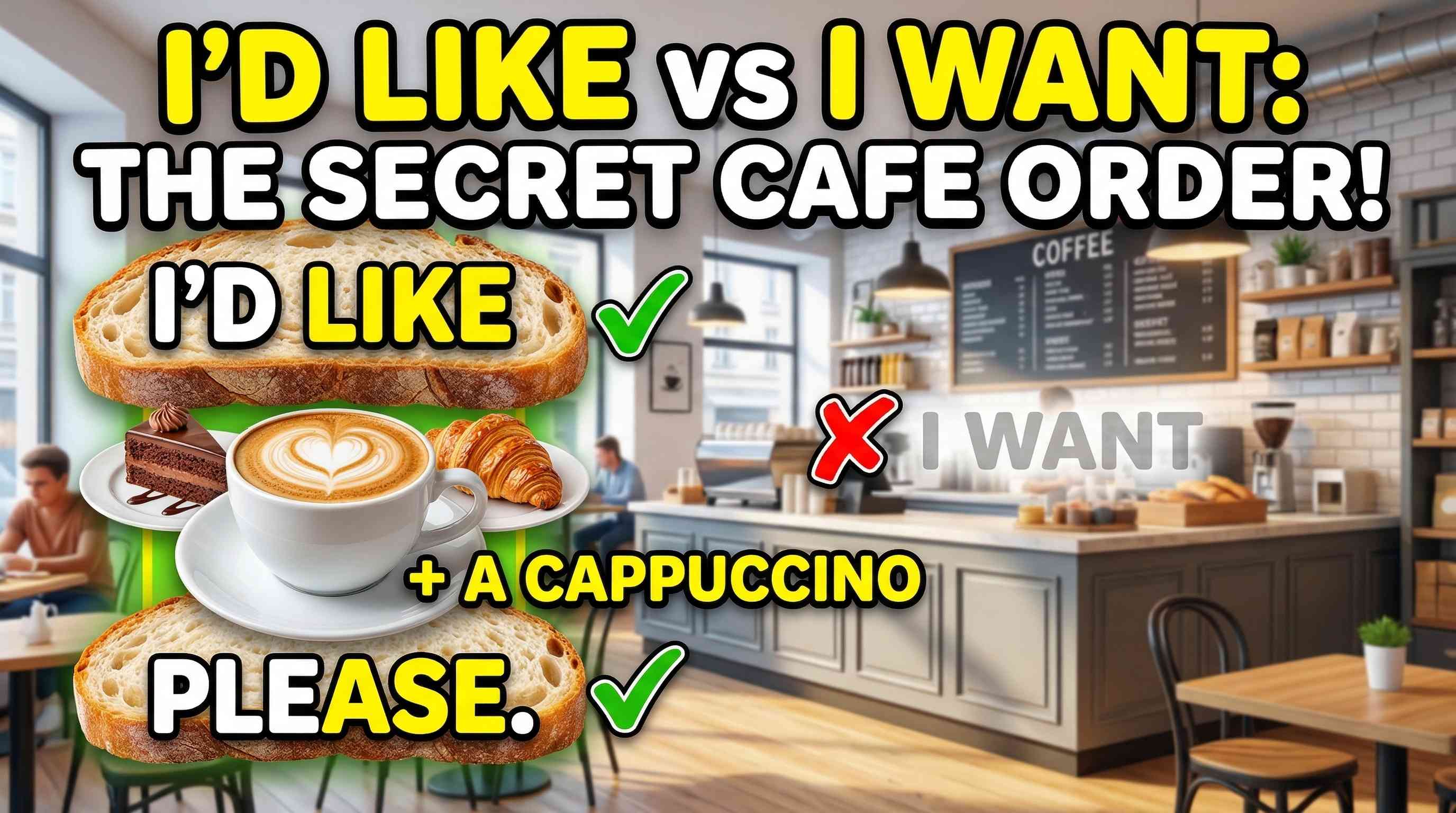
Think of your sentence as a politeness sandwich [3:56]:
- Top slice: "I'd like."
- Middle: your item.
- Bottom slice: "please."
Examples: "I'd like a cappuccino, please." "I'd like the chocolate cake, please" [4:08]. Politeness on both ends, your desire safely in the center.
How do you make polite requests at the office?
Say you need a file from your coworker Sarah. Combine "I'd like" with object pronouns [4:21]:
- "I'd like you to send me the report."
A realistic version: "Hi Sarah, I'd like you to send me the Q4 report when you get a chance. Thanks!" [4:44]. That phrase "when you get a chance" adds an extra layer — you're acknowledging Sarah has her own workload [4:50]. Professional, respectful, effective.
How do you politely ask for information?
Information isn't something you can hold or point at, so you need the extra piece "to know" [5:06]:
- "I'd like to know the price of this product."
- "I'd like to know where the train station is."
- "I'd like to find out when the store closes."
Without "to know," saying "I'd like the price" sounds oddly like you want to own the price — take it home and frame it [5:24].
What is the "volume knob" approach to politeness?
Think of politeness like a volume knob [5:56]. Turn it up for strangers, bosses, and service workers — that's "I'd like" territory. Turn it down for friends and family — "I want" is perfectly natural there. Same caffeine, different words, because the person and the place changed [6:11].
Try a quick self-check with four requests [6:17]:
- To a friend: "I want to borrow your laptop for a bit."
- To a coworker: "I'd like your feedback on this report when you have a moment."
- To a shop worker: "I'd like a medium coffee, please."
- To a stranger: "I'd like to know where the train station is."
If you used "I want" only with the friend and "I'd like" everywhere else, you've got it [6:44].
Practice saying two requests out loud every day — one casual with "I want," one polite with "I'd like" [7:29]. Use real situations from your real life. Your brain remembers what's true about you far better than anything from a textbook. What requests will you practice today?