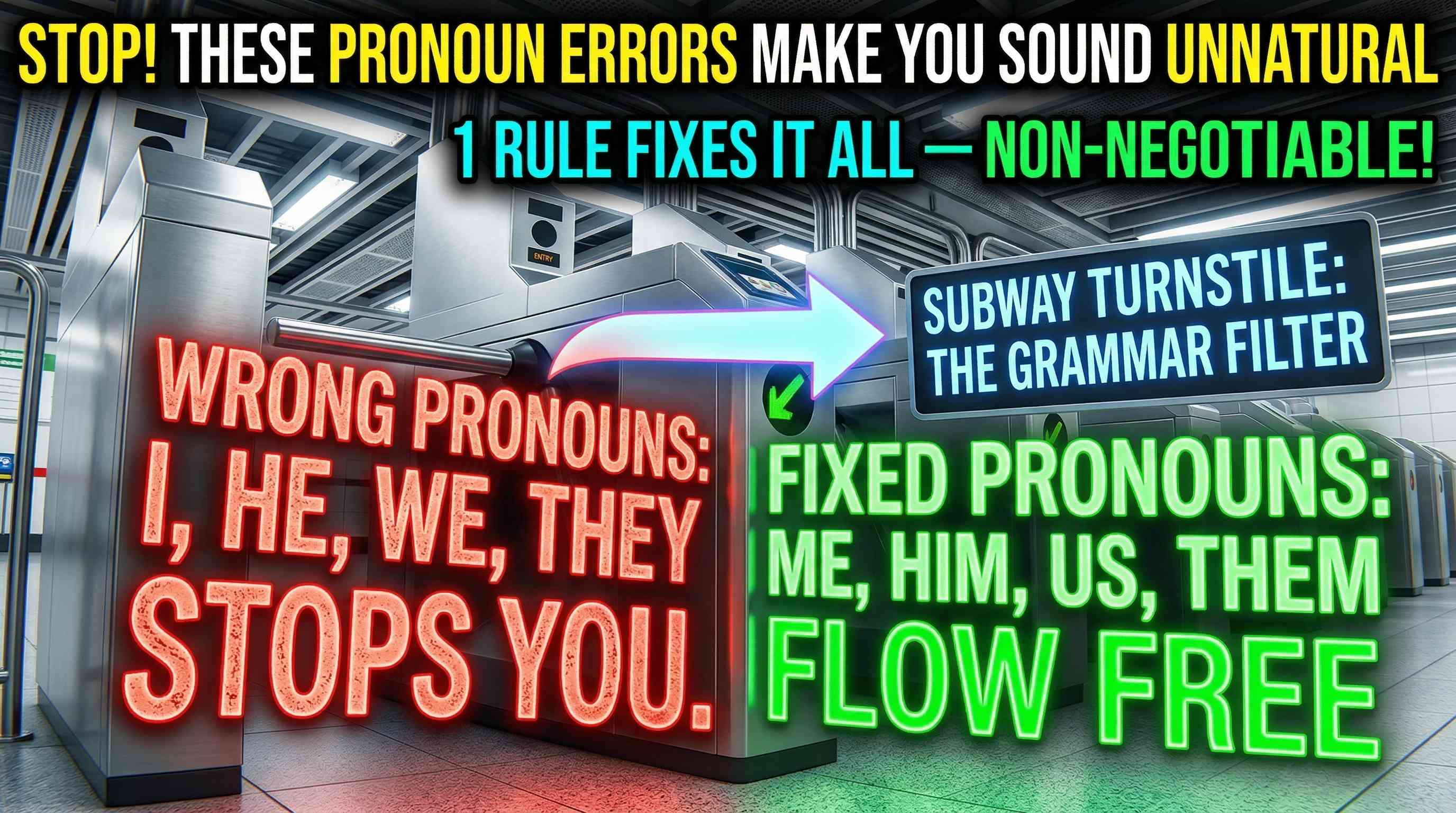
Choosing the wrong pronoun is one of the fastest ways to make your English sound off. Phrases like "help I," "for he," or "between we" feel immediately wrong to any native speaker, even if a learner can't pinpoint the reason. The good news is that one single rule governs all of these choices — and once you internalize it, pronoun errors virtually disappear from your speech.
How do subject and object pronouns work?
English gives most pronouns two forms: one for the person doing the action and one for the person receiving it [0:36]. Think of a seesaw. On one side sits the doer — I, he, she, we, they. These are subject pronouns, and they always go before the verb: "I cook dinner," "She calls every morning" [0:50].
On the other side sits the receiver — me, him, her, us, them. These are object pronouns, and they appear after the verb or after a preposition: "She calls me," "Come with us" [0:59].
Two pronouns refuse to change at all: "you" and "it" stay the same in both positions [1:11]. So you really only need to memorize five switches:
- I → me.
- He → him.
- She → her.
- We → us.
- They → them.
That's the entire system [1:29].
What is the turnstile rule?
Imagine a turnstile at a subway station [1:33]. You walk up to it as your subject self — I, he, she, we, they. But the moment you pass through the gate — the verb or the preposition — you transform into your object version. The gate forces the change, no exceptions.
Why does position matter after a verb?
After a verb, the object pronoun sticks to it like a magnet [1:55]. "Call me tomorrow," not "call I." "Invite him to the party," not "invite he." "Help her with homework," not "help she." You never flip the order either — "Me call tomorrow" is wrong. The subject does the action, the object receives it, and position is everything [2:22].
Why do prepositions always demand the object form?
Small words like to, for, with, from, at, about, between act as bridges [2:27]. Whoever stands on the far side of that bridge always takes the object form:
- "Give it to me," not "to I."
- "This is for her," not "for she."
- "Come with us," not "with we."
- "The secret stays between us," not "between we."
This is where Spanish speakers especially get tripped up [2:56], because Spanish handles pronoun placement completely differently — sometimes before the verb, sometimes attached to an infinitive. English doesn't care about any of that. After the preposition, object form. Non-negotiable [3:13].
When does spoken English break its own rules?
In casual, punchy one-word answers — the kind you shout across a room — English bends its own grammar [4:09]. "Who wants pizza?" → "Me!" Technically "I" is grammatically correct there, but nobody says it. Spoken English overrides the textbook in these quick informal responses [4:03].
The key takeaway: full short answers like "Yes, I do" or "No, she doesn't" keep the subject pronoun because the pronoun is still the doer [3:25]. But rapid informal replies naturally switch to the object form.
How can you self-check in real time?
Whenever you're unsure, ask yourself two questions [5:08]:
- Who is doing the action? → That person gets the subject form.
- Who is receiving the action or standing on the other side of the preposition? → That person gets the object form.
Apply it to common mistakes:
- "She invited I to the party" → "I" comes after the verb "invited," so it must be "me" [5:26].
- "I work with he" → "he" comes after the preposition "with," so it must be "him" [5:34].
- "This gift is for she" → after "for," object form: "her" [5:42].
One rule, every preposition, every verb [5:52].
This skill multiplies everything you already know. Combine it with present simple for routines — "Does she help them?" — or with present continuous for current actions — "I'm waiting for him right now" [6:00]. Each new piece of grammar doesn't replace the old ones; it stacks on top of them. Next up: expressing likes, dislikes, and opinions, where phrases like "I like her" and "I agree with them" will put these object pronouns to work in your real conversations [6:32].