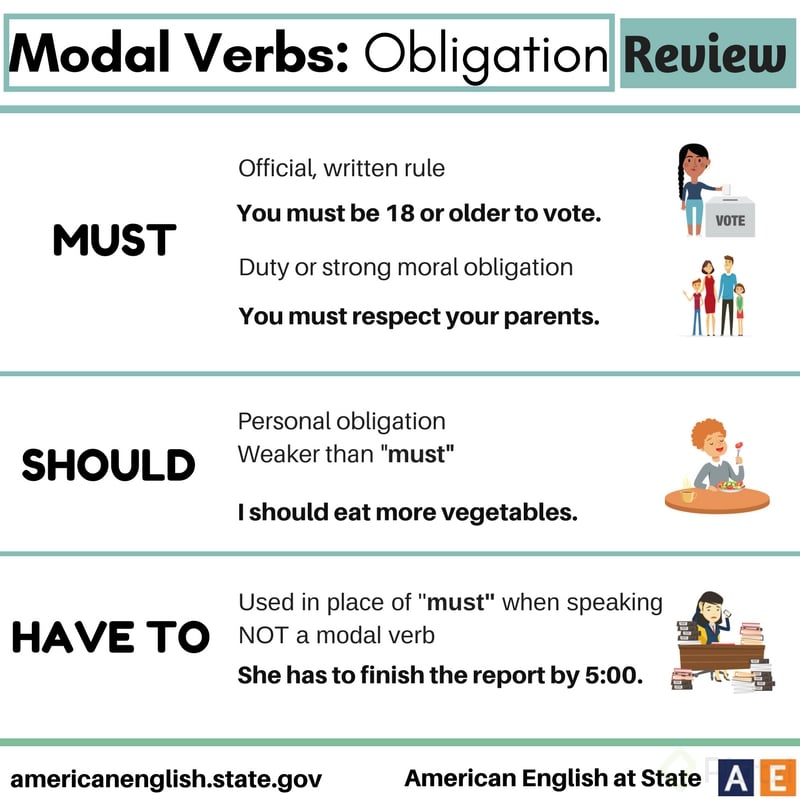
Understanding when to use must and have to is essential for expressing obligations accurately in English. These two expressions may seem interchangeable, but their differences carry important meaning, especially in negative sentences. Knowing how to choose the right one will make your communication clearer and more natural.
What is the difference between must and have to in affirmative sentences?
In affirmative sentences, both words indicate that something is necessary, but the key difference lies in who makes the decision [0:22].
- Must is used when the speaker decides that something is necessary. It is connected to the speaker's feelings or personal authority. For example: "I must call my boss" — here, the speaker feels it is important.
- Have to is used when someone else made the decision for the speaker. It conveys an impersonal obligation with no personal feelings attached. For example: "I have to call my boss" — someone else established this requirement.
A practical scenario helps clarify this distinction [1:10]. When the boss says, "You must finish the report by 10:00 AM," the boss is the speaker giving the instruction. Then the employee would say, "I have to finish the report by 10:00 AM," because the obligation came from someone else.
How does the source of the obligation change the word you choose?
Think of it this way: if you are the authority setting the rule, use must. If the rule comes from an external source — a boss, a law, a regulation — use have to. This distinction is subtle but makes your English sound more precise and natural.
Why are mustn't and don't have to completely different?
While the affirmative forms are similar, the negative forms are totally different [1:34]. This is one of the most common mistakes English learners make.
- Mustn't means something is prohibited. You are not allowed to do it. Example: "You mustn't go" — going is forbidden.
- Don't have to means there is no obligation. It is optional, and you can choose freely. Example: "You don't have to go" — it is your choice whether to go or not.
The word mustn't carries a sense of prohibition, while don't have to communicates freedom from necessity. Confusing these two can completely change the meaning of your sentence.
Can you identify the correct form in real examples?
Here are some practice situations from the lesson [2:48]:
- "My mom said it's my choice, so I don't have to go if I don't want." — No obligation exists. It is optional.
- "I mustn't drive because I'm only 14." — Driving is prohibited by law at that age.
Notice how in the first example the speaker has freedom to decide, while in the second the speaker faces a restriction that cannot be broken.
How can you practice using must and have to effectively?
Try creating your own sentences using all four forms [3:15]:
- Must: for obligations you impose on yourself or others.
- Have to: for obligations imposed by external sources.
- Mustn't: for things that are prohibited or not allowed.
- Don't have to: for things that are optional or not required.
A useful exercise is to think about your daily routine. What rules does your workplace set? What decisions do you make on your own? Assigning must or have to to each situation will reinforce the correct usage.
Remember these key points:
- Affirmative must and have to are similar but not identical.
- Negative mustn't and don't have to are completely different.
- The source of the obligation determines the correct choice.
Share your own examples using these four forms — what obligations do you face every day, and which ones are actually optional?