Formación de Adverbios que Terminan en "LY"
Contenido del curso

Superlativos en Inglés


Expresa cantidades en Inglés
- 6

Uso de "Some", "A Lot Of" y "Lots Of" en Inglés
03:49 min - 7

Uso de Artículos con Sustantivos Contables e Incontables
07:25 min - 8

Sustantivos Contables e Incontables en Contexto
03:00 min - 9

Uso de Cuantificadores con "Of" en Inglés
04:34 min - 10

Usos de Sustantivos Contables e Incontables en Inglés Básico
03:28 min - 11

Práctica de conversación en inglés (contexto cotidiano)
00:00 min
Comparativos en Inglés
- 12
Adjetivos Comparativos en Inglés: Reglas y Ejemplos Prácticos
01:04 min - 13

Comparatives with Long Adjectives in English
04:00 min - 14

Where to Place Adverbs of Frequency
04:43 min - 15

Formación de Adverbios que Terminan en "LY"
Viendo ahora - 16
Formación de Adverbios en Inglés con -ly
01:02 min - 17

Adjetivos y Adverbios en Inglés: Uso y Pronunciación
04:04 min - 18

Adjectives vs Adverbs: 10-Sentence Quiz
05:08 min
Expresiones útiles en Inglés
- 19

Uso de "Should" para Ofertas y Consejos en Inglés
03:16 min - 20

Uso de "of" para Expresar Posesión y Atribución en Inglés
02:46 min - 21

Uso de "with" y "without" para posesión y atribución
02:43 min - 22

Negación de Intenciones y Deseos en Inglés
03:37 min - 23

Diferencias entre "must" y "have to" en inglés
04:28 min - 24

Uso de "should", "must" y negaciones en inglés básico
03:43 min - 25
Práctica de conversación en inglés (contexto cotidiano)
00:00 min
Uso del gerundio en Inglés


Sigue practicando

Recursos
Resumen
Understanding how to transform adjectives into adverbs is one of the most practical skills you can build in English. This lesson breaks down the key rules for forming adverbs ending in -ly, clarifies the difference between adjectives and adverbs, and highlights some irregular cases that every learner should know.
What is the difference between adjectives and adverbs?
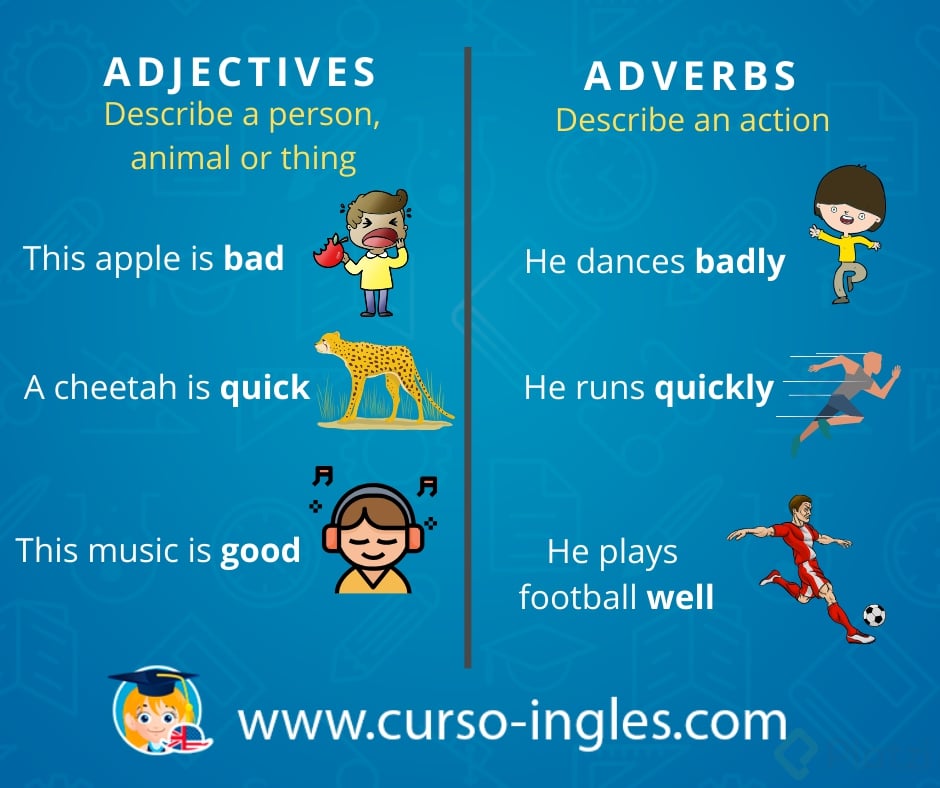
Before forming adverbs, it is essential to understand what makes them different from adjectives. Adjectives describe nouns — people, places, or things. Adverbs, on the other hand, describe how you perform an action or indicate the degree of an adjective [0:30].
- "I cook terribly" — the adverb terribly describes how the cooking is done.
- "This exam is extremely difficult" — the adverb extremely shows the degree of difficulty.
This distinction leads to two important categories. Adverbs of manner indicate how an action is performed, such as "I drive slowly" [1:15]. Adverbs of degree express the intensity or extent of something, like extremely or slightly [1:30].
How do you form adverbs from adjectives?
The most common pattern is straightforward: take an adjective and add -ly [1:00]. Here are some standard examples practiced in the lesson [1:50]:
- Calm → calmly.
- Honest → honestly.
- Beautiful → beautifully.
What spelling rules should you follow?
Not every adjective simply adds -ly without changes. Pay attention to these patterns [2:40]:
- When an adjective ends in -y, change the y to i and add -ly: easy → easily.
- When an adjective ends in -ic, add -ally: tragic → tragically.
- When an adjective ends in -le, drop the final e and add -y: terrible → terribly.
These small spelling adjustments are critical for writing correctly in English.
Are there irregular adverbs that don't change?
Yes. The word hard is a notable example of an irregular adverb [2:30]. It works as both an adjective and an adverb without any change in form.
- As an adjective: "This class is hard" — it describes the noun class.
- As an adverb: "I work hard" — it describes how the action is performed.
This means you should avoid saying "hardly" when you mean with great effort, because hardly actually means almost not at all — a completely different meaning.
How can you practice forming -ly adverbs?
A great exercise is to take any adjective you already know and apply the spelling rules above. Start with a list like the one from the lesson — calm, honest, beautiful, easy, tragic, terrible, hard — and write the adverb form next to each one. Then create your own sentences using both adverbs of manner and adverbs of degree to reinforce the concept.
If you found these rules helpful, share which adverb form you find the trickiest to remember and practice it in a sentence in the comments.
Formación de Adverbios que Terminan en "LY"