Uso de Cuantificadores con "Of" en Inglés
Contenido del curso

Superlativos en Inglés


Expresa cantidades en Inglés
- 6

Uso de "Some", "A Lot Of" y "Lots Of" en Inglés
03:49 min - 7

Uso de Artículos con Sustantivos Contables e Incontables
07:25 min - 8

Sustantivos Contables e Incontables en Contexto
03:00 min - 9

Uso de Cuantificadores con "Of" en Inglés
Viendo ahora - 10

Usos de Sustantivos Contables e Incontables en Inglés Básico
03:28 min - 11

Práctica de conversación en inglés (contexto cotidiano)
00:00 min
Comparativos en Inglés
- 12
Adjetivos Comparativos en Inglés: Reglas y Ejemplos Prácticos
01:04 min - 13

Comparatives with Long Adjectives in English
04:00 min - 14

Where to Place Adverbs of Frequency
04:43 min - 15

Formación de Adverbios que Terminan en "LY"
03:46 min - 16
Formación de Adverbios en Inglés con -ly
01:02 min - 17

Adjetivos y Adverbios en Inglés: Uso y Pronunciación
04:04 min - 18

Adjectives vs Adverbs: 10-Sentence Quiz
05:08 min
Expresiones útiles en Inglés
- 19

Uso de "Should" para Ofertas y Consejos en Inglés
03:16 min - 20

Uso de "of" para Expresar Posesión y Atribución en Inglés
02:46 min - 21

Uso de "with" y "without" para posesión y atribución
02:43 min - 22

Negación de Intenciones y Deseos en Inglés
03:37 min - 23

Diferencias entre "must" y "have to" en inglés
04:28 min - 24

Uso de "should", "must" y negaciones en inglés básico
03:43 min - 25
Práctica de conversación en inglés (contexto cotidiano)
00:00 min
Uso del gerundio en Inglés


Sigue practicando

Recursos
Resumen
Understanding how to express amounts in English is essential for clear communication. Quantifiers with "of" allow you to specify how much of something you are referring to, and mastering them will make your sentences more precise and natural. The main quantifiers covered here are lots of, some of, a lot of, and a bit of, each expressing a different degree of quantity.
How do quantifiers with "of" work in English?
A quantifier is a word that indicates the amount or number of something [0:10]. When combined with the word of, it helps you specify a portion of a whole rather than talking about everything. This structure is extremely common in everyday English.
After the word of, you need to include specific elements to make the sentence grammatically correct [0:40]:
- A noun (person, place, or thing).
- A pronoun such as these or them.
- A determiner like the.
- A possessive form before a noun, such as her, their, or your.
Without these elements, the sentence sounds incomplete or unclear. For instance, saying "some of pens are not mine" is incorrect — you need to say "some of these pens are not mine" [1:15].
What do the examples look like in practice?
Here are key examples that show how to apply the rules [0:55]:
- "She donated a lot of her clothes to charity." — The possessive her comes before the noun clothes, indicating she gave away a large portion but not everything.
- "Some of these pens are not mine." — The pronoun these specifies which pens you are talking about.
- "You should have a bit of optimism." — Optimism is an uncountable noun used directly after of.
- "Lots of their money came from their family." — The possessive their precedes the noun money.
What is the difference between "a lot", "some", and "a bit"?
These three quantifiers represent a scale from large to small [1:50]:
- A lot of / lots of: indicates a large quantity.
- Some of: indicates a moderate or smaller quantity.
- A bit of: indicates the smallest quantity in this group.
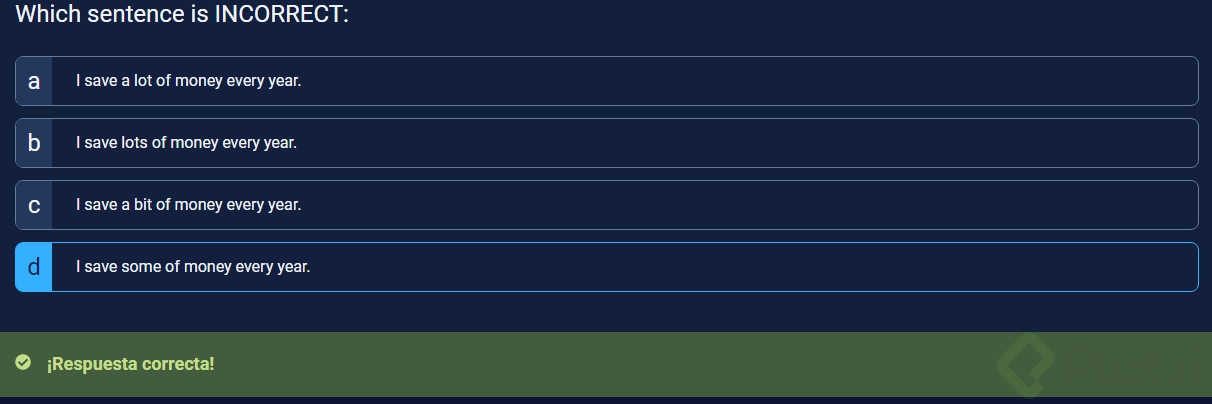
One critical rule to remember is that "a bit of" is used exclusively with uncountable nouns [3:05]. You cannot say "a bit of people" because people is countable. Instead, you would say "a few people." However, you can say "a bit of money", "a bit of optimism", or "a bit of time" because these are all uncountable.
How can you practice using quantifiers with "of"?
The best way to internalize these structures is by creating your own sentences. Here are some practice prompts inspired by the lesson [2:15]:
- Looking at a group of colorful umbrellas: "A lot of the umbrellas are pink" and "Some of the umbrellas are purple."
- Asking for food politely: "Can I have some of your brownies, please?" — Notice how your acts as the possessive form before the noun.
- Talking about saving habits: "I save a bit of money every month" — a perfect example of a bit of with the uncountable noun money [2:55].
Try creating one sentence with each quantifier: some of, a lot of, lots of, and a bit of. Pay attention to whether the noun is countable or uncountable, especially when using a bit of. Share your sentences in the discussion panel and compare them with other learners!
Uso de Cuantificadores con "Of" en Inglés