Where to Place Adverbs of Frequency
Contenido del curso

Superlativos en Inglés


Expresa cantidades en Inglés
- 6

Uso de "Some", "A Lot Of" y "Lots Of" en Inglés
03:49 min - 7

Uso de Artículos con Sustantivos Contables e Incontables
07:25 min - 8

Sustantivos Contables e Incontables en Contexto
03:00 min - 9

Uso de Cuantificadores con "Of" en Inglés
04:34 min - 10

Usos de Sustantivos Contables e Incontables en Inglés Básico
03:28 min - 11

Práctica de conversación en inglés (contexto cotidiano)
00:00 min
Comparativos en Inglés
- 12
Adjetivos Comparativos en Inglés: Reglas y Ejemplos Prácticos
01:04 min - 13

Comparatives with Long Adjectives in English
04:00 min - 14

Where to Place Adverbs of Frequency
Viendo ahora - 15

Formación de Adverbios que Terminan en "LY"
03:46 min - 16
Formación de Adverbios en Inglés con -ly
01:02 min - 17

Adjetivos y Adverbios en Inglés: Uso y Pronunciación
04:04 min - 18

Adjectives vs Adverbs: 10-Sentence Quiz
05:08 min
Expresiones útiles en Inglés
- 19

Uso de "Should" para Ofertas y Consejos en Inglés
03:16 min - 20

Uso de "of" para Expresar Posesión y Atribución en Inglés
02:46 min - 21

Uso de "with" y "without" para posesión y atribución
02:43 min - 22

Negación de Intenciones y Deseos en Inglés
03:37 min - 23

Diferencias entre "must" y "have to" en inglés
04:28 min - 24

Uso de "should", "must" y negaciones en inglés básico
03:43 min - 25
Práctica de conversación en inglés (contexto cotidiano)
00:00 min
Uso del gerundio en Inglés


Sigue practicando

Recursos
Resumen
Adverbs of frequency tell you how often something happens, and placing them correctly in a sentence is what separates a confusing message from a clear one. If you are learning English and want to sound more natural when describing routines, habits or repeated actions, mastering the position of words like always, usually, sometimes, hardly ever and never is the next step.
What are adverbs of frequency in English?
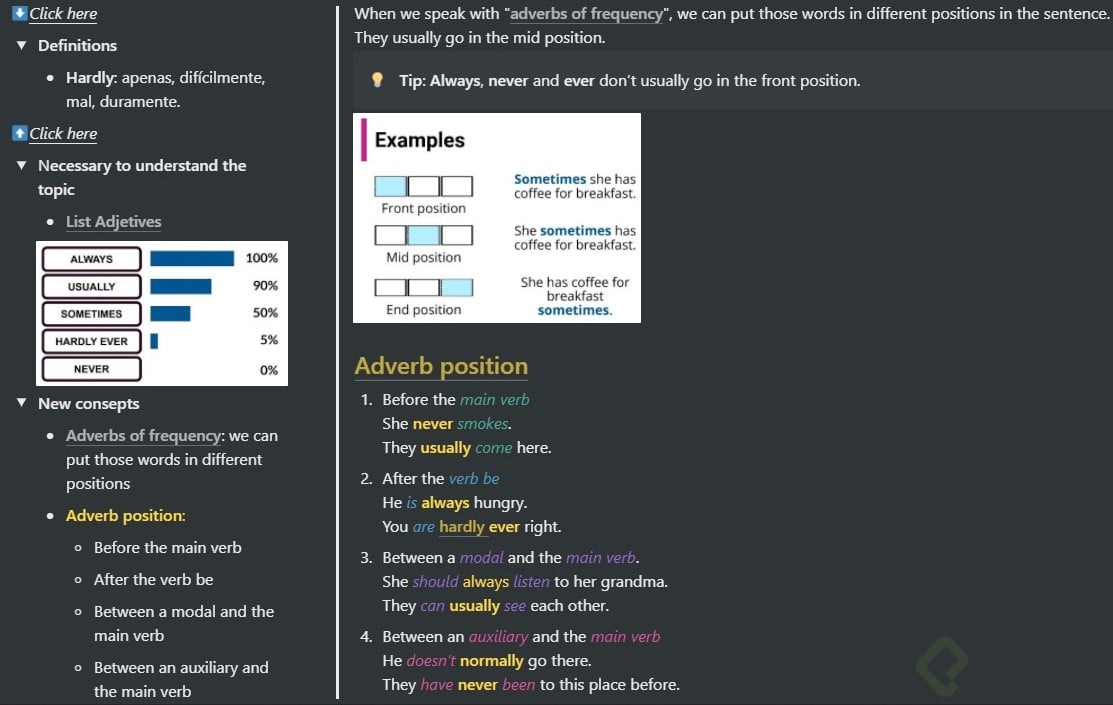
These are words you use to describe how often an action happens. The most common ones include always, usually, sometimes, hardly ever and never, but the list goes much further. They can sit in three different spots inside a sentence: front position, mid position or end position [00:38].
What is an adverb of frequency? It is a word that expresses how often something happens, like always, never or sometimes. You use it to talk about routines, habits or repeated actions.
A quick note before you start placing them everywhere: always, never and ever don't usually go in the front position. Keep that in mind when you build your own sentences.
Where should I place adverbs of frequency in a sentence?
The mid position is the most common, but front and end positions are also valid depending on what you want to emphasize. Look at how the same idea shifts naturally:
- Front position: Sometimes she has coffee for breakfast.
- Mid position: She sometimes has coffee for breakfast.
- End position: She has coffee for breakfast sometimes [01:10].
In the mid position, the adverb sits between the subject and the verb. That's the safest bet when you are not sure where to put it.
How do I place adverbs with main verbs and the verb to be?
This is where most learners get tripped up, and the rule flips depending on the verb you are using.
When you have a regular main verb, the adverb goes before the verb. For example, she never smokes, or they usually come here at night [01:38]. The adverb sneaks in right before the action.
But with the verb to be, the order flips. The adverb goes after be. So you would say he is always hungry or you are hardly ever right [01:53]. Same logic, opposite position.
Where does the adverb go with the verb to be? Right after it. Say she is always late, not she always is late.
What happens with modal verbs and auxiliary verbs?
When modals like should, can, might, may or must enter the sentence, the adverb of frequency lands between the modal verb and the main verb [02:08]. Two clear examples:
- She should always listen to her grandma.
- They can usually see each other [02:24].
The same logic applies to auxiliary verbs such as doesn't, have, don't or will. You place the adverb between the auxiliary and the main verb [02:35]. For instance, he doesn't normally go there, or they have never been to this place before.
How can I practice adverbs of frequency with real sentences?
The best way to lock in these rules is to build sentences that combine different verb structures. Try these prompts and check your placement:
- Use always with the verb to be in simple present: Vicky is always in a hurry [03:05].
- Use never with the modal can and the verb go: Kyle can never go to the gym during the week [03:23].
- Use often with the verb eat in present perfect: The Jacksons have often eaten in this restaurant [03:43].
Notice how the position of the adverb changes depending on whether you have a modal, an auxiliary or just a main verb. That pattern is what you want to internalize.
Can adverbs of frequency go at the beginning of a sentence? Yes, but not all of them. Sometimes, usually and often work in front position, but always, never and ever normally don't.
Now it's your turn. Write a few sentences mixing main verbs, modal verbs and auxiliary verbs, and share them in the comments so we can review them together.
Where to Place Adverbs of Frequency