Pronombres Indefinidos en Inglés: Uso, Prefijos y Sufijos
Curso de Inglés Intermedio B1: Expresiones de Tiempo y Cantidad
Contenido del curso

Nouns and Pronouns
- 2

Comprensión Oral: Diálogo y Preguntas Clave
05:41 min - 3

Pronombres Indefinidos en Inglés: Uso, Prefijos y Sufijos
Viendo ahora - 4

Práctica de pronombres indefinidos en inglés
05:17 min - 5

Pronombres Indefinidos Variables y Uso de "Else"
05:24 min - 6

Countable vs Uncountable Nouns en inglés
05:09 min - 7

Sustantivos Contables e Incontables en Inglés
11:12 min - 8

Much, many o a lot of: cuál usar
05:00 min
Get Ready to Describe!
- 9

Adjetivos em inglês para descrever pessoas
04:38 min - 10

Comparativos en inglés: er, more y less
08:47 min - 11

Comparaciones con "as adjetivo as" en inglés
06:15 min - 12

Reflexive Pronouns: When Myself Really Matters
05:14 min - 13

Práctica de listening con adjetivos en inglés
05:42 min - 14

Práctica de conversación en inglés (cotidiano / día a día)
00:00 min
Knowledge, Needs and Future Plans
- 15

Uso de "By" y "With" en Inglés: Ejemplos y Diferencias
06:19 min - 16

Uso de "Have to" para Expresar Obligaciones y Normas
04:24 min - 17

Uso de "know how to" y "know-how" en inglés
04:18 min - 18

When to Shorten Going To into Gonna
08:08 min - 19

Entrevistas con el Equipo de Platzi: Comunicación y Estrategias
05:27 min
Experiences with Present Perfect Simple
- 20

Cómo usar el present perfect en inglés
09:15 min - 21

Uso de "Since" y "For" en el Presente Perfecto
06:04 min - 22

Preposiciones de tiempo en inglés: since, until y más
07:11 min - 23

Diferencias entre "yet", "still", "already" y "just" en inglés
05:04 min - 24

Comprensión Oral: Practica y Respuestas en Conversaciones Reales
04:29 min - 25
Uso del Presente Perfecto Simple en Inglés
00:18 min - 26
Práctica de conversación en inglés (contexto profesional)
00:00 min
Conclusion

Pronombres Indefinidos en Inglés: Uso, Prefijos y Sufijos
Resumen
Mastering indefinite pronouns is one of those grammar milestones that instantly makes your English sound more natural and fluent. Words like everyone, something, nowhere, and anywhere replace specific nouns when you don't need to be precise, and knowing how to build and conjugate them correctly will save you from common mistakes.
What are indefinite pronouns and why do they matter?
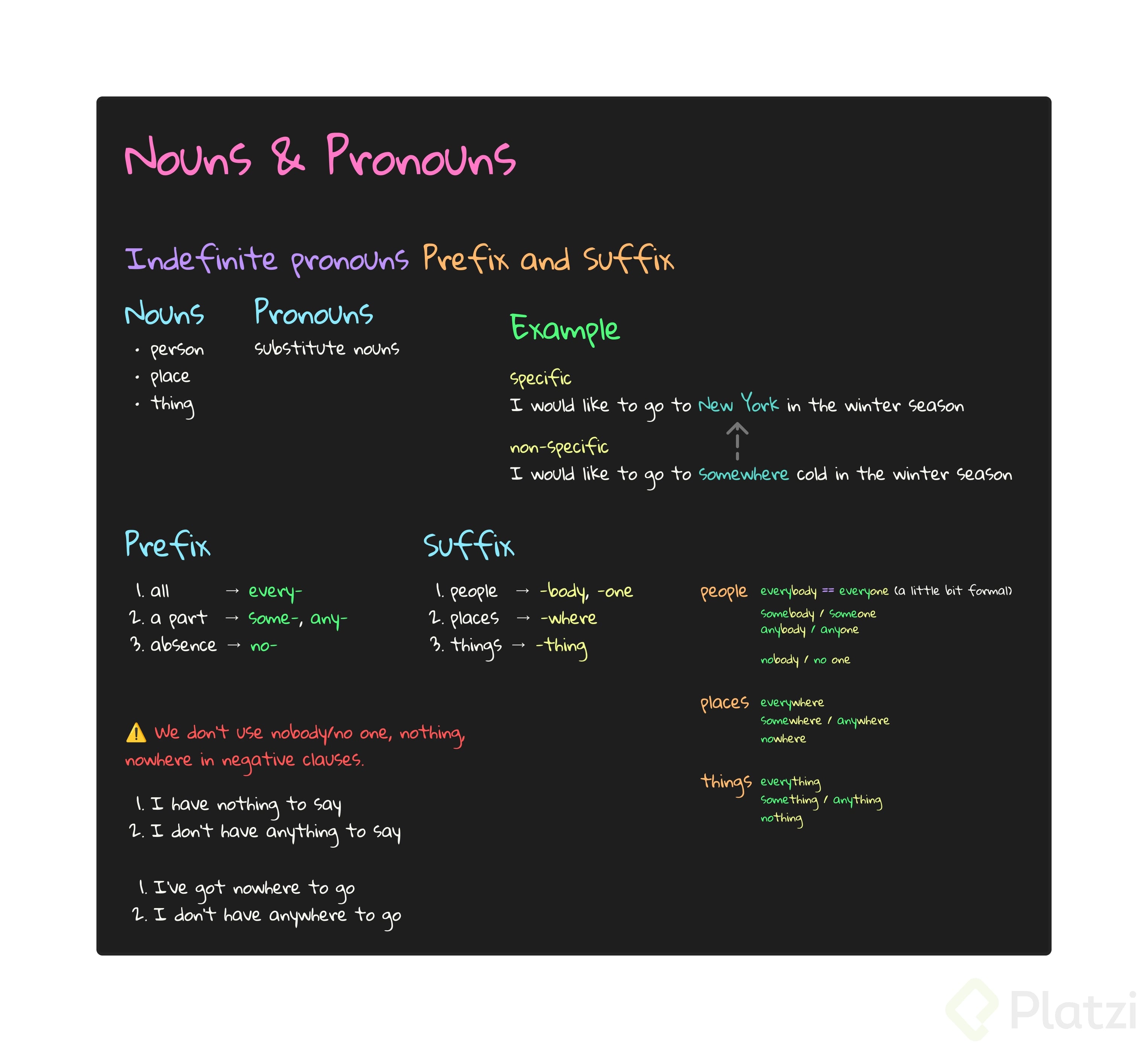
Before working with indefinite pronouns, it helps to recall what a noun is. A noun can be a person (teacher, engineer, scientist), a place (Colombia, supermarket, the office), a thing (computer, cell phone, notebook), or even an intangible concept (freedom, happiness) [0:44]. Indefinite pronouns exist to substitute those nouns when you don't want—or don't need—to be specific.
Consider this shift [1:27]:
- Specific: "I would like to go to New York in the winter season."
- Indefinite: "I would like to go somewhere cold in the winter season."
The noun New York disappears, and the indefinite pronoun somewhere takes its place because any cold location works.
How do you build indefinite pronouns with prefixes and suffixes?
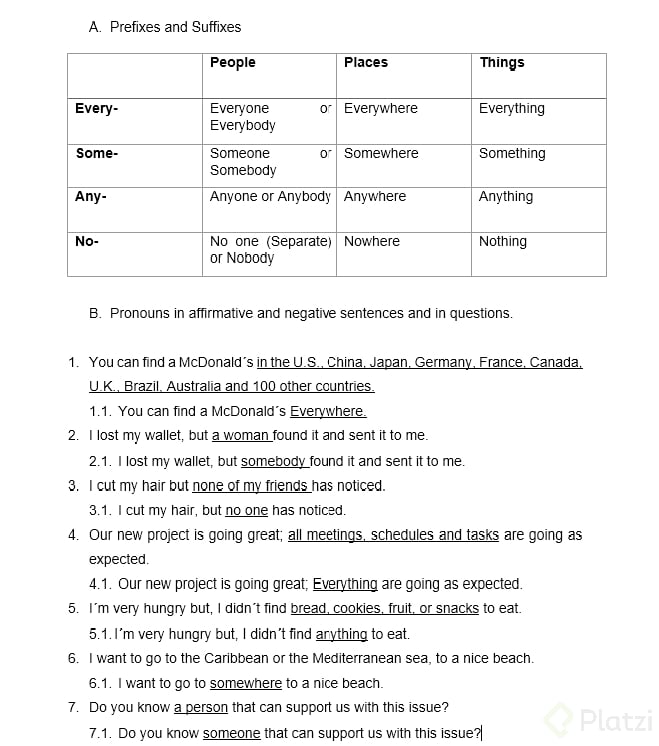
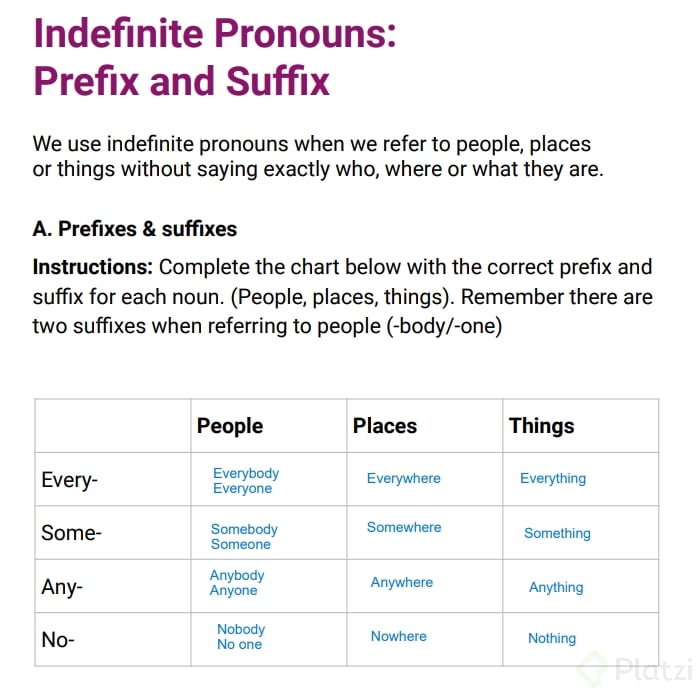
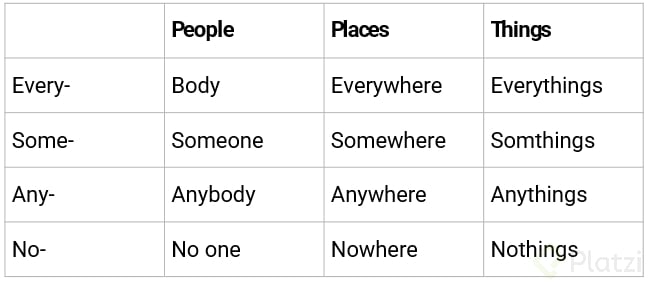
Indefinite pronouns follow a simple formula: prefix + suffix. Understanding each piece makes the whole system click.
Which prefixes set the meaning?
There are four prefixes [2:16]:
- Every- → refers to all (every person, every place, every thing).
- Some- → refers to a part or one.
- Any- → also refers to one, often used in questions and negatives.
- No- → refers to zero, the absence of something.
Which suffixes indicate person, place, or thing?
Four suffixes complete the word [2:52]:
- -body / -one → for people (everybody, someone, anyone, nobody).
- -where → for places (everywhere, somewhere, anywhere, nowhere).
- -thing → for things (everything, something, anything, nothing).
One important spelling rule: when the prefix no- combines with the suffix -one, the result is written as two separate words — no one [3:56]. Every other combination is one word.
Regarding -body versus -one, both are interchangeable in most situations, though -one tends to feel slightly more formal [3:24].
What conjugation rules should you follow?
Two grammar rules are essential to avoid mistakes with indefinite pronouns.
Why must you avoid double negatives?
The prefix no- already carries a negative meaning, so your sentence structure must stay positive [5:12]:
- Correct: "I have nowhere to go."
- Correct: "I don't have anywhere to go."
- Incorrect: "I don't have nowhere to go."
The same logic applies to nothing and anything [6:07]:
- Correct: "I have nothing to say."
- Correct: "I don't have anything to say."
Mixing a negative auxiliary (don't, doesn't) with a no- pronoun creates a double negative, which is considered a grammatical error in standard English.
Why do indefinite pronouns take singular verbs?
Even when an indefinite pronoun refers to a group, it conjugates as third-person singular [6:38]:
- "Everybody likes to be appreciated." (not like).
- "Somebody called me this morning."
- "Nobody works on Sundays."
For questions, anybody and anyone are the typical choices, although somebody and someone can also appear in certain contexts [7:24].
Can you choose the right indefinite pronoun?
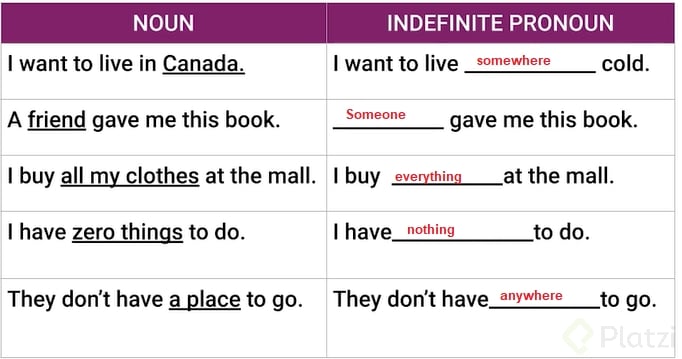
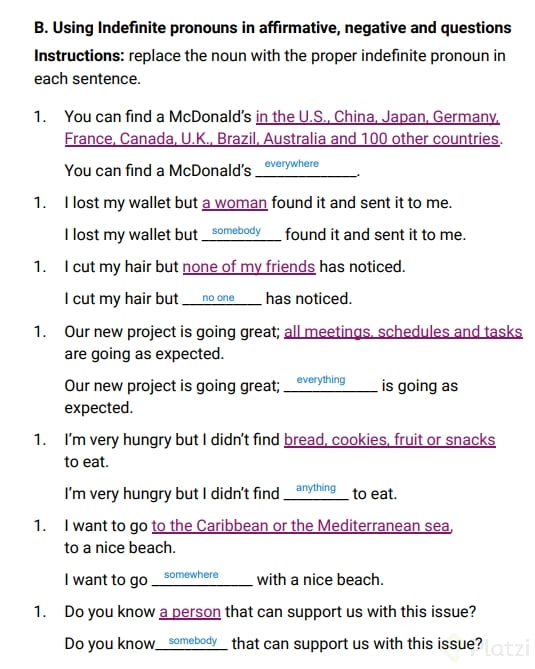
Here is a quick practice set with answers [8:16]:
- "I want to live in Canada" → "I want to live somewhere cold."
- "A friend gave me this book" → "Somebody gave me this book."
- "I buy all my clothes at the mall" → "I buy everything at the mall."
- "I have zero work to do" → "I have nothing to do" or "I don't have anything to do."
- "They don't have a place to go" → "They don't have anywhere to go."
Practice replacing specific nouns in your own sentences and pay close attention to the double-negative rule. Share your examples in the comments so others can learn from your sentences too.