Diferencias entre "yet", "still", "already" y "just" en inglés
Curso de Inglés Intermedio B1: Expresiones de Tiempo y Cantidad
Contenido del curso

Nouns and Pronouns
- 2

Comprensión Oral: Diálogo y Preguntas Clave
05:41 min - 3

Pronombres Indefinidos en Inglés: Uso, Prefijos y Sufijos
12:06 min - 4

Práctica de pronombres indefinidos en inglés
05:17 min - 5

Pronombres Indefinidos Variables y Uso de "Else"
05:24 min - 6

Countable vs Uncountable Nouns en inglés
05:09 min - 7

Sustantivos Contables e Incontables en Inglés
11:12 min - 8

Much, many o a lot of: cuál usar
05:00 min
Get Ready to Describe!
- 9

Adjetivos em inglês para descrever pessoas
04:38 min - 10

Comparativos en inglés: er, more y less
08:47 min - 11

Comparaciones con "as adjetivo as" en inglés
06:15 min - 12

Reflexive Pronouns: When Myself Really Matters
05:14 min - 13

Práctica de listening con adjetivos en inglés
05:42 min - 14

Práctica de conversación en inglés (cotidiano / día a día)
00:00 min
Knowledge, Needs and Future Plans
- 15

Uso de "By" y "With" en Inglés: Ejemplos y Diferencias
06:19 min - 16

Uso de "Have to" para Expresar Obligaciones y Normas
04:24 min - 17

Uso de "know how to" y "know-how" en inglés
04:18 min - 18

When to Shorten Going To into Gonna
08:08 min - 19

Entrevistas con el Equipo de Platzi: Comunicación y Estrategias
05:27 min
Experiences with Present Perfect Simple
- 20

Cómo usar el present perfect en inglés
09:15 min - 21

Uso de "Since" y "For" en el Presente Perfecto
06:04 min - 22

Preposiciones de tiempo en inglés: since, until y más
07:11 min - 23

Diferencias entre "yet", "still", "already" y "just" en inglés
Viendo ahora - 24

Comprensión Oral: Practica y Respuestas en Conversaciones Reales
04:29 min - 25
Uso del Presente Perfecto Simple en Inglés
00:18 min - 26
Práctica de conversación en inglés (contexto profesional)
00:00 min
Conclusion

Diferencias entre "yet", "still", "already" y "just" en inglés
Resumen
Understanding how to use yet, still, already, and just correctly is one of the most practical skills you can build to sound natural in English. These four words often cause confusion because they all relate to time, but each one carries a distinct meaning and follows specific grammar patterns.
What do yet, still, already, and just have in common?
All four words are adverbs of time [0:28]. This means they give us extra details about when actions happen or how they relate to a moment in time. While they share this category, their uses, positions in a sentence, and the tenses they pair with are quite different.
How do you use already and yet correctly?
When should you use already?
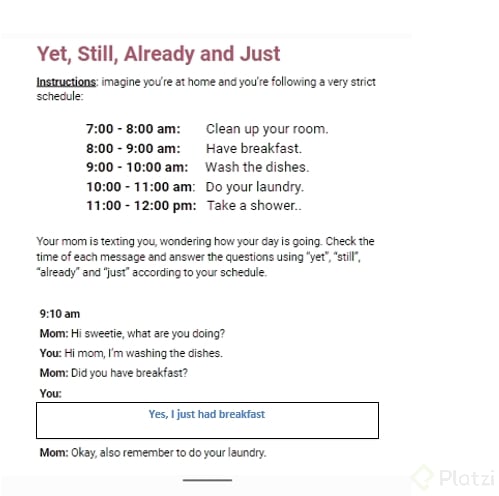
Already refers to something that happened before something else, or something that happened earlier or quicker than expected [0:42]. It typically appears in affirmative sentences with the present perfect tense.
- "The project is due tomorrow, but I've already delivered it."
- "The test started 10 minutes ago, but he's already finished it."
Notice the contractions: I've (I have) and he's (he has). Already sits between the auxiliary verb and the past participle.
When should you use yet?
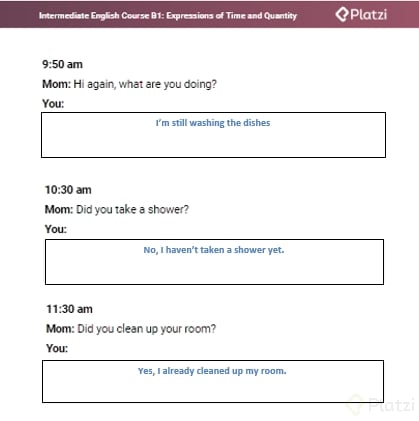
Yet is used when we talk about something we expect to happen soon [1:16]. It normally appears in negatives and questions, and its position is at the end of the sentence.
- "Have you finished your homework yet?"
- "Have they contacted the client yet?"
Here is a clear comparison [1:36]:
- Affirmative: "I've already updated my CV."
- Negative: "I haven't updated my CV yet."
- Affirmative: "She's already completed the job application."
- Negative: "She hasn't completed the job application yet."
The key takeaway is that already goes in affirmative sentences while yet goes in negative sentences and questions, and their position in the sentence changes accordingly.
How are still and just different from yet and already?
What does still express?
Still indicates that an action is ongoing or continuing [2:12]. It has two main uses:
- With present progressive (present continuous) to show an action that continues: "I'm still working on the project" — meaning I continue to work on it [2:26].
- With present perfect simple to show something is taking longer than expected: "I still haven't finished the report" [2:40].
The difference between these two uses is important. The first simply describes continuation, while the second adds a sense of frustration or surprise that something has not been completed.
What does just mean in present perfect?
Just tells us that something happened very recently, a short time before the moment of speaking [2:56]. It pairs with the present perfect tense and sits between the auxiliary verb and the past participle.
- "I've just met with the executives. They're happy with our results."
- "We've just finished the meeting with them."
Using just makes your sentences feel immediate and connected to the present moment, which is why it works so well in professional and everyday conversations.
How can you practice these adverbs right now?
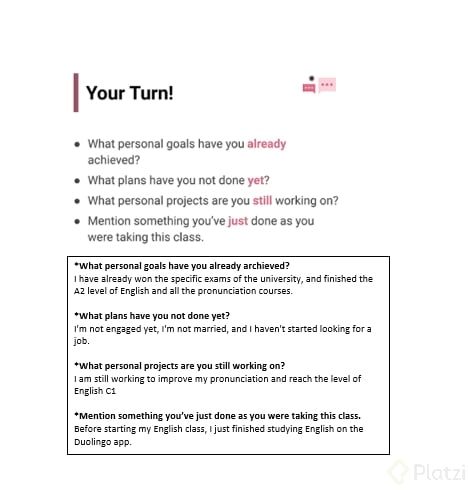
A great way to internalize these four adverbs is to apply them to your own life [3:26]. Think about these prompts:
- What personal goals have you already achieved?
- What plans have you not done yet?
- Which personal project are you still working on?
- What have you just done?
Writing your own sentences using real experiences helps you remember both the meaning and the correct grammar structure. Share your answers and get feedback — practice is the fastest path to confidence with these adverbs.