Much, many o a lot of: cuál usar
Curso de Inglés Intermedio B1: Expresiones de Tiempo y Cantidad
Contenido del curso

Nouns and Pronouns
- 2

Comprensión Oral: Diálogo y Preguntas Clave
05:41 min - 3

Pronombres Indefinidos en Inglés: Uso, Prefijos y Sufijos
12:06 min - 4

Práctica de pronombres indefinidos en inglés
05:17 min - 5

Pronombres Indefinidos Variables y Uso de "Else"
05:24 min - 6

Countable vs Uncountable Nouns en inglés
05:09 min - 7

Sustantivos Contables e Incontables en Inglés
11:12 min - 8

Much, many o a lot of: cuál usar
Viendo ahora
Get Ready to Describe!
- 9

Adjetivos em inglês para descrever pessoas
04:38 min - 10

Comparativos en inglés: er, more y less
08:47 min - 11

Comparaciones con "as adjetivo as" en inglés
06:15 min - 12

Reflexive Pronouns: When Myself Really Matters
05:14 min - 13

Práctica de listening con adjetivos en inglés
05:42 min - 14

Práctica de conversación en inglés (cotidiano / día a día)
00:00 min
Knowledge, Needs and Future Plans
- 15

Uso de "By" y "With" en Inglés: Ejemplos y Diferencias
06:19 min - 16

Uso de "Have to" para Expresar Obligaciones y Normas
04:24 min - 17

Uso de "know how to" y "know-how" en inglés
04:18 min - 18

When to Shorten Going To into Gonna
08:08 min - 19

Entrevistas con el Equipo de Platzi: Comunicación y Estrategias
05:27 min
Experiences with Present Perfect Simple
- 20

Cómo usar el present perfect en inglés
09:15 min - 21

Uso de "Since" y "For" en el Presente Perfecto
06:04 min - 22

Preposiciones de tiempo en inglés: since, until y más
07:11 min - 23

Diferencias entre "yet", "still", "already" y "just" en inglés
05:04 min - 24

Comprensión Oral: Practica y Respuestas en Conversaciones Reales
04:29 min - 25
Uso del Presente Perfecto Simple en Inglés
00:18 min - 26
Práctica de conversación en inglés (contexto profesional)
00:00 min
Conclusion

Much, many o a lot of: cuál usar
Resumen
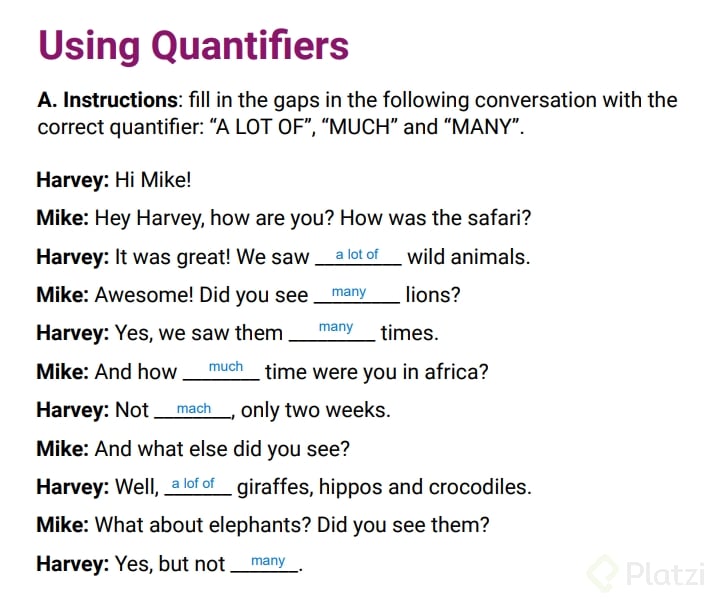
Learning quantifiers in English helps you talk about the quantity or amount of something with the right word for each situation. If you have ever hesitated between much, many and a lot of, this guide clears it up with real examples pulled straight from famous quotes. It is perfect for ESL learners who want to sound natural in both statements and questions.
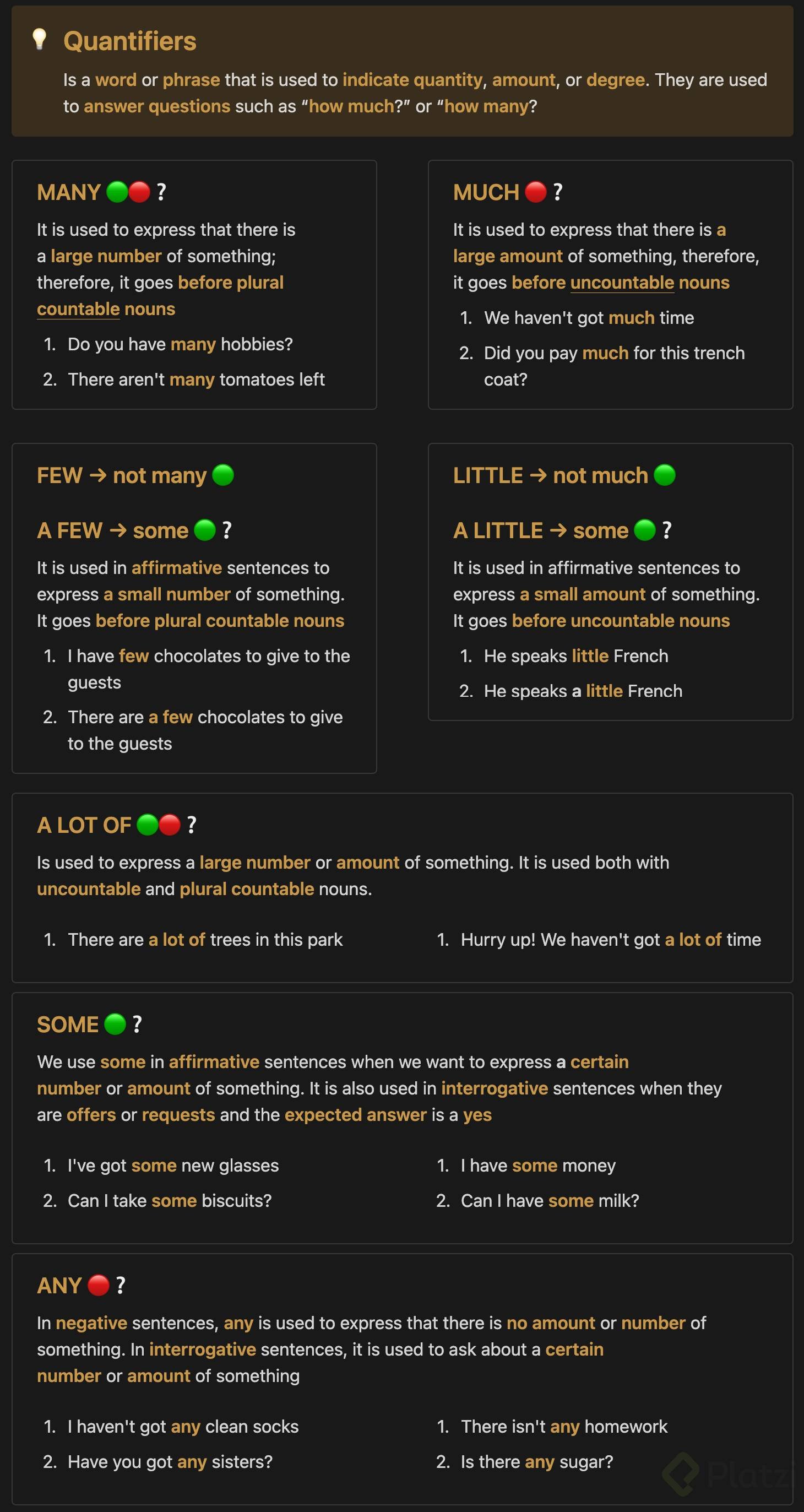
Quantifiers are the words we use to refer to the quantity or amount of something. The trick is knowing which ones go with countable nouns and which ones belong with uncountable nouns. And here is where it gets interesting: some quantifiers work for both.
What is the difference between countable and uncountable nouns?
Before choosing a quantifier, you need to know what kind of noun you are dealing with. Countable nouns are things you can count one by one, like hands, CDs or bedrooms. Uncountable nouns are things you cannot count individually, like courage, time, sugar or flour.
What is a quantifier in English? A quantifier is a word that shows the quantity or amount of something, such as a lot of, much or many. You pick each one based on whether the noun is countable or uncountable.
That single distinction decides almost everything about which quantifier fits.
When should I use a lot of in English?
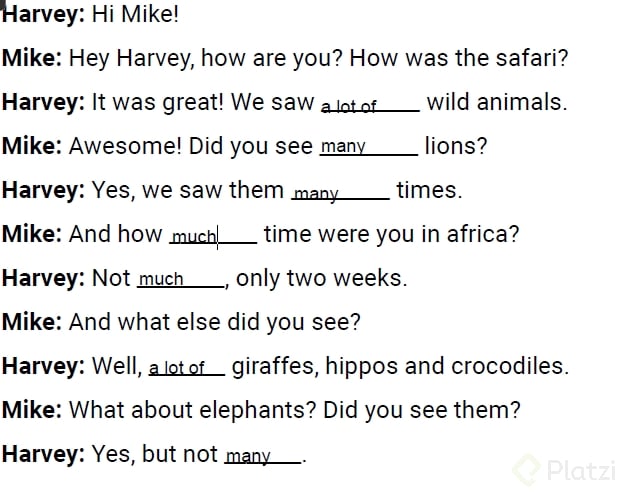
You use a lot of when you want to talk about a large quantity, and the best part is that it works for both countable and uncountable nouns [00:35]. It shows up mostly in positive statements.
Look at how it plays out in Alan Cohen's quote: "It takes a lot of courage to release the familiar and seemingly secure to embrace the new" [00:26]. Here courage is uncountable, yet a lot of fits perfectly.
A few examples to make it concrete:
- We saw a lot of sharks while diving.
- She has a lot of influence in the company.
- Their first album was a hit. They sold a lot of CDs.
Notice how all three are positive sentences, and a lot of never worries about whether the noun can be counted.
How do I use much and many correctly?
This is where most learners slip. Much and many look similar but each has its own job, and both tend to appear in negative statements and questions.
When do I use much with uncountable nouns?
You use much with uncountable nouns [01:03]. Think back to Bruce Lee's line: "If you spend too much time thinking about a thing, you'll never get it done" [00:55]. Since time is uncountable, much is the natural choice.
When do I use much instead of many? Use much with uncountable nouns like money, sugar or flour, especially in negative sentences and questions. Example: How much sugar should you eat per day?
More examples that show the pattern:
- He doesn't have much money.
- How much sugar should you eat per day?
- Follow the recipe. Don't put much flour.
Since flour is an uncountable noun, much is exactly what you need there.
When do I use many with countable nouns?
You use many with countable nouns [01:27]. John Heywood said it best: "Many hands make light work" [01:22]. Because hands can be counted, many is the right quantifier.
Like much, you will find many mostly in negative statements and questions:
- This house doesn't have many bedrooms.
- How many countries are in the world?
- I don't like to have many things in my pockets.
Since things is a countable noun and the sentence is negative, many wins over a lot of here.
How can I practice quantifiers on my own?
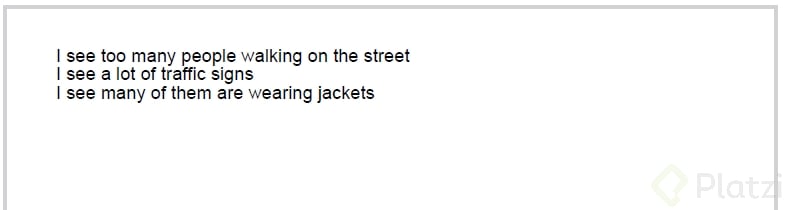
The fastest way to lock this in is to complete sentences and check yourself against the rules. Try the same exercise from the lesson [01:52] and decide which quantifier fits each blank:
- Their first album was a hit. They sold ___ CDs. (Answer: a lot of, positive statement.)
- I don't like to have ___ things in my pockets. (Answer: many, negative plus countable.)
- Follow the recipe. Don't put ___ flour. (Answer: much, negative plus uncountable.)
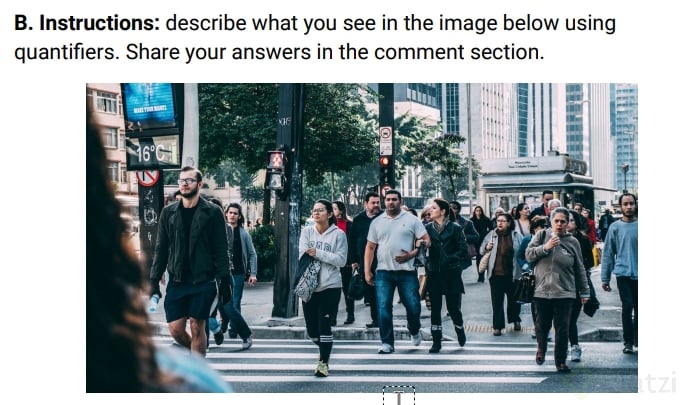
Practice makes perfect, so try writing your own descriptions of your home, your office or your apartment using these three quantifiers. Share your sentences in the comment section and tell me which quantifier gave you the most trouble.