Reflexive Pronouns: When Myself Really Matters
Curso de Inglés Intermedio B1: Expresiones de Tiempo y Cantidad
Contenido del curso

Nouns and Pronouns
- 2

Comprensión Oral: Diálogo y Preguntas Clave
05:41 min - 3

Pronombres Indefinidos en Inglés: Uso, Prefijos y Sufijos
12:06 min - 4

Práctica de pronombres indefinidos en inglés
05:17 min - 5

Pronombres Indefinidos Variables y Uso de "Else"
05:24 min - 6

Countable vs Uncountable Nouns en inglés
05:09 min - 7

Sustantivos Contables e Incontables en Inglés
11:12 min - 8

Much, many o a lot of: cuál usar
05:00 min
Get Ready to Describe!
- 9

Adjetivos em inglês para descrever pessoas
04:38 min - 10

Comparativos en inglés: er, more y less
08:47 min - 11

Comparaciones con "as adjetivo as" en inglés
06:15 min - 12

Reflexive Pronouns: When Myself Really Matters
Viendo ahora - 13

Práctica de listening con adjetivos en inglés
05:42 min - 14

Práctica de conversación en inglés (cotidiano / día a día)
00:00 min
Knowledge, Needs and Future Plans
- 15

Uso de "By" y "With" en Inglés: Ejemplos y Diferencias
06:19 min - 16

Uso de "Have to" para Expresar Obligaciones y Normas
04:24 min - 17

Uso de "know how to" y "know-how" en inglés
04:18 min - 18

When to Shorten Going To into Gonna
08:08 min - 19

Entrevistas con el Equipo de Platzi: Comunicación y Estrategias
05:27 min
Experiences with Present Perfect Simple
- 20

Cómo usar el present perfect en inglés
09:15 min - 21

Uso de "Since" y "For" en el Presente Perfecto
06:04 min - 22

Preposiciones de tiempo en inglés: since, until y más
07:11 min - 23

Diferencias entre "yet", "still", "already" y "just" en inglés
05:04 min - 24

Comprensión Oral: Practica y Respuestas en Conversaciones Reales
04:29 min - 25
Uso del Presente Perfecto Simple en Inglés
00:18 min - 26
Práctica de conversación en inglés (contexto profesional)
00:00 min
Conclusion

Reflexive Pronouns: When Myself Really Matters
Resumen
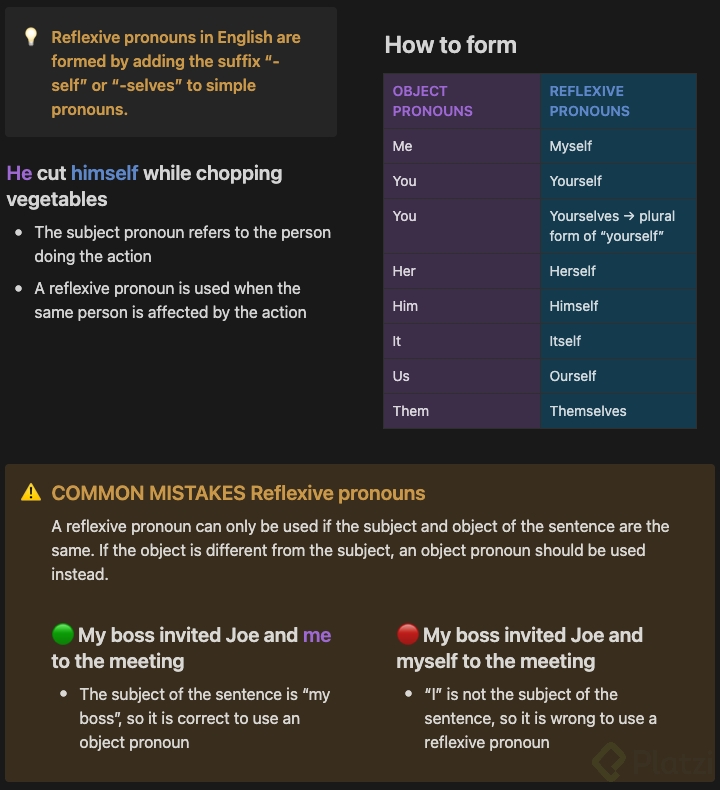
Reflexive pronouns are the words you use when the subject and the object of a sentence are the same person or thing. If you have ever wondered why we say "she saw herself in the mirror" instead of "she saw her," this is exactly what you need. This lesson is for English learners who want to speak with precision and add emphasis the right way.
What are reflexive pronouns and when do they appear?
A reflexive pronoun points back to the subject. In "she saw herself in the mirror," she is the subject and herself is the object, and they refer to the same person [0:24]. That mirror image is the whole idea: the action bounces back to whoever started it.
There is a small spelling detail that changes everything. The suffix for singular is self, and the suffix for plural is selves [1:00]. So one person uses myself, but a group uses ourselves.
What is a reflexive pronoun? It is a word ending in self or selves used when the subject and object of a sentence are the same, like in "I hurt myself."
Which reflexive pronoun matches each pronoun?
Each personal pronoun has its own reflexive partner, and it helps to memorize them as pairs [1:15]. Write these down, because you will need them for practice.
- I becomes myself.
- You becomes yourself (singular) or yourselves (plural).
- He becomes himself.
- She becomes herself.
- It becomes itself.
- We becomes ourselves.
- They becomes themselves.
Notice how the plural forms all end in selves, while the singular forms end in self. That pattern is your shortcut when you are unsure which one to pick.
Why do some verbs skip reflexive pronouns?
Here is where many learners overuse reflexives. Some everyday verbs normally do not take a reflexive pronoun: wash, shave, dress, and brush [1:52]. You would not say "George shaves himself every morning." You just say "George shaves every morning."
The exception is emphasis. If your goal is to show the action was done without any help, the reflexive returns. For example, "Sam is old enough to dress himself" [2:20] highlights independence.
When should I use a reflexive pronoun with verbs like wash or dress? Only when you want to emphasize that someone does it alone, such as "Sam is old enough to dress himself." Otherwise, leave it out.
How do you use reflexive pronouns for emphasis?
Reflexive pronouns show up in a few specific situations, and each one adds meaning. Let me walk you through them.
- As an object, when the action returns to the subject: "when she sees her mother, she sees herself" [2:40].
- After prepositions, but not prepositions of place: "some people talk to themselves" [2:52].
- With the preposition by to stress that something was done without help: "I do the homework by myself" [3:05].
- To emphasize the importance of the subject: "the president himself called me" [3:20].
That last use is powerful. Adding himself or herself tells your listener that the subject matters more than usual, not that the action bounced back.
Can you complete these reflexive pronoun sentences?
The class includes a practice activity worth trying before you check the answers [3:35]. Here are the correct completions so you can confirm your work.
- Allison baked this cake herself (or by herself for extra emphasis).
- Did you build this website by yourself?
- The CEO himself told me not to arrive late.
- They cut themselves with a knife while they were cooking dinner.
- We might hurt ourselves if we are not careful.
Notice how sentence three uses himself purely for emphasis, while sentences four and five use reflexives because the action truly returns to the subject. Same tool, different jobs.
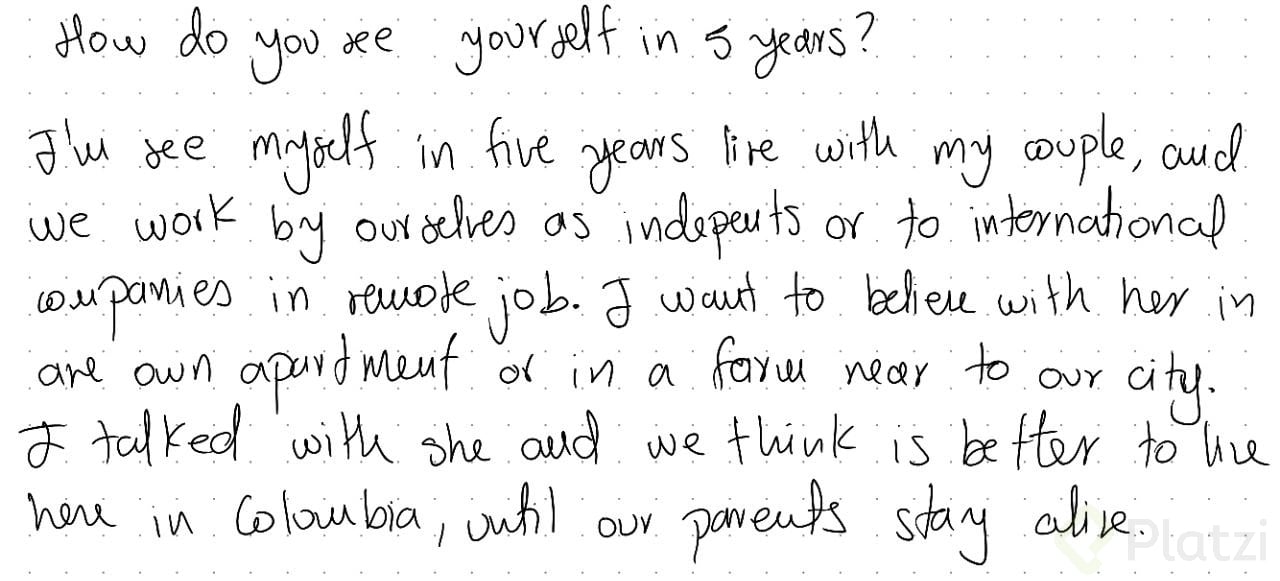
Now it is your turn. How do you see yourself in five years? Write your own sentences using reflexive pronouns in the comments, and share the most creative one you can build.