Desafío de Comunicación: Resolución de Problemas con Clientes
Contenido del curso

Atiende Llamadas de Clientes en Inglés
- 2

Saludo telefónico profesional en atención al cliente en inglés
06:30 min - 3

Hacer Preguntas Educadas en Atención al Cliente
06:58 min - 4

Cómo Expresar Empatía en Atención al Cliente
06:31 min - 5

Simulación de Atención al Cliente: Práctica Telefónica
03:54 min - 6

Gestión del tiempo para estudiantes universitarios
00:01 min
Comunícate eficazmente con tu cliente en inglés
- 7

Comunicación Efectiva en Atención al Cliente
06:48 min - 8

Preguntas en Inglés con "Did" para Atención al Cliente
05:41 min - 9

Técnicas de Comunicación Positiva en Atención al Cliente
06:33 min - 10

Comunicación Positiva y Amigable en Atención al Cliente
01:05 min - 11
Programación de Interfaces Gráficas con Python
00:01 min - 12
Práctica de conversación en inglés (atención al cliente)
00:00 min
Maneja quejas y peticiones con el linglés adecuado
- 13

Reconocer y Responder a Expresiones de Enfado de Clientes
05:55 min - 14

Prácticas Efectivas en Atención al Cliente
05:47 min - 15

Soluciones Positivas para Atención al Cliente en Situaciones Difíciles
04:51 min - 16

Desafío de Comunicación: Resolución de Problemas con Clientes
Viendo ahora - 17
Práctica de inglés para manejo de quejas y situaciones difíciles
00:00 min
¿Estás listo para trabajar en servicio al cliente en inglés?
- 18
Autoevaluación del curso
- 19

Habilidades de Inglés para Atención al Cliente
01:20 min
Recursos
Resumen
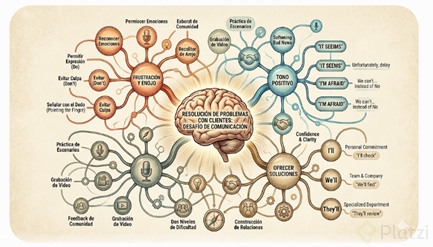
Putting skills into practice is where real learning happens. After working through strategies for handling angry customers, softening bad news, and offering solutions, the next step is to demonstrate those abilities in a real communication scenario. This final project brings together everything covered and turns it into a hands-on challenge.
What does the communication challenge involve?
The task is clear: respond to a customer's problem by recording a video message that communicates a solution [01:00]. This format pushes you beyond writing and into spoken communication, which demands tone control, clarity, and confidence all at once.
The video response simulates a realistic customer service interaction. You need to address the customer directly, acknowledge their concern, and present a path forward — all while maintaining a positive tone and professional language.
How do the two difficulty levels work?
You get to choose between two problems, each designed for a different comfort level [01:22]:
- Problem one asks you to apply several communication strategies you have already practiced.
- Problem two requires similar strategies but at a higher level of ability, meaning more complexity and nuance in your delivery.
Both options test the same core skills — identifying how clients express anger, softening bad news, and offering solutions — but the second option challenges you to integrate them more fluidly. Pick the level that matches where you are, or stretch yourself by going for the harder one.
What skills should you demonstrate?
The challenge is built around three key areas practiced throughout the course:
- Recognizing customer anger: understanding the different ways frustration shows up in communication.
- Softening bad news with a positive tone: delivering information the customer may not want to hear without escalating the situation.
- Using solution-oriented language: choosing words and phrases that move the conversation toward resolution.
All instructions are available in the resources section [01:48]. Recording yourself might feel uncomfortable at first, but it is one of the most effective ways to evaluate your own communication style and build real confidence in handling difficult customer interactions.
Share your video with the community and let others see your progress — feedback from peers is a powerful way to keep improving.
Desafío de Comunicación: Resolución de Problemas con Clientes