Soluciones Positivas para Atención al Cliente en Situaciones Difíciles
Contenido del curso

Atiende Llamadas de Clientes en Inglés
- 2

Saludo telefónico profesional en atención al cliente en inglés
06:30 min - 3

Hacer Preguntas Educadas en Atención al Cliente
06:58 min - 4

Cómo Expresar Empatía en Atención al Cliente
06:31 min - 5

Simulación de Atención al Cliente: Práctica Telefónica
03:54 min - 6

Gestión del tiempo para estudiantes universitarios
00:01 min
Comunícate eficazmente con tu cliente en inglés
- 7

Comunicación Efectiva en Atención al Cliente
06:48 min - 8

Preguntas en Inglés con "Did" para Atención al Cliente
05:41 min - 9

Técnicas de Comunicación Positiva en Atención al Cliente
06:33 min - 10

Comunicación Positiva y Amigable en Atención al Cliente
01:05 min - 11
Programación de Interfaces Gráficas con Python
00:01 min - 12
Práctica de conversación en inglés (atención al cliente)
00:00 min
Maneja quejas y peticiones con el linglés adecuado
- 13

Reconocer y Responder a Expresiones de Enfado de Clientes
05:55 min - 14

Prácticas Efectivas en Atención al Cliente
05:47 min - 15

Soluciones Positivas para Atención al Cliente en Situaciones Difíciles
Viendo ahora - 16

Desafío de Comunicación: Resolución de Problemas con Clientes
01:19 min - 17
Práctica de inglés para manejo de quejas y situaciones difíciles
00:00 min
¿Estás listo para trabajar en servicio al cliente en inglés?
- 18
Autoevaluación del curso
- 19

Habilidades de Inglés para Atención al Cliente
01:20 min
Recursos
Resumen
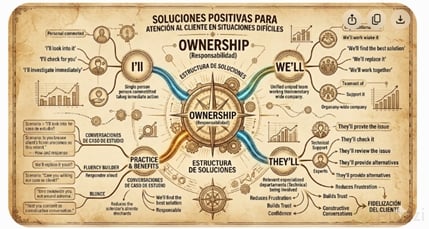
Dealing with frustrated clients is one of the most common challenges in customer service, and knowing exactly how to respond in English can make all the difference. Using a positive tone and offering clear solutions reduces frustration and builds trust. The key structure revolves around three simple contractions: I'll, we'll, and they'll.
How do you offer solutions using "I'll," "we'll," and "they'll"?
When a client has a problem, the fastest way to sound helpful and action-oriented is by using the will form contracted into everyday speech [0:52]. Each version signals a different level of responsibility:
- I'll shows personal commitment: "I'll send it for you."
- We'll represents the company as a whole: "We'll find one for you."
- They'll refers to another department: "They'll check it for you."
This structure works because it immediately tells the client that someone is taking action. Instead of leaving the problem open, you are giving ownership of the solution. Practicing the pronunciation of these contractions — I'll, we'll, they'll — is essential because native speakers use them constantly in fast-paced conversations [1:10].
Another useful expression is to hand over, which means to give responsibility of something to someone else [0:38]. For example: "I'll hand over your phone to our technical support team." It sounds more sophisticated than send or take and shows professionalism.
What does a real customer service conversation look like?
In the role-play example, Veronica assists a client who wants to return a phone due to camera and microphone issues [1:24]. She follows a clear pattern:
- She asks for details: "Can you tell me what specific issues you had with the phone?"
- She checks the warranty period and explains what will happen next.
- She offers a first solution: "I'll send it to our tech support team and they'll check if there is anything wrong" [2:10].
- When the client asks for alternatives, she offers a second option: "We'll make sure the replacement is tested before you receive it" [2:30].
Notice how Veronica emphasizes teamwork. She does not say "I will fix everything." She distributes the action across the team — I'll, they'll, we'll — so the client feels that the whole company is working to solve the problem [2:48].
How can you practice offering solutions on your own?
The best way to build fluency is by responding to common client scenarios out loud [3:00]. Here are some practice prompts:
- A client asks: "Do you know if I can use this gift card in Spain?" You could say: "I'm not sure, but I'll check that for you right away."
- A client says: "I bought this sweater for my sister, but it's too small." You might respond: "I'll help you find the right size" or "We'll exchange it for you."
- A client yells: "Your service is terrible. I've been waiting on the phone forever." A good response: "I'm sorry about the wait. I'll take care of your issue right now."
- A client asks: "Why hasn't my package arrived?" You could say: "I'll look into your tracking information and we'll find out what happened."
Why does a positive tone matter when delivering bad news?
Even when the answer is not what the client wants to hear, framing it with an action you will take keeps the conversation constructive. Saying "I'll send it to our tech support team" is far more reassuring than "There's nothing I can do." The will form turns a potential dead end into a promise of action.
Try applying these structures in your next practice session — and if you have your own creative solutions to the prompts above, share them in the comments.
Soluciones Positivas para Atención al Cliente en Situaciones Difíciles