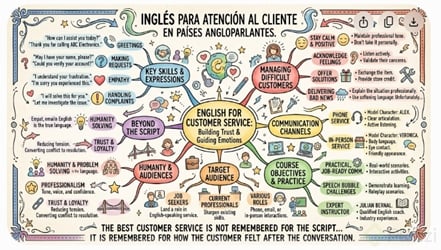
Inglés para Atención al Cliente en Países Angloparlantes
Contenido del curso

Atiende Llamadas de Clientes en Inglés
- 2

Saludo telefónico profesional en atención al cliente en inglés
06:30 min - 3

Hacer Preguntas Educadas en Atención al Cliente
06:58 min - 4

Cómo Expresar Empatía en Atención al Cliente
06:31 min - 5

Simulación de Atención al Cliente: Práctica Telefónica
03:54 min - 6

Gestión del tiempo para estudiantes universitarios
00:01 min
Comunícate eficazmente con tu cliente en inglés
- 7

Comunicación Efectiva en Atención al Cliente
06:48 min - 8

Preguntas en Inglés con "Did" para Atención al Cliente
05:41 min - 9

Técnicas de Comunicación Positiva en Atención al Cliente
06:33 min - 10

Comunicación Positiva y Amigable en Atención al Cliente
01:05 min - 11
Programación de Interfaces Gráficas con Python
00:01 min - 12
Práctica de conversación en inglés (atención al cliente)
00:00 min
Maneja quejas y peticiones con el linglés adecuado
- 13

Reconocer y Responder a Expresiones de Enfado de Clientes
05:55 min - 14

Prácticas Efectivas en Atención al Cliente
05:47 min - 15

Soluciones Positivas para Atención al Cliente en Situaciones Difíciles
04:51 min - 16

Desafío de Comunicación: Resolución de Problemas con Clientes
01:19 min - 17
Práctica de inglés para manejo de quejas y situaciones difíciles
00:00 min
¿Estás listo para trabajar en servicio al cliente en inglés?
- 18
Autoevaluación del curso
- 19

Habilidades de Inglés para Atención al Cliente
01:20 min
Recursos
Resumen
Working in customer service requires more than just technical knowledge — it demands strong communication skills, especially when the job is in English. This course is designed for professionals who want to land a role in an English-speaking customer service environment or who already work in the industry and want to sharpen their language abilities for real-world situations.
What will you learn in this customer service English course?
From the very first moment, the focus is on practical, job-ready communication. You will practice how to take a phone call from a client in English using professional greetings like "Thank you for calling ABC Electronics. This is Alex. How can I assist you today?" [0:12]. These opening lines set the tone for every interaction, and mastering them builds confidence right away.
Beyond greetings, the course covers how to empathize with customers — a critical skill when clients are frustrated or upset. For example, offering solutions such as "I'll help you exchange the shirt for a different size or give you store credit" [0:27] shows the customer you understand their problem and are ready to act. Empathy in customer service means acknowledging how the client feels before jumping to a solution.
How do you handle difficult customers in English?
Dealing with customers in a bad mood is an unavoidable part of the job. The first goal is always to show them that you understand how they feel [0:40]. This is where empathy expressions and a calm tone of voice make all the difference. Sometimes you also have to deliver bad news professionally [0:48]. The course teaches you exactly how to do that without damaging the relationship with the client.
Who is this course designed for?
- Professionals looking to get a job in customer service in an English-speaking setting.
- People who already work in the industry and want to improve their English communication.
- Anyone who handles clients on the phone or in person [1:07].
Whether your role is at a call center or a retail store, the course has you covered.
How is the course structured for maximum practice?
Practice is at the core of every lesson. Whenever you see the speech bubble during the course, it is your turn to demonstrate what you have learned [1:16]. This active approach ensures you are not just listening but actually producing language in realistic scenarios.
You will also meet two characters who guide you through the material:
- Alex, who works in a call center and models phone-based customer interactions [1:23].
- Veronica, who works in a store and demonstrates in-person service situations [1:28].
Both characters help you practice key expressions that are essential in everyday customer service exchanges — from greeting and identifying problems to offering solutions and closing conversations.
Why does this course stand out for customer service professionals?
The course instructor, Julian Bernal, is a qualified English coach with over two decades of experience helping learners acquire communication skills [1:37]. He has also worked extensively in the customer support industry, which means the content reflects real challenges you will face on the job [1:46].
This combination of language teaching expertise and hands-on industry knowledge ensures every lesson is relevant and immediately applicable. If you are ready to strengthen your English for customer service, this is the place to start. Share in the comments what aspect of customer service communication you find most challenging!
Inglés para Atención al Cliente en Países Angloparlantes