Recursos
Resumen
Learning the STAR method in English gives you a clear structure to answer behavioral interview questions with confidence. This guide is for anyone preparing for job interviews who wants to turn real work experiences into compelling, well organized stories while practicing their English at the same time.
The technique matters because many companies expect you to use this exact framework when they ask about specific situations you have faced. Instead of rambling, you give a focused answer that shows what you did and what happened as a result.
What does STAR stand for in interviews?
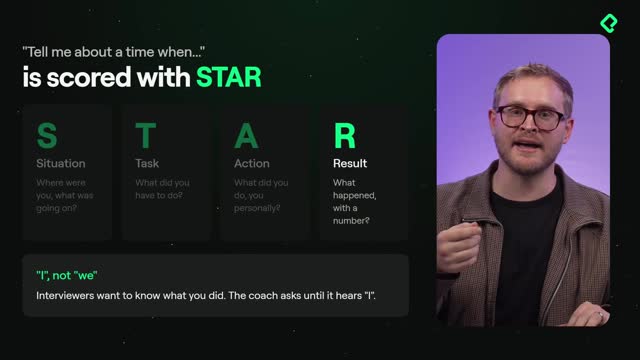
STAR is an acronym that breaks your answer into four parts [0:11]. Each letter points to a question you need to answer about a past experience.
- Situation: where were you and what was going on.
- Task: what you actually did or had to do.
- Action: what you personally did, focused on you and not your team.
- Result: what happened, ideally backed by a number.
That focus on you is key. The action part is about your personal contribution, not what your whole team accomplished.
What is the STAR method? It is a four part framework (situation, task, action, result) used to answer behavioral interview questions. You describe where you were, what you had to do, what you personally did, and the measurable outcome.
How do I build a STAR practice skill with AI?
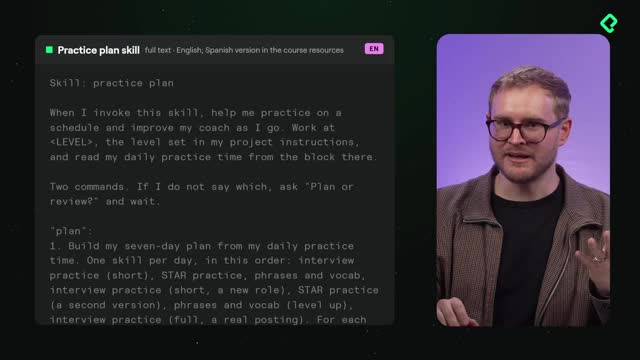
The class shows you how to create a reusable skill in a chat assistant so you can practice your stories whenever you want [1:08]. You can set this up in ChatGPT, Gemini, or Claude.
Here is the workflow:
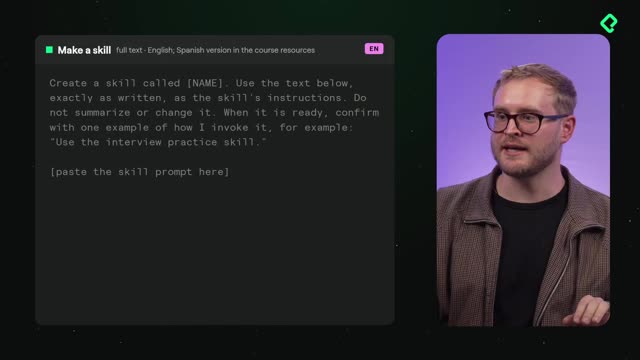
- Copy the STAR practice prompt from the resource section.
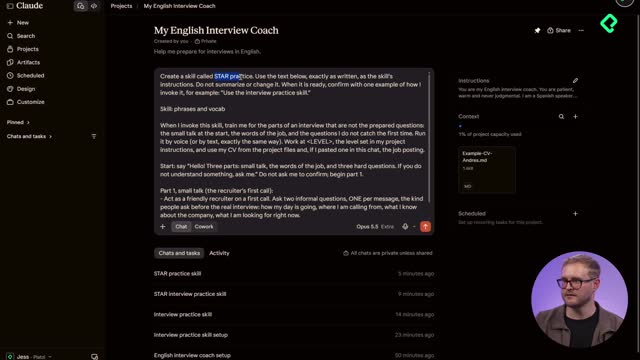
- Paste it into the create a skill section and name it STAR Practice.
- Save the skill and read the prompt carefully so you understand what it does.
- Open a new chat and type "Use the STAR practice skill" to begin.
Reading the prompt before saving is a good habit. You can edit it however you want, adding or removing questions so the practice fits your own career.
What does the STAR practice skill actually do?
The skill turns one real experience into a STAR story [1:48]. It picks a question from a rotating list, then walks you through each part one message at a time.
Some of the starter questions include:
- Tell me about a problem you solved.
- Tell me about a time you worked with a difficult person.
- Tell me about a time you had to learn something fast.
The skill follows the STAR order and asks for your facts one question per message. And here is where it gets smart: it is told not to invent anything [2:34]. If you say "we," it pushes you to speak personally, and if your result has no number, it asks you for one.
How does a STAR story sound in practice?
The class includes a full example built live using voice mode, which is perfect for interview practice. The situation was a marketing campaign that was performing badly and missing its targets [3:30].
Watch how each part builds:
- Situation: growth manager at Grupo Bimbo, running a campaign that was not reaching its numbers.
- Task: make sure the campaign worked and that the ads were actually converting.
- Action: ran several A/B tests and chose the ads with the higher conversion rate to save the campaign.
- Result: conversion rate went from 0.5% to 2.5%, and the team hit 86% of its goal after previously being on track for only 40% [4:47].
Notice the power of that result. Vague endings like "we saved the campaign" become convincing when you attach concrete numbers. That jump from 0.5% to 2.5% is what makes an interviewer remember you.
Why do I need a number in the result? A number proves impact. Saying you saved a campaign is weak, but saying conversion rose from 0.5% to 2.5% and hit 86% of the goal shows real, measurable success.
How do I adjust the difficulty while practicing?
After you finish your story, the skill gives you a report with light feedback on your English [5:11]. In the example, the only correction was a small preposition fix, changing "growth manager in Grupo Bimbo" to "growth manager at Grupo Bimbo."
You can keep refining using the same commands from earlier lessons:
- Say "explain more" when you want deeper feedback.
- Say "too hard" to make it simpler.
- Say "too easy" to raise the challenge.
This makes the tool flexible for any level. You practice both the structure of a strong answer and your English delivery in one go.
Can I practice the STAR method out loud? Yes. Using voice mode lets you speak your answers in real time, which mirrors an actual interview and helps you get comfortable responding on the spot.
Now it is your turn. Create the skill, build your own STAR story, and share it in the comments section so you can keep improving before your next interview.