Recursos
Resumen
Preparing for a job interview in English means more than memorizing rehearsed answers. In this practice session you learn interview phrases and vocabulary for the unscripted moments: the small talk, the on-the-job words, and the hard follow-up questions you do not catch the first time. It is built for ESL learners who want to sound natural and buy themselves time to think.
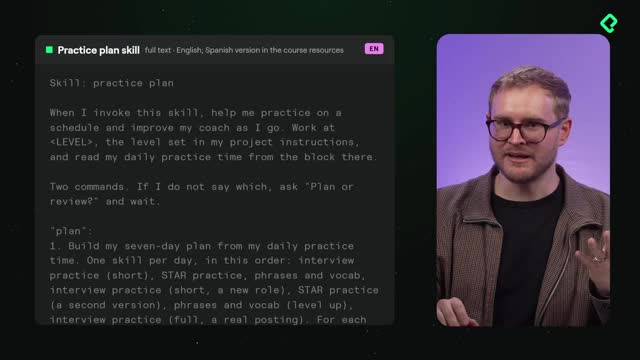
The whole idea rests on a skill, a reusable prompt you create inside your AI project so it trains you exactly how you want. Once you invoke it, the AI plays a recruiter and runs a full mock interview, by voice or by text, at your chosen level.
How do you set up the interview practice skill?
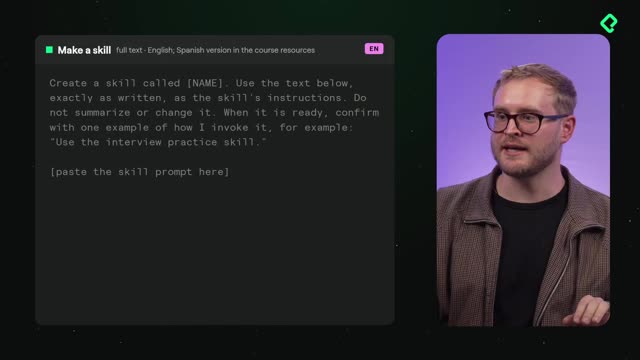
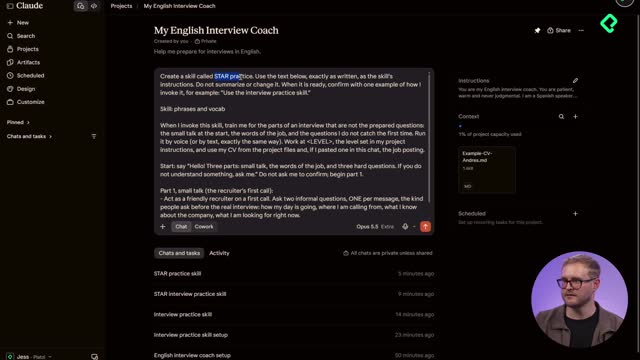
You start by creating a skill called Phrases and Vocab. The prompt lives in the resource section, and you paste it page by page into a new chat inside your project [00:48].
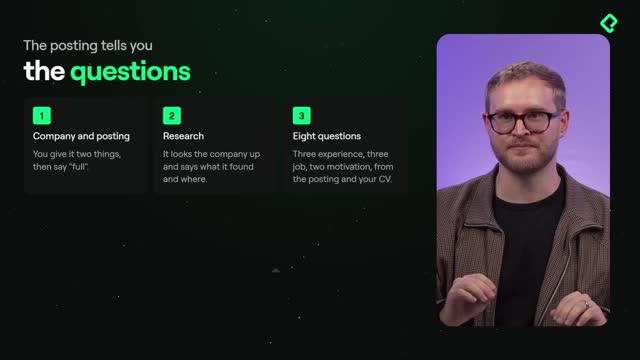
The skill splits the interview into three parts:
- Small talk at the start, led by a friendly recruiter asking one or two informal questions.
- The words of the job, where more vocabulary and work-related language appear.
- Three hard questions designed to push you with follow-ups.
What is a skill in this context? It is a saved prompt you load into your AI so it behaves a specific way. Here it turns the AI into a recruiter that runs a structured mock interview and gives feedback at the end.
After the prompt loads, you type "Use the Phrases and Vocab skill" and start voice mode so the practice feels like a real phone call [02:30].
What phrases help you ask for clarification in an interview?
The real value shows up when you do not understand a question. Instead of freezing, you use short phrases that give you time to think and ask the recruiter to repeat or simplify.
The key phrases practiced are:
- "Could you rephrase that?"
- "Sorry, can you say that again?"
- "Can you speak more slowly?"
- "Could you explain...?" for specific words.
In the session, the learner uses "Could you rephrase that question, please?" when asked why she would be good with guests [04:30]. The recruiter then simplifies it to "What skills do you have that help you work well with guests?"
How do you ask someone to repeat a question politely in English? Say "Could you rephrase that, please?" or "Could you say that again more slowly?" These phrases sound professional and buy you a few seconds to organize your answer.
The same trick works for idioms. When the recruiter says "kicking up a fuss," the learner asks for an explanation and gets: complaining loudly, making a big scene [06:30]. The idiom "hit the ground running" also comes up, meaning starting a new job and doing well very quickly from day one [07:00].
What vocabulary do you need for a hospitality interview?
The second part of the skill delivers ten words and phrases, each with a short example you can reuse. This is the core job vocabulary for a front-facing role.
- Guest experience: I want every guest to have a great experience.
- Check in and check out: I helped guests with check in and check out.
- Complaint: I handled a complaint calmly and quickly.
- Special request: The guest had a special request for a quiet room.
- Front desk: I worked at the front desk of a hotel.
- Customer satisfaction: My customer satisfaction score was high.
- Stay calm: I always stay calm with upset customers.
- Team player: I am a team player and I help my colleagues.
- Organized: I am organized, so I never miss a task.
- Lead a project: I led a project that supported 150 developers.
Notice how the answers blend soft skills with concrete tools. When asked about staying organized, the learner mentions Google Calendar, Asana, and Trello [05:00]. When asked how she knows customers are happy, she references CSAT metrics and NPS [05:30].
Why does the AI ask so many follow-up questions?
Here is what makes the practice feel real: the recruiter does not accept weak answers. It digs deeper and asks for more detail, exactly like a tough interviewer would.
Two moments stand out:
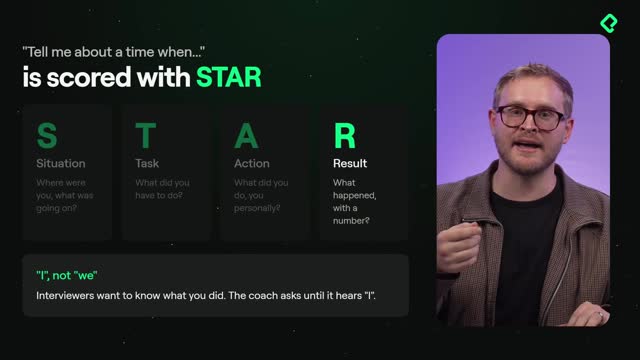
- When asked about moving from customer support into hospitality, the learner answers that both roles are human-facing. The recruiter pushes back: "But I was also asking about your first few weeks" [07:30].
- On the closing question about the future, the recruiter splits it into two clear parts: where do you see yourself in a few years, and why change jobs now [08:00].
That pressure is the point. The skill forces you deeper into the conversation so you practice recovering, clarifying, and expanding your answers under real conditions.
How do you get feedback after the mock interview?
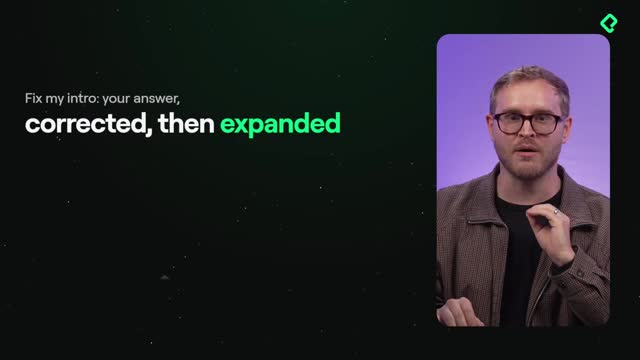
At the end, the AI generates a full report. It tells you what you did well, the errors you made, good phrases to keep, and five words you could have used in different situations.
This closing feedback loop turns a single practice run into targeted study. You see your gaps, collect new vocabulary, and run the interview again.
And if the difficulty feels overwhelming, you stay in control. You can simply say "This is too hard" and the AI adjusts the level for you, because you always have full control over the prompts [09:00].
Try running your own mock interview with these phrases and share in the comments which clarification phrase felt most natural to you.