Uso de Prefijos en Adjetivos para Ampliar Significados
Curso de Inglés Intermedio B1: Preguntas de Confirmación y Posibilidades
Contenido del curso
According to the Cambridge Dictionary:
“Prefixes are letters which we add to the beginning of a word to make a new word with a different meaning. Prefixes can, for example, create a new word opposite in meaning to the word the prefix is attached to. They can also make a word negative or express relations of time, place or manner”.
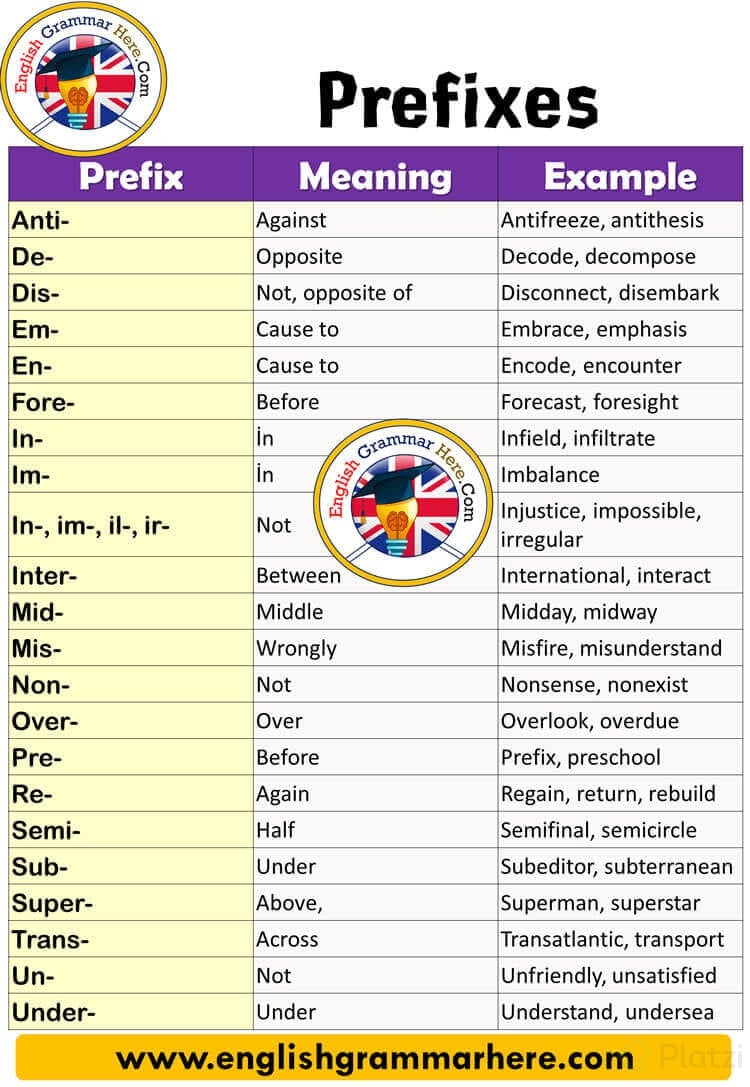
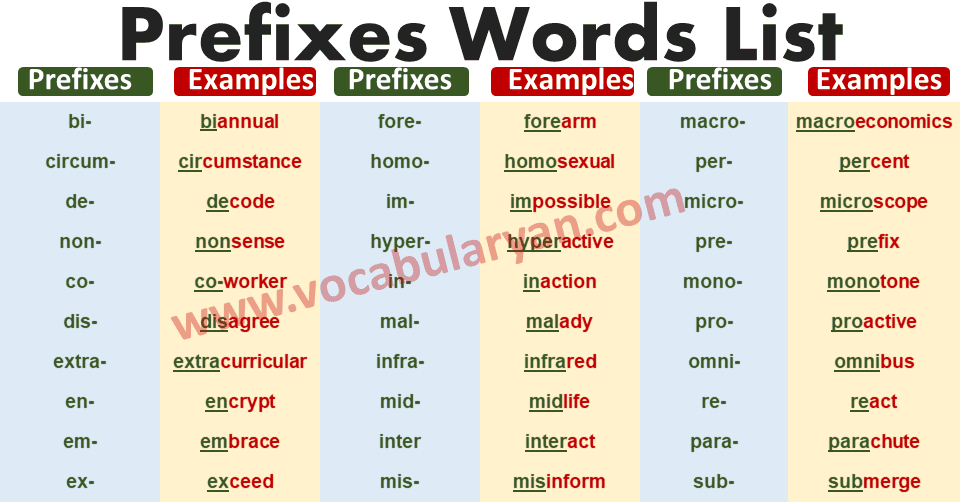
You will see different prefixes, their meaning, and examples using adjectives. The goal of this class is for you to be able to use a range of common prefixes, enhancing the meaning of adjectives.
| PREFIX | MEANING | EXAMPLES |
|---|---|---|
| anti- | against / opposed to | Anti-racist, antiviral |
| dis- | not / opposite of | disloyal, dishonest, dissimilar, distrustful |
| extra- | beyond / outside | extraordinary, extraterrestrial, extracurricular |
| hyper- | extreme / more than normal | hyperactive, hypersonic |
| il-, im-, in-, ir- | not / opposite of | illegal, impolite, insecure, irrational |
| inter- | between / among | interactive, international |
| non- | Not / absence | non-fiction, non-political, non-neutral |
| over- | too much / excessive | overused, overconfident |
| pre- | before | prehistoric, pre-adolescent |
| pro- | in favor of / in support of | pro-communist, prodemocratic |
| semi- | Half / partly | semi-conscious, semi-retired |
| sub- | under / below / near | subtropical, sub-Saharan |
| super- | above, beyond | super-hero, supermodel, super-human |
| trans- | across / beyond | transatlantic, transnational |
| ultra- | extremely / beyond | ultra-compact, ultrasonic |
| un- | not / opposite of | unhappy, unreal, unpleasant |
| under- | less than / beneath | underpaid, underage |
| up- | make or move higher | upgrade, uphill |

Juan Felipe Jimenez Pacheco
Felipe Bernardo González Barranco
Michael Aguillón
Marcela Alejandra Madrid López
Mery Johanna Gutiérrez Ortiz
Manuel Rodríguez
Ingrid Zamora
Andrés Alberto naranjo Hernández
Daniel Steven Carrera Osorno
Javier Garnica Soria
Tiffany Botero
Hogla Marina
Jenny Gomez
Darly Sucely
Vega Mallon Claudia Alejandra
AYDEE QUISPE FARFAN
Cristian Jesus Choqueticlla Quintanilla
ANDRES ALFONSO MIRA MEJIA
Andres Nelson Aguirre Mamani
Martha Lucrecia Rivera Mejía
José Daniel García Méndez
Connie Aracelly Condori Roque
:clap: :clap: :clap:
Great input
Excellent table. It is an amazing guide
anti-crist dis-troyed hyper-loop
Hyperactive significa "extremadamente activo" y se refiere a alguien que tiene más energía de lo normal, a menudo con dificultad para concentrarse. Hypersonic, por otro lado, se refiere a velocidades que están por encima de cinco veces la velocidad del sonido (Mach 5). Ambos términos incluyen el prefijo "hyper-", que implica un nivel extremo o más allá de lo normal. Estos conceptos pueden aplicarse en contextos de comportamiento y física respectivamente.
Excellent table. It is an amazing guide
Platzi must take action over those text format issues around the whole discussion panel.
The term "overlap" refers to a situation where two or more elements share some common features, functions, or areas. In technology, especially in software and programming, overlap can occur when different systems or applications use similar code, functionalities, or data structures. For instance, two software tools might overlap in their capabilities, allowing users to achieve similar outcomes with both. This concept is essential when analyzing compatibility or integration between various software solutions.
Your theet brush is overused My mother used to be hyperactive in home She is about to enter to the pre-adolescent Do not be impolite with your uncles.
pro-life
antivirus
imprudent.
Hello
Here there are my examples:
"Increasing the meaning of adjectives"
Good night, thanks...
El adjetivo modifica siempre a un sustantivo y concuerda con dicho sustantivo en género y en número
Muy buenos videos
✅
great
Todo much
"Too much" is exactly what over- is for. When you say something is "overused," you're not just saying it's used a lot—you're saying it's excessive.
If you were describing a course that demands way more effort than it should, how would you use over- to replace "too much"?
Thank you for this important table!
“very,” “extremely,” “absolutely,” and “truly.”