Contenido del curso

Whether vs If en preguntas indirectas

Resumen

When you want to report a yes/no question in English, you can use whether or if, two connectors that work almost like twins but carry one subtle difference that changes the meaning of your sentence. This guide is for intermediate learners who already form basic questions and want to sound more natural when reporting information indirectly.

What is a yes/no question and why does it matter?

A yes/no question is any question that can be answered with yes, no, or I don't know. For example, Has the train arrived? admits three replies: Yes, it has, No, it hasn't, or I don't know if the train has arrived.

Instead of asking directly, you can soften the question with an indirect statement using if or whether:

  • I wonder if the train has arrived.
  • I wonder whether the train has arrived.
  • Would you like to know if the train has arrived?

Both versions are correct and interchangeable in most contexts.

¿Whether and if mean the same thing? Most of the time, yes. You can swap them when reporting yes/no questions. The difference appears when you talk about conditional outcomes, where whether covers both possibilities and if covers only one.

When should I use whether instead of if?

Here comes the key nuance. Use whether when you want to cover both possible outcomes, and use if when you only care about one outcome.

Look at this pair:

  • Let me know whether she arrives. You want to be informed in both cases: if she arrives and if she doesn't.
  • Let me know if she arrives. You only want to be informed in one case: when she arrives. If she doesn't show up, you don't need an update.

That tiny shift changes the speaker's expectation completely. Ask yourself: do I care about both scenarios or just one? That question tells you which word to choose.

How does this work in real conversations?

Let's break down three examples that mirror everyday situations.

  1. Would you like to know whether she's free? The speaker is offering full information either way.
  2. I don't know whether I can go, I have a lot of work. You can also say I don't know if I can go; both are natural.
  3. I'm not sure whether she joined the meeting. Equivalent to I'm not sure if she joined the meeting.

Notice how whether and if are interchangeable in examples 2 and 3 because there's no conditional consequence attached.

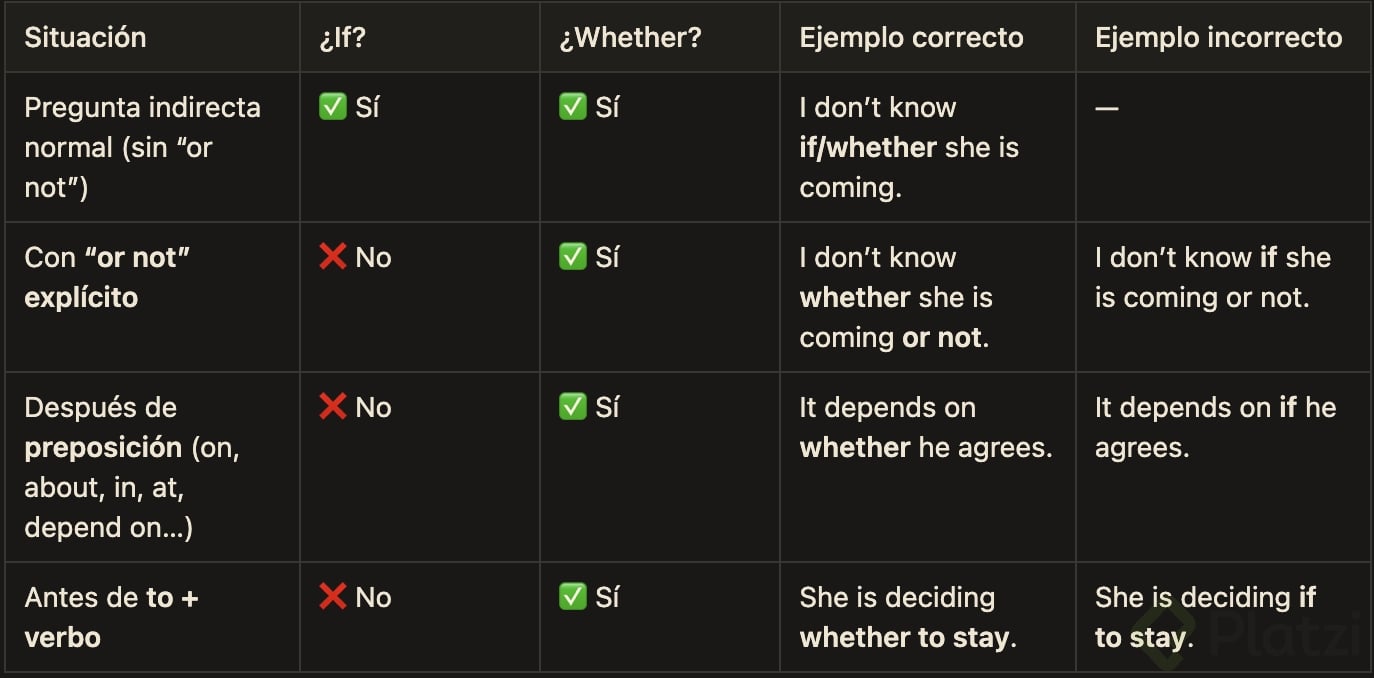
¿When is whether better than if? Use whether when both outcomes matter, after prepositions, before infinitives, and in formal writing. Use if for casual speech and single conditional outcomes.

How can I practice whether and if with yes/no questions?

The best way to lock in the difference is to answer real questions out loud or in writing. Try these prompts and build full sentences using if or whether:

  • Is the soda free?I'm not sure whether the soda is free.
  • Would you like to learn French?I don't know if I'd like to learn French.
  • Did he finish the project?I wonder whether he finished the project.
  • Does your friend like vegetables?I'm not sure if my friend likes vegetables.

Write a few of your own and pay attention to the meaning. If both outcomes matter to you, lean toward whether. If only one outcome matters, if fits better.

What verbs commonly introduce these structures?

Reporting yes/no questions usually starts with verbs and expressions like:

  • I wonder…
  • I don't know…
  • I'm not sure…
  • Would you like to know…
  • Let me know…

Pair any of these with if or whether and you'll have a natural, polite way to ask or report indirect questions in English.

Share your sentences in the comments so we can review them together and keep building your fluency.