Present perfect and vocabulary in a café chat
Curso de Inglés Intermedio B1: Solicitudes y Pronombres Reflexivos
Contenido del curso

Adding information


Adverbs


Requests
- 11

Second conditional advice: Emily and Thomas roleplay
04:23 min - 12

Would vs will: making polite requests in English
03:52 min - 13

Uso formal de "necesario" en inglés para expresar importancia
01:15 min - 14

Why English says "if I were you" not "was"
03:28 min - 15
Práctica de conversación en inglés (contexto cotidiano)
00:00 min
Useful phrases


Phrasal verbs


Till the next time!

Recursos
Resumen
If you want to learn intermediate English through a real conversation, this role play between two friends meeting on the street shows you how present perfect, correlative conjunctions, and everyday vocabulary sound in natural speech. It is ideal for ESL learners moving beyond the basics who want context, not just rules.
The idea is simple but powerful: Emily and Thomas bump into each other, head to a café called Espresso, and chat about work, promotions, and taking a career break. Every highlighted phrase in the script is grammar and vocabulary you will study across modules one and two.
Why should you follow the script while listening?
Before diving in, download the script from the resources section and read along as you listen. This dual practice trains your ear and your eyes at the same time, which is one of the fastest ways to connect spoken sounds to written words.
The highlighted phrases are not random. They preview the exact structures you will break down later, so listening first gives you a mental hook for each lesson [00:29].
How can I improve my English listening and reading together? Listen to a conversation while following its written script. Reading along while you hear native speech links pronunciation to spelling and boosts comprehension faster than doing either alone.
What grammar appears in this café conversation?
The dialogue is packed with the present perfect tense, one of the trickiest points for intermediate learners. Notice how Emily opens with "I've been doing well" and Thomas asks "Have you heard of this new café?" [01:20].
That structure, the present perfect continuous, shows up again when Thomas says "I've been studying and working so much that I have hardly slept" [03:10]. It describes actions that started in the past and still affect the present, which is why it feels so natural in casual catch-ups.
There is also a great example of correlative conjunctions. When Emily explains her career break, she says "neither my parents nor my friends think it's a completely good idea" [04:05]. The neither... nor pattern lets you connect two negative ideas in a single, elegant sentence.
What does the present perfect express? It links the past to the present. Saying "I've been working incredibly hard for so many years" shows an action that began earlier and still matters now.
Which vocabulary and expressions stand out?
Beyond grammar, the conversation is full of useful phrases you will hear in real life. A few worth memorizing:
- Long time no see: a friendly way to greet someone you have not seen in a while [01:05].
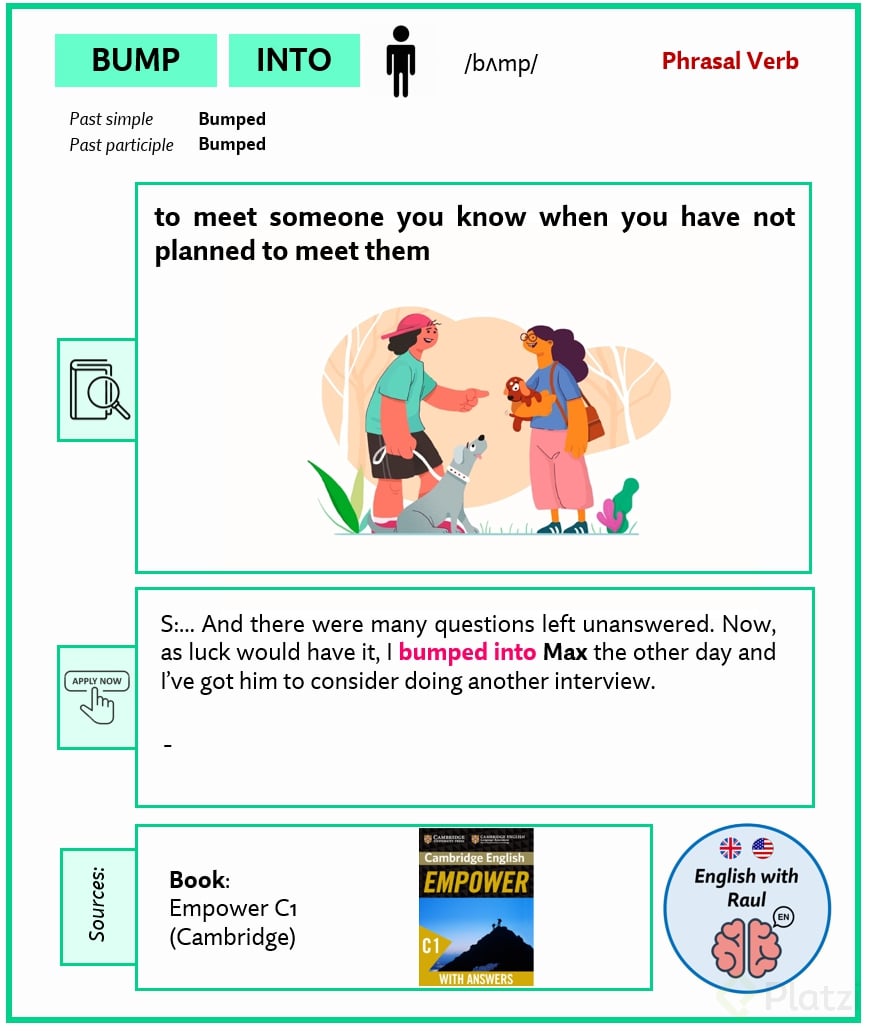
- Bump into someone: to meet someone by chance, exactly what happens to Thomas and Emily.
- Career break: taking time off from work, which Emily is planning [03:45].
- Put it off: to postpone something, as when her friends suggest she delay her plans for a year [04:20].
- Goal-oriented and committed: adjectives Emily uses to describe Thomas and his focus on a new managerial position [03:30].
After learning these, try spotting them again on your second listen. Repetition in context is what turns passive vocabulary into words you actually use.
How does context help you learn faster?
The real value here is watching grammar work inside a story. Thomas is chasing a managerial position open to employees who have been at the company for more than two years [02:40]. Emily is weighing a break because of restrictions in certain cities due to the current situation [04:10].
Those small details give each phrase a reason to exist. Instead of memorizing "present perfect" as an abstract rule, you remember it because Thomas was so busy he had hardly slept.
Throughout modules one and two, you will take extracts from this exact dialogue and analyze how Emily and Thomas use different structures, grammatical points, and vocabulary [05:05]. So treat this first listen as your map for everything ahead.
How did you feel as you listened and read along? Share your thoughts in the discussion panel and tell me which phrase surprised you the most.
Present perfect and vocabulary in a café chat