Reflexive vs Reciprocal Pronouns: Each Other or Themselves
Curso de Inglés Intermedio B1: Solicitudes y Pronombres Reflexivos
Contenido del curso

Adding information


Adverbs


Requests
- 11

Second conditional advice: Emily and Thomas roleplay
04:23 min - 12

Would vs will: making polite requests in English
03:52 min - 13

Uso formal de "necesario" en inglés para expresar importancia
01:15 min - 14

Why English says "if I were you" not "was"
03:28 min - 15
Práctica de conversación en inglés (contexto cotidiano)
00:00 min
Useful phrases


Phrasal verbs


Till the next time!

Recursos
Resumen
If you want to know how to use reflexive and reciprocal pronouns in English, the difference comes down to one question: is the subject doing the action to themselves, or are two people doing it to each other? This class opens module four on useful phrases and is perfect for intermediate ESL learners who want their sentences to sound natural.
Emily and Thomas set the scene in a role play where these pronouns appear again and again. When Thomas says "We still love each other" and later "I often think to myself," he is quietly showing you the whole lesson in action.
When should I use a reflexive pronoun in English?
You use a reflexive pronoun when the object of the sentence is the same as the subject. In other words, the person doing the action also receives it.
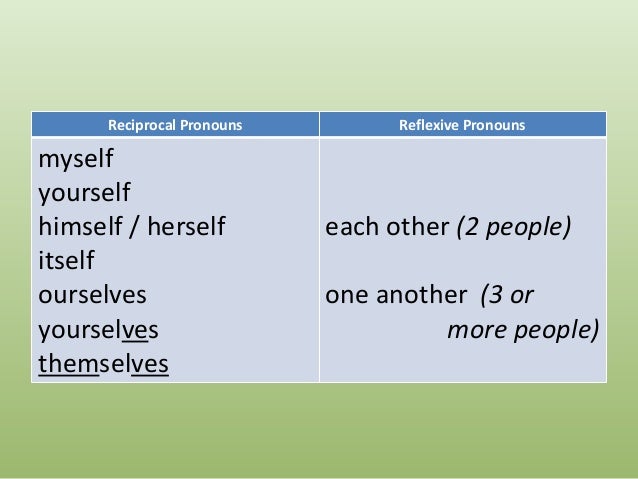
Here is the full list of personal pronouns and their reflexive partners [02:07]:
- I becomes myself.
- You becomes yourself.
- He becomes himself.
- She becomes herself.
- It becomes itself.
- We becomes ourselves.
- You plural becomes yourselves.
- They becomes themselves.
Look at two examples from the class: "Be careful with that knife. You might hurt yourself" and "Would you like to pour yourself a drink?" [02:44]. With verbs like hurt or pour, we naturally expect an object. You could hurt someone else, so when you mean you, the reflexive pronoun makes it clear.
When do I use a reflexive pronoun? Use it when the subject and object are the same person. "I hurt myself" means I received my own action, not someone else's.
Which verbs commonly take reflexive pronouns?
Some verbs almost invite a reflexive pronoun because they expect someone to receive the action [03:19]:
- amuse, blame, cut, dry.
- enjoy, help, hurt, introduce.
- kill, prepare, satisfy, teach.
Take help. If you say "I help," the natural question is: help whom? Adding myself answers it: "I help myself." That small word closes the gap the listener is waiting to fill.
Why do some verbs not need a reflexive pronoun?
We skip the reflexive pronoun with actions people usually do for themselves. Saying "He always shaved before going to bed" already implies he did it alone, no extra pronoun needed [04:15]. The same goes for "Kim got dressed and got ready for the party," because getting dressed is something we normally handle ourselves.
And here is the interesting part: you can add the reflexive pronoun to those same verbs when you want to emphasize. Watch the shift:
- "She dressed herself even though she's only three." You are stressing that a small child managed it alone.
- "He is old enough to shave himself." Imagine someone offering help and you replying with this. The pronoun pushes back and highlights independence.
Can I use a reflexive pronoun for emphasis? Yes. With verbs like shave or dress, the pronoun is optional, but adding it stresses that the person did the action alone, such as "She dressed herself even though she's only three."
What are reciprocal pronouns and how do they work?
Reciprocal pronouns are the words each other and one another, and they describe an action that goes both ways between people [05:30]. They let you collapse two sentences into one.
Start with "Mark helped John" and "John helped Mark." Put them together and you get "Mark and John helped each other." The same trick works here: "I sent Ana a gift" plus "Ana sent me a gift" becomes "We sent one another a gift."
How is "each other" different from a reflexive pronoun?
This contrast is where many learners get tripped up, so compare these two carefully:
- "Ana and César talk to each other regularly." Ana talks to César, and César talks to Ana.
- "Ana and César talk to themselves regularly." Ana talks to Ana, and César talks to César, each one alone.
Same verb, completely different meaning. The reciprocal pronoun connects two people; the reflexive one loops each person back to themselves.
What is the difference between "each other" and "themselves"? "Each other" means two people act on one another. "Themselves" means each person acts on their own self. The action either crosses between people or stays within one.
How can I practice reflexive and reciprocal pronouns?
The class closes with a short writing task, and it is worth doing to lock in the concepts [07:38]. Write three sentences:
- One using a reflexive pronoun to refer back to the subject.
- One using a reflexive pronoun to emphasize an action people normally do alone.
- One using a reciprocal pronoun, either each other or one another.
Once you can produce all three on your own, you have the whole lesson in your pocket. Give it a try and share your three sentences in the comments so others can learn from your examples too.
Reflexive vs Reciprocal Pronouns: Each Other or Themselves