Question tags with phrasal verbs in English
Curso de Inglés Intermedio B1: Solicitudes y Pronombres Reflexivos
Contenido del curso

Adding information


Adverbs


Requests
- 11

Second conditional advice: Emily and Thomas roleplay
04:23 min - 12

Would vs will: making polite requests in English
03:52 min - 13

Uso formal de "necesario" en inglés para expresar importancia
01:15 min - 14

Why English says "if I were you" not "was"
03:28 min - 15
Práctica de conversación en inglés (contexto cotidiano)
00:00 min
Useful phrases


Phrasal verbs


Till the next time!

Recursos
Resumen
Question tags and common phrasal verbs are the focus of this intermediate English lesson, where you learn how to confirm information in conversation and expand your vocabulary. If you want to sound more natural when speaking English, this is where the fun begins.
This class opens the last module of the intermediate course: phrasal verbs. You will review common ones, prepare for more complex verbs with three particles, and get ready for a second interactive role-play that works a little differently from the first.
What are question tags and when do you use them?
Question tags are those short questions we add at the end of a sentence, like are there? or don't you? They appear in the role-play between Emily and Thomas, when Thomas says: "There are no perfect relationships, are there?" [00:52]
We use them mostly in speaking, not writing, and specifically when we expect the other person to agree with us. That agreement expectation is the whole point of a tag.
What is a question tag in English? It is a short question added at the end of a statement to confirm information or invite agreement, like "You like pizza, don't you?" It turns a statement into a soft question.
Why does intonation change the meaning?
Here is where it gets interesting. The same tag can mean two different things depending on how your voice moves. There are two types of intonation, falling and rising [01:47].
- Falling intonation means you are almost sure about what you said.
- Rising intonation means you are less sure and genuinely asking.
Take the sentence "You're not thinking of calling her, are you?" With a falling tone you sound confident. With a rising tone you sound doubtful, as if you really want to check. Your voice does the work your words cannot.
How do you build a question tag correctly?
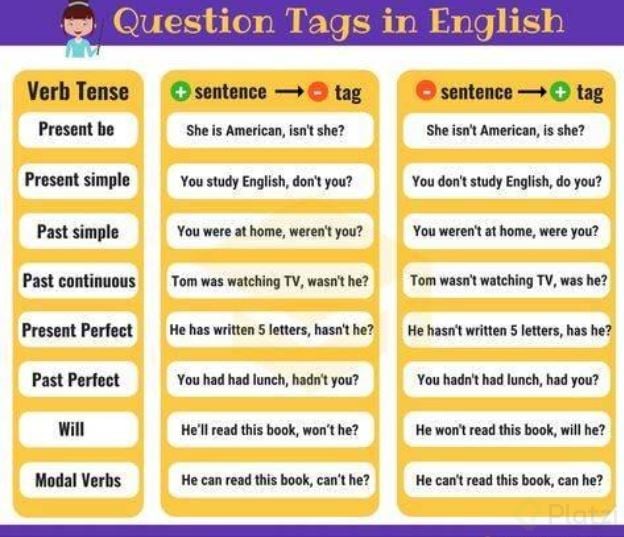
The rule is simpler than it looks. If your statement is positive, your tag is negative. If your statement is negative, your tag is positive [02:57].
- Positive statement plus negative tag: "You like pizza, don't you?"
- Negative statement plus positive tag: "You don't like broccoli, do you?"
And when there is an auxiliary verb already in the sentence, you reuse it in the tag. So "You don't like meat" becomes "You don't like meat, do you?" The auxiliary you started with is the one that comes back.
How do you form a negative question tag? Take the auxiliary from a positive sentence and make it negative. "She works, doesn't she?" The tag always mirrors the subject and verb of the main clause.
Which common phrasal verbs are worth learning here?
The lesson pairs question tag practice with a solid list of everyday phrasal verbs. Each one carries a meaning you cannot always guess from the individual words, which is exactly why they trip up learners.
Here are the phrasal verbs reviewed, with their meaning and the matching tag:
- Dress up means to put fancy clothes on. "I don't have to dress up, do I?" [04:07]
- Hang out means to spend time with family or friends. "Sarah doesn't want to hang out, does she?" [04:14]
- Clean up means to clean a space, like a room. "John didn't clean up the room, did he?" [04:44]
- Call off means to cancel. "They haven't called off the meeting, have they?" [04:50]
- Find out means to discover or learn something. "He couldn't find out the answer, could he?" [05:20]
- Get along means to have a good relationship. "They didn't get along, did they?" [05:29]
Notice how the tag always borrows the auxiliary or modal from the statement: couldn't pulls back could, didn't pulls back did.
How do modal verbs work inside these tags?
Modals like will and would follow the same mirror logic. The lesson shows two clear examples [06:07].
- Give up means to quit. "You won't give up, will you?" If you are tired and say "I give up," you mean you do not want to continue.
- Let down means to disappoint someone. "You wouldn't let me down, would you?" Saying "Don't let me down" means "Don't disappoint me."
The final pair rounds out the vocabulary [06:58]:
- Work out means to do exercise. "She hasn't worked out, has she?"
- Do over means to repeat a task, to do it again. "We don't have to do this over, do we?"
After learning these, the best move is to build your own sentences. Pick different contexts and situations, and attach a question tag to each verb so the grammar and vocabulary stick together in your memory.
The next class steps up to more complex phrasal verbs with three particles. Try writing a sentence for each verb above and share which one feels hardest to use naturally.
Question tags with phrasal verbs in English