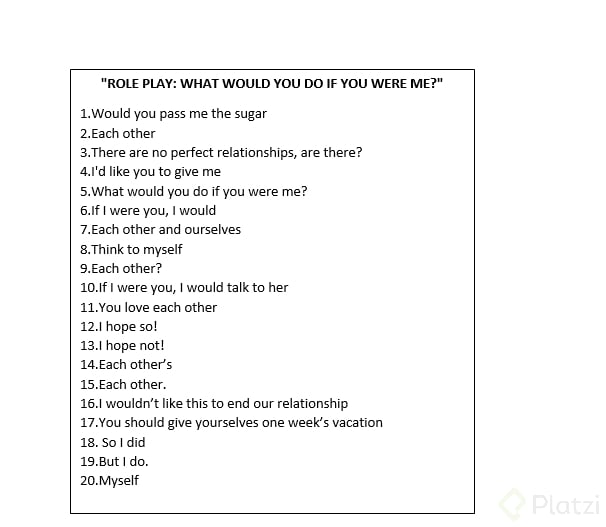
Second conditional advice: Emily and Thomas roleplay
Curso de Inglés Intermedio B1: Solicitudes y Pronombres Reflexivos
Contenido del curso

Adding information


Adverbs


Requests
- 11

Second conditional advice: Emily and Thomas roleplay
Viendo ahora - 12

Would vs will: making polite requests in English
03:52 min - 13

Uso formal de "necesario" en inglés para expresar importancia
01:15 min - 14

Why English says "if I were you" not "was"
03:28 min - 15
Práctica de conversación en inglés (contexto cotidiano)
00:00 min
Useful phrases


Phrasal verbs


Till the next time!

Recursos
Resumen
If you want to learn real English conversation, this role play between Emily and Thomas shows how native speakers talk about family, relationships, and giving advice using natural grammar and vocabulary. It is designed for ESL learners in modules 3, 4, and 5 who want to hear phrases in context before studying them in depth.
The idea here is simple but powerful: you download the script, listen, and read at the same time. That way, highlighted phrases, vocabulary, and grammar stop feeling like isolated rules and start sounding like something a real person would say. And that is exactly what makes a conversation stick.
What do Emily and Thomas talk about in this conversation?
The dialogue starts with small talk about family and moves into something deeper: whether Thomas and his partner Josie should move in together before getting married. Along the way, you hear how English speakers ask questions, give advice, and stay polite even about personal topics.
Here are the main topics covered in the role play:
- Family updates, including retired parents planning to travel the world, a sister finishing high school, and a brother getting married next year.
- Relationship advice about marriage and moving in together.
- Work and health, including requesting time off through human talent.
- Staying in touch and making plans to meet for lunch.
Notice how the conversation flows from light topics to serious ones. That natural progression is something you can copy in your own English chats.
How do you give advice in English using the second conditional?
One of the most useful patterns in this dialogue is the second conditional, which you use to talk about imaginary or hypothetical situations. Thomas asks Emily a very human question: what would you do if you were me?
What is the second conditional in English? It is a grammar structure for imaginary situations. You use if + past tense, then would + base verb. Example from the role play: "If I were you, I would ask her why she doesn't want to move in first."
Emily repeats this pattern several times, and that repetition is intentional. Each time she says "If I were you, I would..." she is modeling how to soften advice so it sounds caring instead of bossy.
This is the kind of phrase you will study more closely in the upcoming modules, so hearing it first inside a real conversation gives you a head start.
Which useful phrases and requests appear in the role play?
The conversation is full of polite requests and everyday expressions you can reuse immediately. These small phrases are what make you sound fluent and friendly rather than robotic.
Keep an eye on these examples:
- "Would you pass me the sugar, please?" is a polite request using would.
- "My manager said I needed to request some time off" shows how to talk about work permissions.
- "Let's keep in touch" and "Have a good one" are casual ways to end a conversation.
- "We've had ups and downs, like every relationship" is a common idiom for good and bad moments.
How do you make polite requests in English? Use would you plus a verb, and add please. For example, "Would you pass me the sugar, please?" sounds much softer than "Pass me the sugar."
After hearing these lines in context, they feel less like textbook sentences and more like something you would actually say to a friend over coffee.
Why is listening and reading at the same time so effective?
When you read the script while you listen, you connect spelling, sound, and meaning all at once. This helps you recognize phrasal verbs like "move in," "come up with," and "head home," which are a big focus of the next modules.
What is a phrasal verb? It is a verb combined with a preposition or adverb that creates a new meaning. In the dialogue, "head home" means to go home, and "move in" means to start living together.
These verbs are tricky because their meaning is not always obvious from the individual words, so seeing them used naturally is the best way to learn them.
What will you learn in modules 3, 4, and 5?
This role play is your foundation for what comes next. The lines you just heard will be broken down piece by piece so the grammar and vocabulary make full sense.
In the upcoming classes you will focus on:
- Requests, so you can ask for things politely in any situation.
- Useful phrases that make your English sound natural.
- Phrasal verbs, so you understand and use them with confidence.
The goal is to take real speech and reverse engineer it, so you not only understand Emily and Thomas but also start speaking like them.
So, what was your favorite part of the conversation between Emily and Thomas? Share it in the comments and tell us which phrase you want to start using this week.
Second conditional advice: Emily and Thomas roleplay