How to ask wh- questions in the past
Contenido del curso

Habla de preferencias personales en Inglés


Habla de tu familia en Inglés



Habla de prendas de vestir en Inglés


Habla de tu rutina personal en Inglés


Habla de lugares y compras en Inglés


¡Practica tu Inglés!

Recursos
Resumen
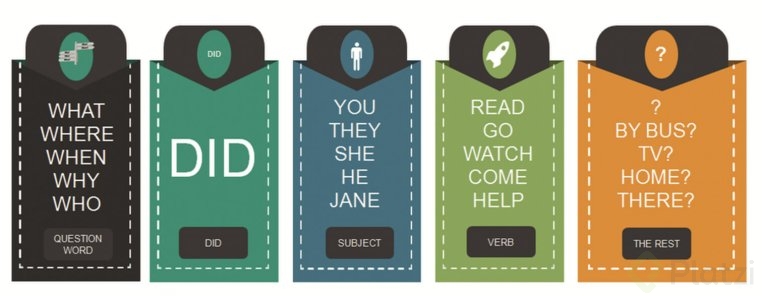
If you want to ask wh- questions in the past in English, you only need one formula and a little practice. This lesson shows you how to build questions like What did you do yesterday? using a question word, the auxiliary did, a subject, and a verb. It is perfect for English learners who want to sound natural when talking about past events.
What is the formula to ask wh- questions in the past?
The whole idea rests on one clear structure. You start with a wh- question word, add the auxiliary verb did, name the subject, and finish with a verb in its infinitive form [00:19].
Those wh- question words are the ones that begin with wh-: who, what, where, why [00:03]. They tell your listener exactly what kind of information you want.
Here is the sequence written out:
- Wh- question word (what, where, why, who).
- The auxiliary verb did.
- The subject (the person or thing doing the action).
- The verb in its infinitive form, with no past ending.
After that base structure, you can add a complement to make a full, natural sentence.
Why don't you change the verb to past tense in these questions? Because did already carries the past meaning. That is exactly what the auxiliary verb is there to do, so the main verb stays in its infinitive form [00:38].
Why does the verb stay in its infinitive form?
Here is where many learners get tripped up. Since did already signals the past, the main verb does not change [00:33].
Look at the first example from the lesson. The question word what, plus did, plus the subject you, plus the verb do [00:47]. Put it together with a complement and you get: What did you do yesterday? [00:58].
You are asking about an activity that happened in the past, specifically yesterday. And notice the verb do never turned into did twice. The auxiliary handles the tense, the main verb stays clean.
Another quick example uses the same pattern: Where did you go? [01:12]. Same four ingredients, same reliable result.
How can you use follow-up questions with the same structure?
Real conversations rarely stop at one question. Imagine two friends talking. One asks What did you do on Sunday? and the other answers I went for a walk [01:26].
Naturally, you want more details. And here is the beautiful part: you keep the exact same formula to dig deeper.
- Where did you go for a walk? when you are curious about the place [01:41].
- Why did you go there? when you want the reason or motivation [01:52].
- Who did you go with? when you want to know about company, like a friend or family member [02:04].
In all four of these questions, the structure never changes. A wh- word, then did, then the subject, then the verb [02:14]. Master one pattern and you unlock dozens of questions.
What is the difference between who did you go with and why did you go there? Only the question word changes. Who asks about a person, why asks about a reason. The rest of the structure stays identical.
How does this work in a real conversation?
The lesson uses a role play between two friends, Katie and Ollie, to show these questions in action [02:22]. Their phone call is full of past wh- questions flowing naturally.
Ollie asks Who did you go with? and Katie explains she went with her friend Aldo to his sister's birthday party. Then comes What present did you get her? and Katie answers she got a new tennis racket.
When Katie describes going out of the city, the questions keep coming:
- And where did you go? leading to a new Italian restaurant.
- And what did you order? leading to a pizza.
- And why did you go to that restaurant? leading to the answer.
The practice question was: why did Katie go to that Italian restaurant? The correct answer is that a friend, Susan, recommended it [04:38]. Did you catch it while listening?
Notice how every single question in that conversation followed the same reliable formula you just learned. That is the power of understanding one clear structure.
Now it's your turn to practice. Answer these three wh- questions about your own past in the comment section: What did you do last weekend? Where did you go? And why did you go to that place? [04:53]. Leave your answers below and keep building your confidence with past questions.
How to ask wh- questions in the past