This, These, That, Those: Near or Far?
Contenido del curso

Habla de preferencias personales en Inglés


Habla de tu familia en Inglés



Habla de prendas de vestir en Inglés


Habla de tu rutina personal en Inglés


Habla de lugares y compras en Inglés


¡Practica tu Inglés!

Recursos
Resumen
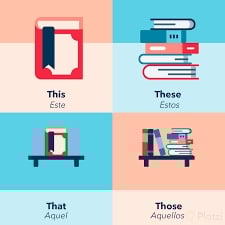
Choosing between this, these, that, and those comes down to two questions: how far is the object, and how many are there? These four demonstrative adjectives help you point to things clearly in English, and this quick guide is perfect for beginner ESL learners ready to talk about clothes, objects, and everything around them.
When do I use this and these?
Both words describe objects that are close to the speaker. The difference is quantity.
- Use this for one thing near you: This is my notebook [01:33].
- Use these for several things near you: These toys are fun [02:00].
Pay attention to the sound too, because it changes the meaning. This is short and sharp, while these stretches the vowel [01:11]. Say them out loud a few times and you will feel the difference.
What is the difference between this and these? This points to one object close to you, and these points to two or more objects close to you. Example: this pen versus these pens.
When do I use that and those?
Here the object moves away from the speaker. Distance is the key clue.
- Use that for one thing far from you: That laptop belongs to Robert [02:40].
- Use those for several things far from you: Those plants are not real [03:07].
Again, listen to the pronunciation. That is quick, and those softens into a longer sound [03:20]. And here is a small trap worth noticing: the instructor briefly says these when describing the plural far version, but the correct word for multiple distant objects is always those.
How do demonstrative adjectives work in a real room?
Imagine sitting at a table full of objects. That is exactly the demo used to show all four words in action [03:33].
- This is my mug for one close item.
- These are my pens and markers for several close items.
- That is my plant for one distant item.
- Those are my jackets for several distant items behind the speaker.
Notice how one simple room lets you practice every option without adding new vocabulary. The trick is always asking yourself: near or far, one or many?
How do I choose the right demonstrative adjective? Ask two questions. Is the object near or far? Is it one or many? Near and one equals this, near and many equals these, far and one equals that, far and many equals those.
How do I answer "What are you wearing to the party?"
This is the guiding question of the lesson, and demonstrative adjectives make the answer natural [00:07].
When you are touching or holding the clothes, you use the close forms. So if you have boots in plural and a single necklace in your hand, you say: I'm going to wear these boots and this necklace [05:52]. The plural item takes these, and the single item takes this.
A few more practice sentences reinforce the pattern:
- This shoe is mine for one nearby shoe [04:40].
- These shoes are mine for two nearby shoes [04:58].
- Those drawings on the wall were inspired by nature for distant, multiple drawings [05:12].
- These drawings are for my new collection when the woman holds them in her hand [05:35].
Each example anchors the rule to something you can see, which makes it easier to remember.
What vocabulary and skills should I take away?
Beyond the grammar, the lesson quietly builds useful everyday vocabulary through the party role play [06:20].
- Clothing words like sweater, jeans, sneakers, earrings, and necklace.
- The idea of casual clothes for informal events.
- Descriptive pairs such as soft brown sweater and warm white sweater.
The core skill is spatial reasoning in English: mapping proximity and quantity onto the correct word. Once that click happens, you stop translating and start pointing naturally.
And now the fun part. You are invited to Aldo's sister's celebration too. So tell me in the comments: what are you wearing to the party? Use this, these, that, or those and show off what you just learned.
This, These, That, Those: Near or Far?