Using "at" and "after" to describe routines
Contenido del curso

Habla de preferencias personales en Inglés


Habla de tu familia en Inglés



Habla de prendas de vestir en Inglés


Habla de tu rutina personal en Inglés


Habla de lugares y compras en Inglés


¡Practica tu Inglés!

Recursos
Resumen
Learning to describe your daily routine in English is one of the first practical skills you build as a beginner, and it starts with two small but powerful words: the prepositions at and after. This lesson shows you how to talk about your morning activities, sequence them correctly, and answer the everyday question what is your day like?
Why does the question "what is your day like?" matter?
This question opens the door to real conversation. When someone asks about your day, you need a clear way to describe actions and the order in which they happen. That is exactly what this class builds.
The teacher models the answer with a personal example: I wake up at 6:00 a.m. From there, every action connects to the next, so you learn vocabulary and grammar at the same time [00:33].
What does "what is your day like?" ask for? It asks you to describe your daily routine, the activities you do and when you do them. You answer with verbs like wake up, shower, and have breakfast, plus a time reference.
How do I use the preposition at to talk about time?
You use at before a specific hour. It points to an exact moment on the clock, not a general part of the day.
Look at how the teacher applies it:
- I wake up at 6:00 a.m. [00:35]
- I shower at 6:30 a.m. [01:07]
- I walk my dog at 7:00 a.m. [01:15]
After seeing these examples, notice the pattern: verb plus at plus the exact time. That structure repeats no matter which activity you describe.
When do I use "at" for time in English? Use at before an exact clock time. Say at 6:00 a.m. or at 6:30, but not for general periods like morning or night.
How does after help me sequence my daily activities?
The preposition after builds a timeline. It tells your listener which action happens first and which one follows, so your story flows in the right order.
The teacher walks through her morning as a chain of events [00:52]:
- She wakes up at 6:00 a.m., then she gets up.
- After she gets up, she makes her bed.
- After she showers, she gets ready.
- After she walks her dog, she has breakfast.
- After she has breakfast, she starts work [01:31].
And here is the interesting part: each after clause links two actions, so the whole routine reads like a connected story instead of a list of random verbs.
What daily routine vocabulary should I learn first?
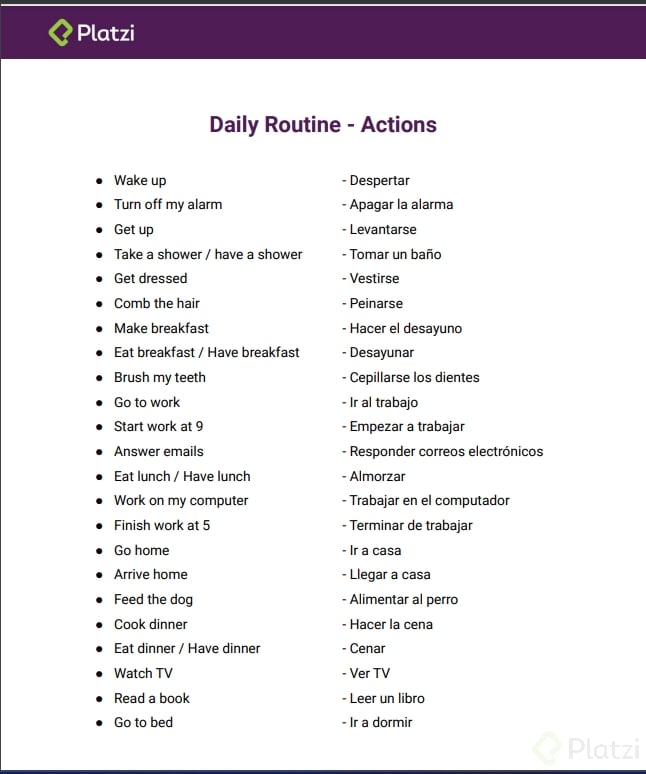
This lesson gives you a starter set of everyday action phrases you can reuse immediately. They cover the typical steps of a morning.
- wake up, the moment you stop sleeping.
- get up, when you leave the bed.
- make my bed, tidying the sheets.
- shower and get ready.
- walk my dog and have breakfast.
- start work, the end point of the morning routine [01:31].
Once you own this vocabulary, you can swap in your own times and activities to build a personalized answer.
How can I answer these questions about my own day?
The class ends with a short practice challenge so you apply at and after right away [01:38]. Try answering these in English:
- What time do you wake up?
- What do you do after you wake up?
- What time do you have breakfast?
- What other activities do you do?
Use at for your exact times and after to connect one action to the next. Go ahead and share your daily routine in the comment section.
Using "at" and "after" to describe routines