







Claudia D.
I like studying English in this course and this teacher. I love eating pasta too. I hate forgeting the pronunciation words in English :/

Gina Pedraza
ProfesorPasta!! 🤤🍝

Sarah Daniela Zafrani Lamoth
HE/SHE/IT LIKES
¿Quieres aprender a expresar gustos en inglés y hablar de lo que te encanta o detestas? Con tres verbos clave, like, love y hate, más el sufijo -ing, puedes describir tus preferencias con naturalidad. Esta lección del módulo My Life es ideal para principiantes que empiezan a construir frases sobre sus emociones y actividades favoritas.
Qué verbos usar para hablar de preferencias en inglés
Cuando hablas de tus gustos, tienes tres niveles de emoción y cada uno tiene su propio verbo. La idea es sencilla: eliges el verbo según qué tan fuerte es lo que sientes.
Cada verbo funciona como un termómetro de tus emociones. Y aquí viene lo interesante: la estructura para los tres es prácticamente la misma.
¿Cómo digo que me gusta hacer algo en inglés? Usa I like seguido de un verbo terminado en -ing. Por ejemplo, I like doing puzzles significa "me gusta hacer rompecabezas".
Por qué se usa el sufijo -ing después de estos verbos
La clave de esta lección está en la estructura. Después de like, love o hate, el verbo que describe la acción lleva el sufijo -ing [01:04]. Esto convierte la acción en algo que puedes disfrutar o detestar.
Mira estos ejemplos con I like:
Ahora sube el nivel de emoción con I love, para las cosas que te encantan de verdad:
Y del otro lado están las cosas que detestas. Con I hate expresas ese rechazo claro:
En todos los casos, el patrón se repite: verbo de preferencia más acción en -ing. Una vez que lo interiorizas, puedes construir infinitas frases.
Cómo hablar de los gustos de otras personas en inglés
Hasta aquí has hablado de ti mismo. Pero ¿qué pasa cuando quieres describir lo que le gusta a otra persona? Aquí entra la tercera persona del singular.
Cuando hablas de he, she o it, debes agregar una S al verbo [02:53]. Así, la estructura cambia ligeramente:
Esa pequeña S es la marca de la tercera persona y no debes olvidarla. Es un detalle pequeño, pero cambia por completo la corrección de tu frase.
¿Cuándo agrego S a like, love o hate? Cuando hablas de una sola persona o cosa: he, she o it. Por ejemplo, she loves cooking significa "a ella le encanta cocinar".
Un ejemplo práctico con Carlos
Para practicar, la lección presenta a Carlos y te invita a completar dos frases sobre lo que le gusta y lo que no [03:20]. Recuerda que sigues usando la tercera persona y el sufijo -ing.
Estas son las respuestas del ejercicio:
Con este ejemplo puedes ver cómo se combinan la tercera persona, el verbo con S y la acción en -ing en una sola frase.
¿Cómo describo lo que a alguien le gusta comer en inglés? Usa la tercera persona más -ing: he loves eating pasta o she hates eating sushi. Así indicas la preferencia de otra persona.
Cómo practicar tus propios gustos y disgustos
Ahora te toca a ti responder a la pregunta central del módulo: what do you like and what do you dislike? [04:23]. La mejor forma de fijar estos verbos es usarlos con tus propias actividades.
Para reforzar lo aprendido, descarga la ficha de trabajo en la sección de recursos y practica respondiendo preguntas sobre lo que te gusta y lo que no con las actividades incluidas [04:33]. Cuéntanos en los comentarios: ¿qué actividad amas hacer y cuál detestas?
Claudia D.
I like studying English in this course and this teacher. I love eating pasta too. I hate forgeting the pronunciation words in English :/
Gina Pedraza
ProfesorPasta!! 🤤🍝
Sarah Daniela Zafrani Lamoth
HE/SHE/IT LIKES

Angie Figueroa Berbesi
I like reading books about romance I love listening music in English I hate feeling hot 🔥

Miguel Andres Rendon Reyes
I hate feeling hot all guys relate xd.

Violeth Valmont Azahar
you could also say: I don't like the hot weather.

Diego Ademir Duarte Santana
ProfesorI hate listen regueton music.
Yoselin Nieto
Hola Diego, tengo entendido que debes agregar ING al verbo - listening.

Francisco Javier Rodriguez Gomez
I hate listening to reggaeton music 👍🏻.

Alan Díaz Díaz
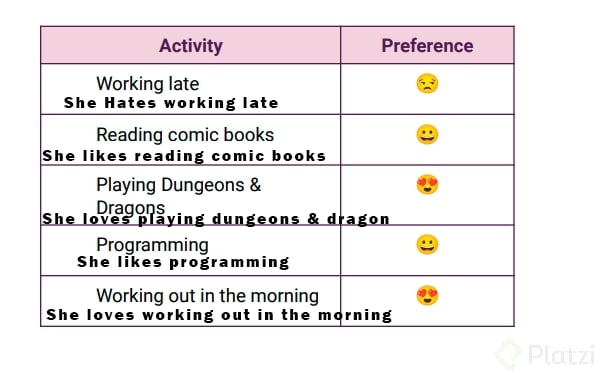
Practice Worksheet Instructions: Write 5 complete sentences about Naomi’s preferences using the information in the table:
Naomi hates working late.
Naomi likes reading comic books.
Naomi loves playin dungeons and dragons.
Naomi likes programing.
Naomi loves workig out in the morning.

Valeria Schembri
Hi! I´m Valeria and I like watching movies, I love going to the swimming pool and I hate cooking
Sarah Daniela Zafrani Lamoth
I like l love I hate

Mi Chu
I also hate going to the dentist 😅😅😅
Gina Pedraza
Profesor🫣🦷

Alberto José León Castelli
Why? It's very funny.

Carlos Emmanuel Córdoba
I like learning. I love running. I love listening music. I like cooking, but I hate washing dishes.
Gina Pedraza
Profesor*I like listening to music 🤓🎶
Sarah Daniela Zafrani Lamoth
I like music and dancing I love my pets and I hate hot weather summer to hot ; uwu

Martin Salomon
what is the difference between: i like reading and i like read??

Andres Felipe Cogollo Hincapie
I think that the reason is to be grammatically correct, when you use the first ver in present you should use the second ver with (-ing )

Paola Alapizco
Hi Martin. . Both examples mean the same, but the first sentence "I like reading" you mustn't use "to" after "like/love/hate" because the verb ends with -ing . . The second example "I like to read", needs the word "to" after "like/love/hate" because the verb is in its infinitive form. . I hope this comment will help to you.
Katheryn Alejandra Gomez Girón
I like to study📚 I like to listen to music 🎶. I don't like to read 📖 I don't like to cook.

Edwin Pérez
Hello Kateyn. Look at the structure noun+like+verb(ing) -> for your examples it could be: 1. I like studiying. 2. I like listening to music. 3. I don't like reading 4. I don't like cooking.

José Eduardo Juárez Cárdenas
And for this class… I don’t like to read books — I hate reading books I don’t like to cook — I hate cooking

Dante Gustavo Hurtado Arica
Holaaa, alguien por aquí? Veo puros comentarios de hace 4 años jajaja
Monica Marcela Mieles Montenegro
Tengo una inquietud. ¿Es lo mismo decir "I like solving jigsaw puzzles" que "I like to solve jigsaw puzzles"?

Jose Orozco
la misma duda tengo yo, en una clase ella especifica que para hobbies usemos "like to"

Leidy Vaneza Vicente Ccorimanya
I love this class. 🏛
I love waking up early.
She loves to play the guitar. 🎸🎸
I love reading. 📚📖
He likes to listen to music.
She likes to cook. 👩🏻🍳🍳
She hates cleaning her kitchen in the mornings. 🧹🧽
He hates riding the bus. 🚌🚌
Gina Pedraza
ProfesorGreat examples Leidy! ✅ ✅ ✅
Leidy Vaneza Vicente Ccorimanya

Maria Alejandra Rojas Eslava
I like doing exercise I love eating lasagna I hate studying with noise
Third Person
Hana likes reading novel books Hana loves playing with her pets Hana hate cooking on the weekends

Jacky Martinez
ooohhh I hate eating berejena
Rosario Elizabeth Castillo Santos
i like sleeping
i love watching kdramas
i hate cooking every day

Silvia Yojana Ajpacajá
Naomi hates working late. Naomi likes reading comics books. Naomi loves playing dangeons and dragons. Naomi likes programming. Naomi loves working in the morning.
Gina Pedraza
ProfesorGreat job Silvia!! 🤩
Elizabeth Romero
He Hastes eating Sushi. HE loves cokking onions and meat

Diego Herrera
So, is this the only way to express likes and dislikes? With the ing verbs?
Like saying "I like to eat apple" or "I love drink coffee" are both wrong?
thanks again.

Johsting Gabriel Ordóñez Mazurek
If you don't want to use the gerund "ing", you can use the auxiliary "to" before the verb, like: I love cooking pasta.
Lisgleydi Perez
Hi! I'm Lis. I love reading and I hate eating Spanish food. I like travelling. :)

Nicol Mejia
I like reading a book
she/he/it likes cold weather
I love watching series
she/he/it loves running at the park
I hate cooking
she/he/it hates going outside
Gina Pedraza
ProfesorGood examples Nicol!! 🤓✅