BCG Matrix: Where to Invest or Cut
Contenido del curso


Análisis competitivo

Investigación del usuario
Trabajo colaborativo






Tendencias y valor



Implementación y crecimiento



BCG Matrix: Where to Invest or Cut
Resumen
The BCG matrix helps you turn raw market research into clear strategic decisions about where your business stands and where it can grow. If you already know your customer and your category, this tool shows you which products to fund, which to milk, which to question, and which to cut.
What is the BCG matrix and why does it matter for your business?
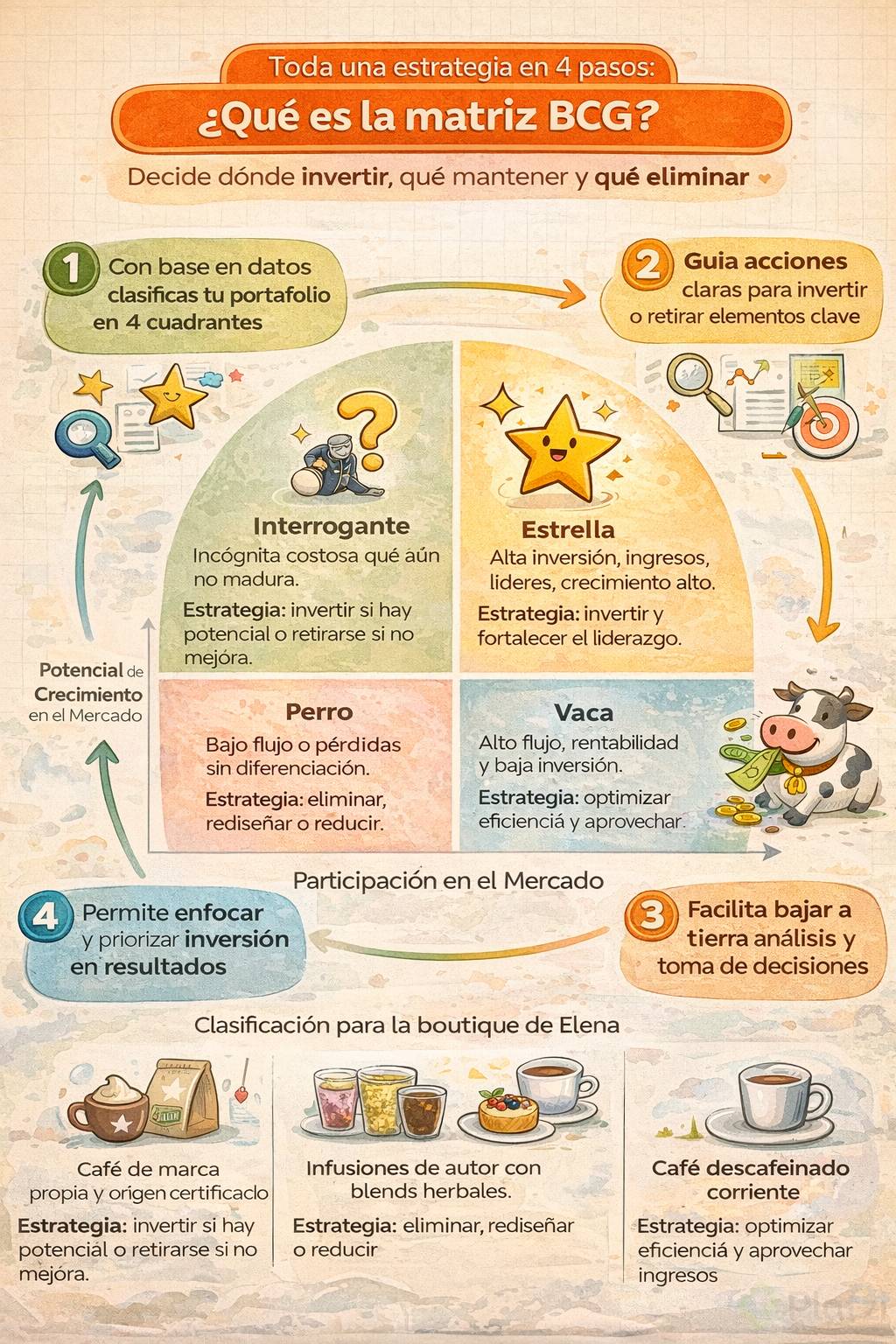
Think of it as a map. On the horizontal axis you plot market share, and on the vertical axis you plot growth potential. The crossing of those two lines creates four quadrants: stars, question marks, cows, and dogs. Each quadrant tells you a different story about your products or services.
Before you jump in, keep three things in mind. The matrix is not a fill-in-the-blank exercise; it needs solid prior research. It works better with your team than alone, because different perspectives sharpen the analysis. And whatever you conclude has to translate into real decisions, not stay locked in a document.
What is the BCG matrix? It is a strategic tool that classifies products into four categories based on market share and growth potential, helping you decide where to invest, hold, or cut.
How do you read each quadrant of the BCG matrix?
Each quadrant points to a different action. Here is how to interpret them.
Stars and question marks: where is your growth hiding?
Stars are the products that generate high revenue but also demand high investment to keep their leadership position. They make you look like the pioneer, the innovator, the brand setting the trend. The strategy here is simple: keep investing to protect that lead while the market matures around you.
Question marks are the trickier ones. They have the potential to become stars, but the market is still too young and uncertain. They drain resources and force you to ask, again and again, whether to push forward or let them die. Constant analysis is the only way to avoid burning cash on a bet that will not pay off.
Cows and dogs: what is really paying the bills?
Cows are the quiet heroes. They produce a steady cash flow with minimal investment, and that profitability is exactly what funds your stars and your question marks. The strategy is efficiency: squeeze the most out of them without overcomplicating things.
Dogs are the opposite. Low cash flow, sometimes losses, no competitive edge. They occupy space and energy without giving anything back. Your call here is binary: redesign them completely or remove them from the offer.
What is the difference between a star and a cash cow? Stars lead high-growth markets and need heavy investment. Cash cows dominate stable markets, generate steady profit, and require little reinvestment.
How would the BCG matrix look in a real coffee shop?
Let me walk you through Elena's boutique as a concrete example. It makes the framework click.
- Star: her private-label coffee with certified origin. It positions the boutique as the leader in the coffee break category and justifies ongoing investment.
- Question mark: the signature infusions, those artisanal or imported herbal blends. They differentiate the menu, but they are expensive and hard to maintain. Worth it? That depends on the next analysis.
- Cash cow: the daily combo, a hot drink paired with a seasonal pastry. Constant demand, predictable flow, and the financial engine that supports everything else.
- Dog: plain decaf coffee. Hard to source, low demand, no real differentiation. A clear candidate to cut from the menu.
Notice how each item maps to a different action. The star gets reinforcement, the question mark gets scrutiny, the cow gets optimized, and the dog gets removed. That is the whole point of the exercise.
How do you apply the BCG matrix to your own project?
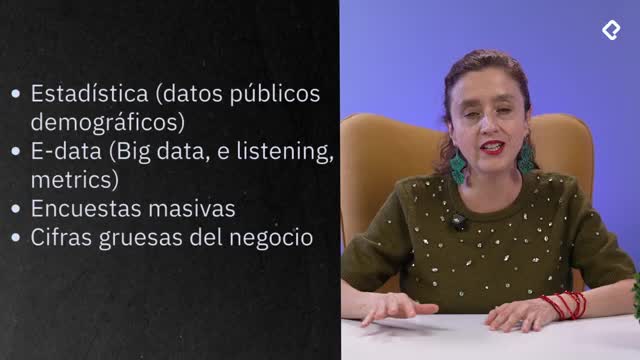
Start by listing every product, service, or business line you offer. Then gather the data you already have from your market research: sales volume, profit margin, growth rate of the category, and your share within it. Without that base, the matrix becomes guesswork.
Next, place each item in its quadrant with your team. Discuss the disagreements; they usually reveal where your assumptions are weak. Once the map is complete, define one clear action per quadrant: invest, evaluate, optimize, or eliminate.
How often should I update my BCG matrix? Review it whenever your market shifts or at least once per quarter, because positions change as products mature and competitors move.
And remember the warning: a matrix that does not lead to decisions is just a pretty grid. The value comes from acting on what you see.
Download the template from the class resources, run the exercise with your team, and drop your results in the comments. I want to see which quadrant surprised you the most.