
How to Run User Interviews That Reveal Insights
Contenido del curso

Análisis competitivo

Investigación del usuario
Trabajo colaborativo
Tendencias y valor
Implementación y crecimiento
How to Run User Interviews That Reveal Insights
Resumen
User interviews let you go deeper than any survey can. Once you have a first read of reality through quantitative data, interviews help you confirm insights, capture nuances and co-create ideas with the people you are designing for. This guide breaks down how to plan, run and analyze interviews that actually inform strategic decisions.
Why use interviews after running surveys?
Surveys give you a snapshot. Interviews give you the texture behind that snapshot, the small details that only appear when a real person is talking to you about their day-to-day.
They are useful when you need to:
- Confirm insights that surfaced in your quantitative data.
- Capture subtle details and contextual nuances.
- Co-create ideas directly with users.
- Approach a topic from multiple angles and stakeholders.
What is a user interview in product research? It is a guided conversation with a real user designed to uncover motivations, behaviors and context that surveys cannot reveal on their own.
How do you prepare a user interview that flows naturally?
Preparation is what separates a stiff Q&A from a real conversation. Before you sit down with anyone, get clear on what you want from that specific person and communicate it when you make first contact. A relaxed interviewee gives you better answers.
Some interviews need preproduction: researching the person beforehand or scouting the field where the conversation will happen, so nothing derails you on the day.
Then build a discussion guide, not a questionnaire. A list of topics you want to cover, phrased in everyday language, keeps the talk fluid. A rigid script makes it feel cardboard and kills the rapport.
A few practical moves that help:
- Start with simple, low-pressure questions to warm up the conversation.
- Move to deeper questions only after trust is built.
- Show up with an open, relaxed attitude; it sets the tone.
- Stay flexible. If the person drifts, improvise to bring the conversation back to your topics without cutting them off.
Why does documentation matter so much?
If you do not record it, you do not have it. Capture every interview in video, audio, photos, written notes or all of the above, so you can revisit responses during analysis and compare across participants.
What tools help you transcribe and analyze interviews?
When you plan to use AI to support your analysis, you first need clean transcripts of every conversation. Three tools that automate this step are Clipto, TurboScribe and ChatGPT (extracting the audio from your video file).
When you run the transcription, ask the tool for two specifications:
- A literal transcription, word by word, including pauses and filler words when context matters.
- Speaker identification, so you get person 1, person 2, person 3 clearly tagged.
Once you have the transcripts, NotebookLM can help you spot patterns. Do not hand over the full analysis to it. Use it to surface clues that you, as a human, develop into real insights.
Should I let AI analyze my interviews for me? No. Use it to find patterns and accelerate reading, but keep the interpretation in your hands so you do not lose the depth of the research.
Are synthetic users a reliable replacement for real interviews?
With generative AI on the rise, platforms trained on real user testimonials now let brands simulate conversations with target audiences. These are called synthetic users. Examples include Synthetic Users, Dev.ai and ChatGPT when you assign it a specific persona to roleplay.
They can be interesting as a complement, but leaning on them fully carries real risks:
- They are trained on data that rarely reflects Latin American realities, so local context gets distorted.
- We live in a changing environment that needs to be checked at the moment of your research, not through pretrained data.
- You accumulate cognitive debt: by delegating the work, you end up with gaps in your own understanding of the topic.
- You lose the nuances that only appear when you walk the street and talk to real humans.
What is a synthetic user? It is an AI-generated profile trained on real testimonials that simulates a target user, useful for early exploration but limited for capturing local and emotional nuance.
How can you apply interviews to a real business case?
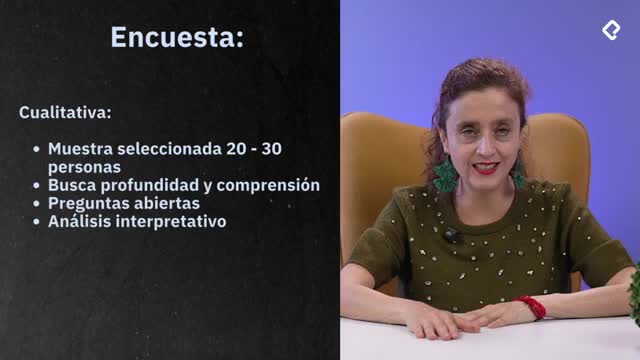
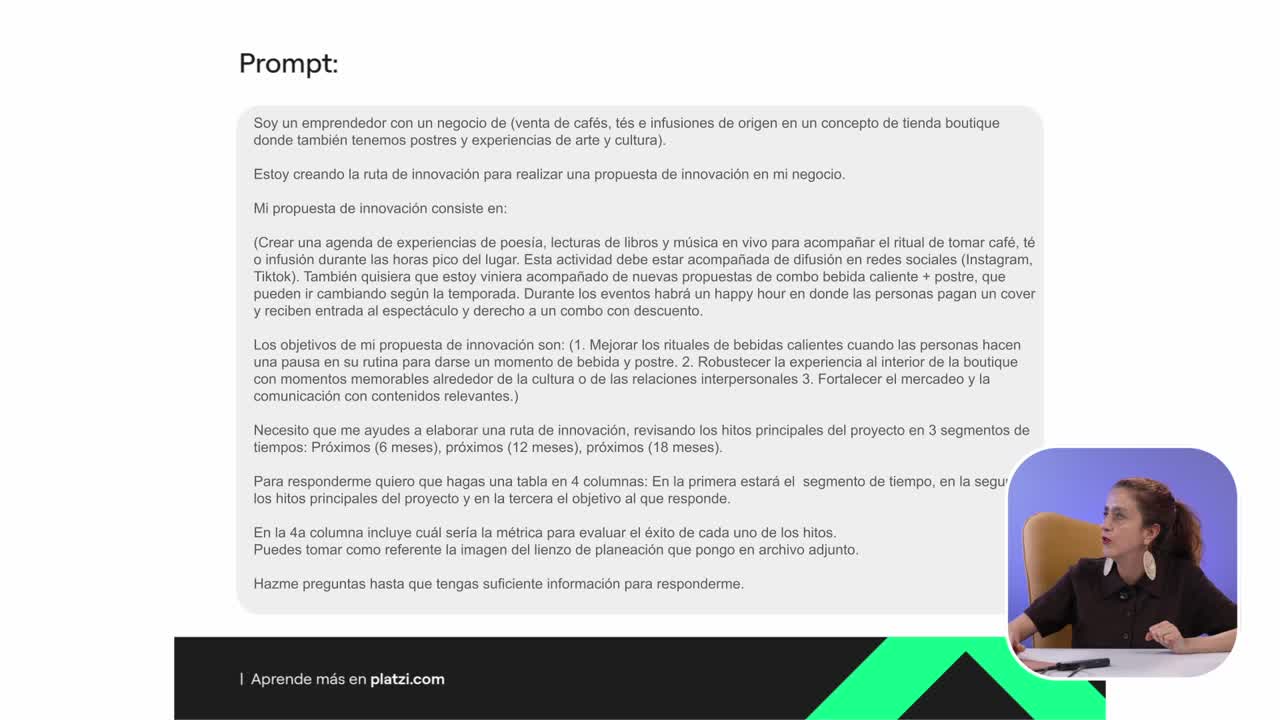
Take Elena's boutique as an example. To understand the ritual around hot beverages, you could interview around 20 students and dig into their daily habits. To explore service and customer treatment, you could talk to 10 young people with experience as waiters. And to map the production chain, you could sit with 10 coffee farmers and learn about their role and expectations toward the final consumer.
Each group gives you a different layer of the same business. That is the power of the method: interviews are a versatile tool to map the terrain where you are making strategic and innovation decisions.
Which populations would you interview to go deeper into your own business? Drop your answer in the comments.