What an Insight Really Is in Research
Contenido del curso
Análisis competitivo

Investigación del usuario
Trabajo colaborativo
Tendencias y valor

Implementación y crecimiento
What an Insight Really Is in Research
Resumen
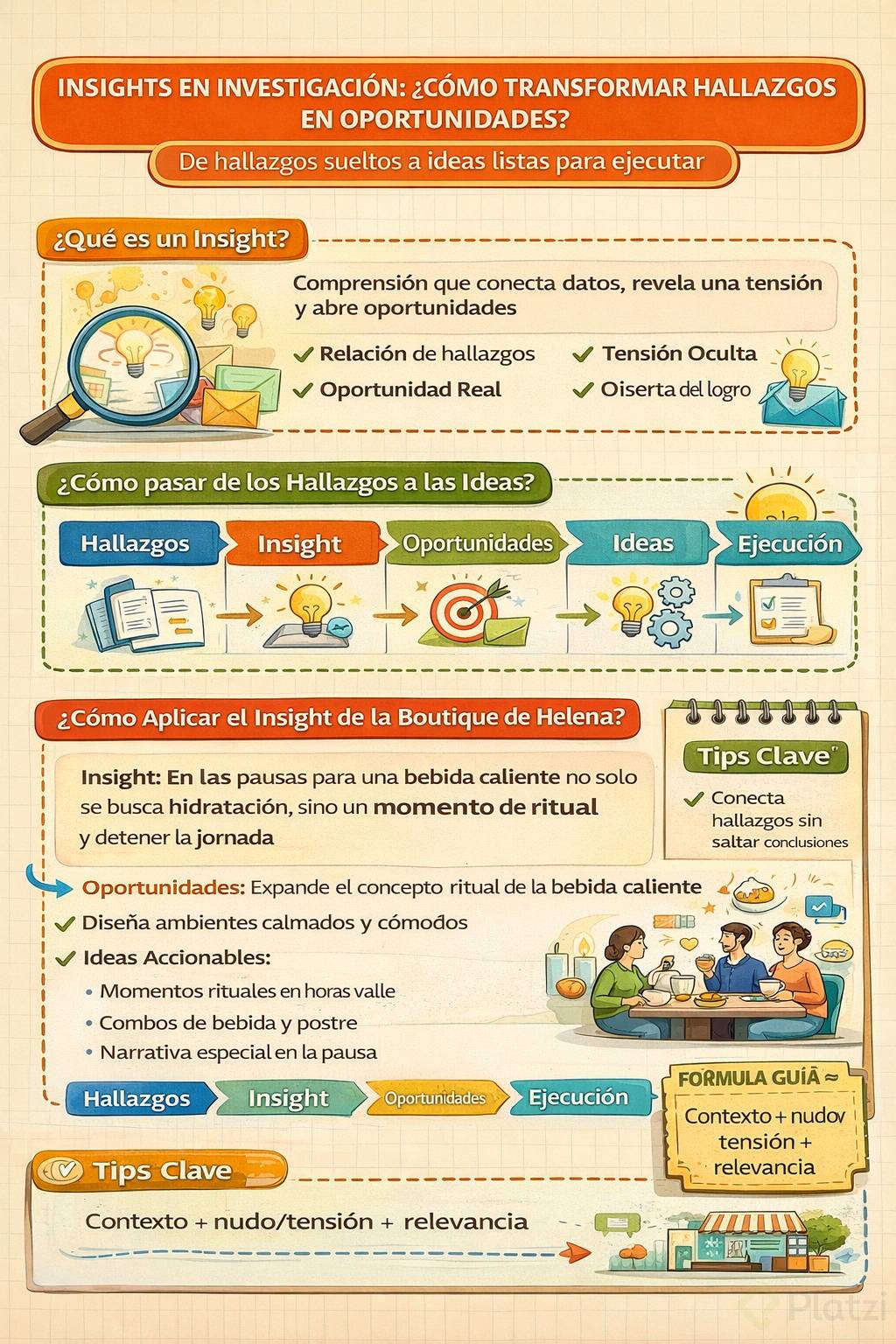
Understanding what an insight is changes the way you run research for your business. An insight is not a random finding; it is the deeper comprehension that connects multiple data points and reveals a hidden truth you can act on. If you are building a product, a service, or a brand strategy, learning to distinguish insights from raw observations is what turns research into smart decisions.
What is an insight in research and why does it matter?
An insight is the English term used to name that moment of comprehension when scattered data starts to make sense together. It goes beyond the obvious and helps you synthesize what you are discovering through qualitative and quantitative research.
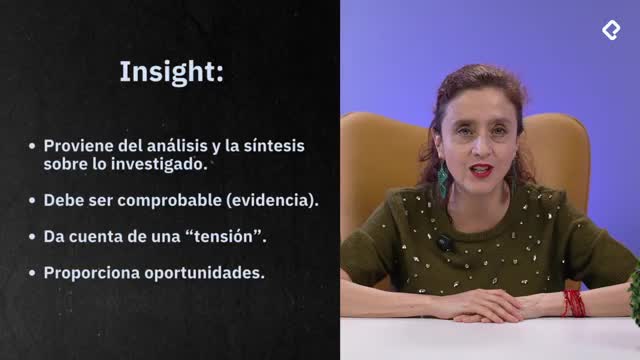
A real insight has four traits worth remembering:
- Goes beyond appearances and gives you the full picture of what you are studying.
- Is verifiable, meaning it must rely on real evidence captured during fieldwork, not on personal opinion.
- Reveals a tension, contradiction, or enigma inside the data.
- Opens opportunities and points toward where to act or innovate.
What is an insight in simple terms? It is a verifiable discovery that connects several findings, reveals a hidden tension, and shows you where to innovate. It is not a single data point, it is the meaning behind them.
Where can you discover insights for your business?
Insights can emerge from very different territories, and recognizing the field helps you frame your research questions better. You can find them inside your own business, in the market and its competitors, in the people you serve and how they live, think, feel and consume, or in the broader environment surrounding your category.
There is also a useful distinction between global and local insights. Global insights come from international or multisectoral signals, the more peripheral context that influences your category. Local insights come from the specific geography or category where your business operates. Both layers matter when you are deciding where to channel innovation.
How do I formulate an insight step by step?
Writing an insight is often the hardest part. A simple formula makes it easier and keeps you from jumping to conclusions. The structure has three components: context, elaboration of the tension, and relevance.
- Context: the broad frame where your discovery lives.
- Elaboration: the tension, correlation, hidden truth, or cause and effect that links your findings.
- Relevance: the impact this discovery has on the questions guiding your research.
How do you write an insight? Start with context, then express the tension or hidden truth that connects your findings, and close with why it matters. Three sentences are usually enough.
Example: applying the formula to Elena's boutique
Imagine you ran surveys and observations for a coffee boutique and gathered these findings:
- Hot drinks act as a pause in the day, not just nourishment.
- People prefer to drink them in company, with friends, a partner, a book, or a chat.
- They choose quiet places without loud music or heavy traffic.
- They want comfortable chairs, never stools or benches.
- They almost always pair the drink with something sweet.
These are loose findings. To turn them into an insight you connect the dots: In the pauses for a hot drink (context), people are not only looking for hydration but for a moment of ritual that holds the day together (tension), which is why the ambiance and the company become essential (relevance).
Notice how the insight reframes the data. You are no longer describing behaviors, you are explaining the meaning behind them.
How do insights become opportunities and ideas?
Once you have a solid insight, you can extract opportunities, which are the broad actionable paths it suggests. From those opportunities you finally generate ideas, the concrete executions you will launch.
For Elena's boutique, the insight points to two opportunities: expanding the ritual concept and designing the in-store experience, with care for decoration and ambiance. From there, a concrete idea emerges: create ritual moments during off-peak hours, with combo promotions that pair a drink and a dessert, wrapped in a small narrative or message for the customer.
Why you should not skip from finding to idea
The sequence matters: findings, insight, opportunity, idea. Each step filters and sharpens the previous one.
- Findings are the raw, scattered observations from your research.
- The insight synthesizes and correlates them into one comprehension.
- Opportunities translate that comprehension into broad action paths.
- Ideas are the specific executions you will take to market.
When you skip steps and jump straight to the idea, you risk building something that looks creative but is not grounded in evidence. Going from the general to the particular is what makes your innovation defensible and aligned with what people actually need.
If you are about to design your next survey or interview, pause first and ask yourself: am I collecting findings, or am I ready to articulate an insight? Share in the comments how you are using this framework in your own research.