Co-creating Ideas With Real Users
Contenido del curso
Análisis competitivo
Investigación del usuario
Trabajo colaborativo
Tendencias y valor
Implementación y crecimiento
Co-creating Ideas With Real Users
Resumen
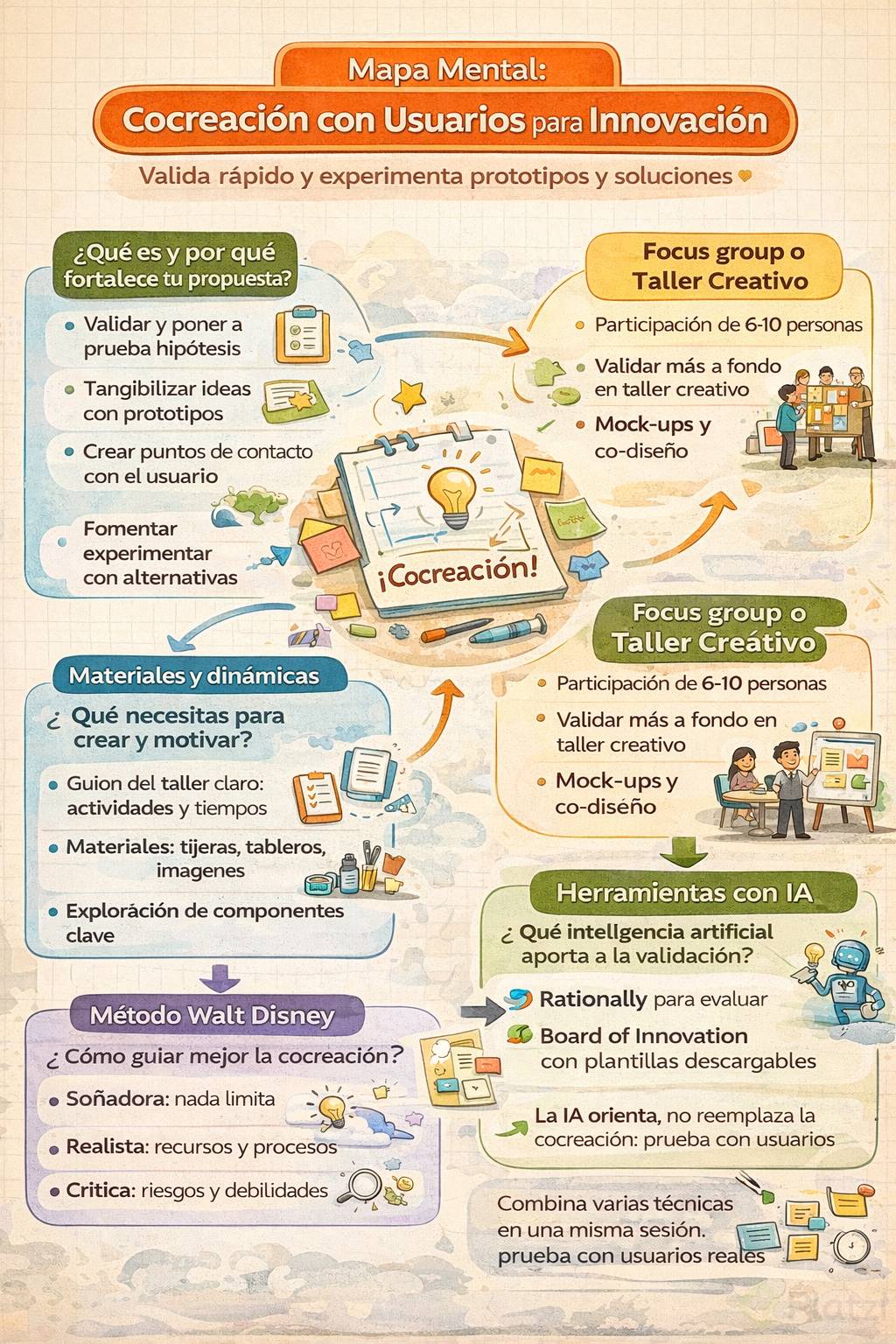
Co-creating with your user is the moment when an idea stops being a guess and starts becoming a real proposal. If you already have market research and a first read on your audience, co-creation is how you validate, stress-test and enrich your innovation before investing more resources. It matters for entrepreneurs, product designers and brand teams who want ideas that actually resonate.
In the next sections you will see why co-creation works, how to run it as a creative workshop instead of a flat focus group, and which AI tools can give you a first sanity check.
Why does co-creating with your user matter?
Co-creation is the bridge between your idea in your head and a tangible proposal you can show, touch and improve. It pulls the user closer so you can hear what they think, what they feel, and let them become part of the authorship of what you are building.
There are four reasons this stage is non-negotiable:
- You validate and robustecer your proposal with real input.
- You start prototyping, turning the idea into something tangible even in low resolution.
- You create touchpoints with the user and bring them into the process.
- You give yourself permission to experiment with ideas that feel too playful for executive meetings.
What does prototyping mean in co-creation? It means moving your idea from imagination to a tangible version, even if it is low fidelity or cheap. The goal is to make it real enough to test.
How do I run a co-creation session that actually works?
The traditional path is the focus group: six to ten people in a guided conversation around a topic the company wants to validate. It works, but if you want to squeeze real juice out of the experience, go for a workshop format instead.
A creative workshop lets you build brand or innovation concepts together, hand people the tools to feel free and propositive, and break your proposal into all its facets instead of asking one flat question. You can also test mockups, those first graphic, visual or aesthetic prototypes, and invite the user to play with them.
What would a co-creation example look like?
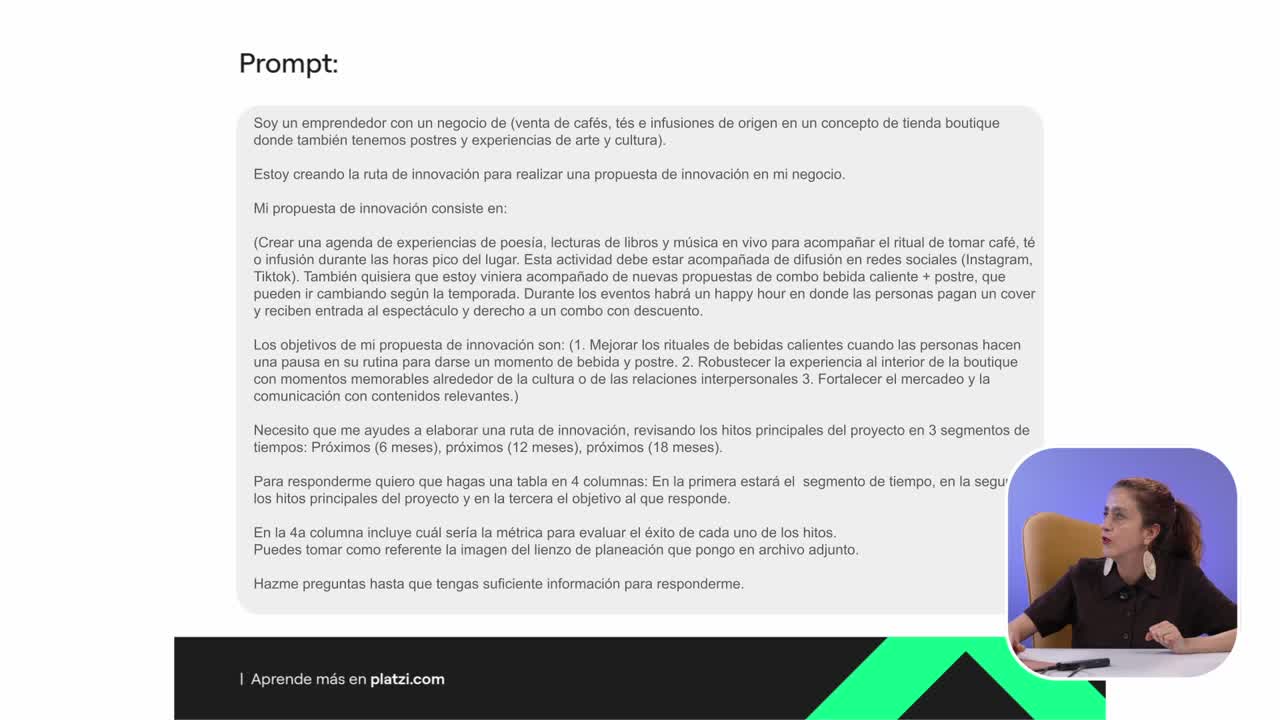
Think about Elena's boutique café. Imagine gathering a group of students and co-creating the dessert and drink combo together: which flavors, how it should be presented, whether it changes daily, whether it follows seasons like spring, Halloween or Christmas. The ideas no longer come only from your creative team, they come from the consumer who will later connect with the proposal.
What should I prepare before the workshop?
Before running the session, get crystal clear on what will happen during the experience so you can plan materials in advance. Scissors, cutouts, cards, boards, images: whatever helps people feel creative in the moment and contribute real value to your proposal.
Which tools and methods can I combine for co-creation?
A single dynamic is rarely enough. The recommendation is to mix methodologies so the workshop feels complete and rich. Neuronilla is a useful library of techniques you can adapt depending on your business case and your specific objective, because the right tool depends on the outcome you need.
One example is the Walt Disney method, which walks users through three phases: dreamer, realist and critic. In the boutique café case, this method helps evaluate the rituals and experiences proposed inside the café, and pushes participants to enrich the idea with their own contributions.
What is the Walt Disney method in co-creation? It is a technique that guides users through dreamer, realist and critic phases so they evaluate an idea from three angles and add ideas to strengthen it.
How can AI tools support co-creation?
With the rise of generative AI, some tools help you do a first validation before sitting down with real users. They are not a replacement, they are a warm-up.
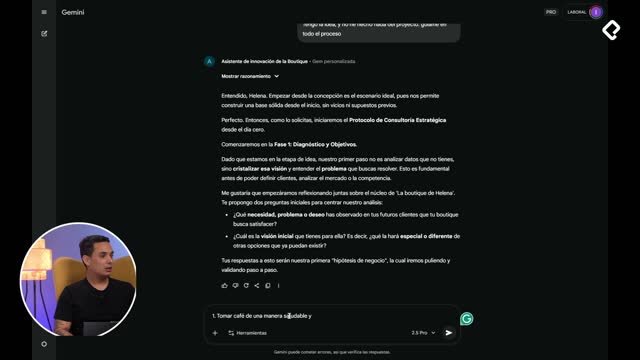
- Rational: you log in, write your idea in the I decide to field, and it returns recommendations, pros and cons. In the boutique café example, it suggested investigating the market and building a sustainable model, listed pros like appeal for students and differentiation, and flagged cons like high costs, dependency on student traffic and competition.
- Board of Innovation: a platform with many downloadable and AI-powered tools for creative and innovation processes. Options like The Future Scenario let you work directly on the platform using the information you already have about your business.
Can I replace user co-creation with AI? No. AI gives you a first read on pros and cons, but the value comes from co-creating with real people who will actually use your product.
Pick two tools from Neuronilla, think about them in the context of your project, and tell me in the comments which ones caught your attention and how you would apply them.