Build Your Innovation Roadmap With AI
Contenido del curso
Análisis competitivo
Investigación del usuario
Trabajo colaborativo
Tendencias y valor
Implementación y crecimiento
Build Your Innovation Roadmap With AI
Resumen
Turning a business idea into something real takes more than enthusiasm. You need an innovation roadmap: a structured plan that connects tasks, timelines, costs, and metrics so you can tell whether your project is moving in the right direction or needs adjustments. And yes, you can build it faster with AI.
What is an innovation roadmap and why does it matter?
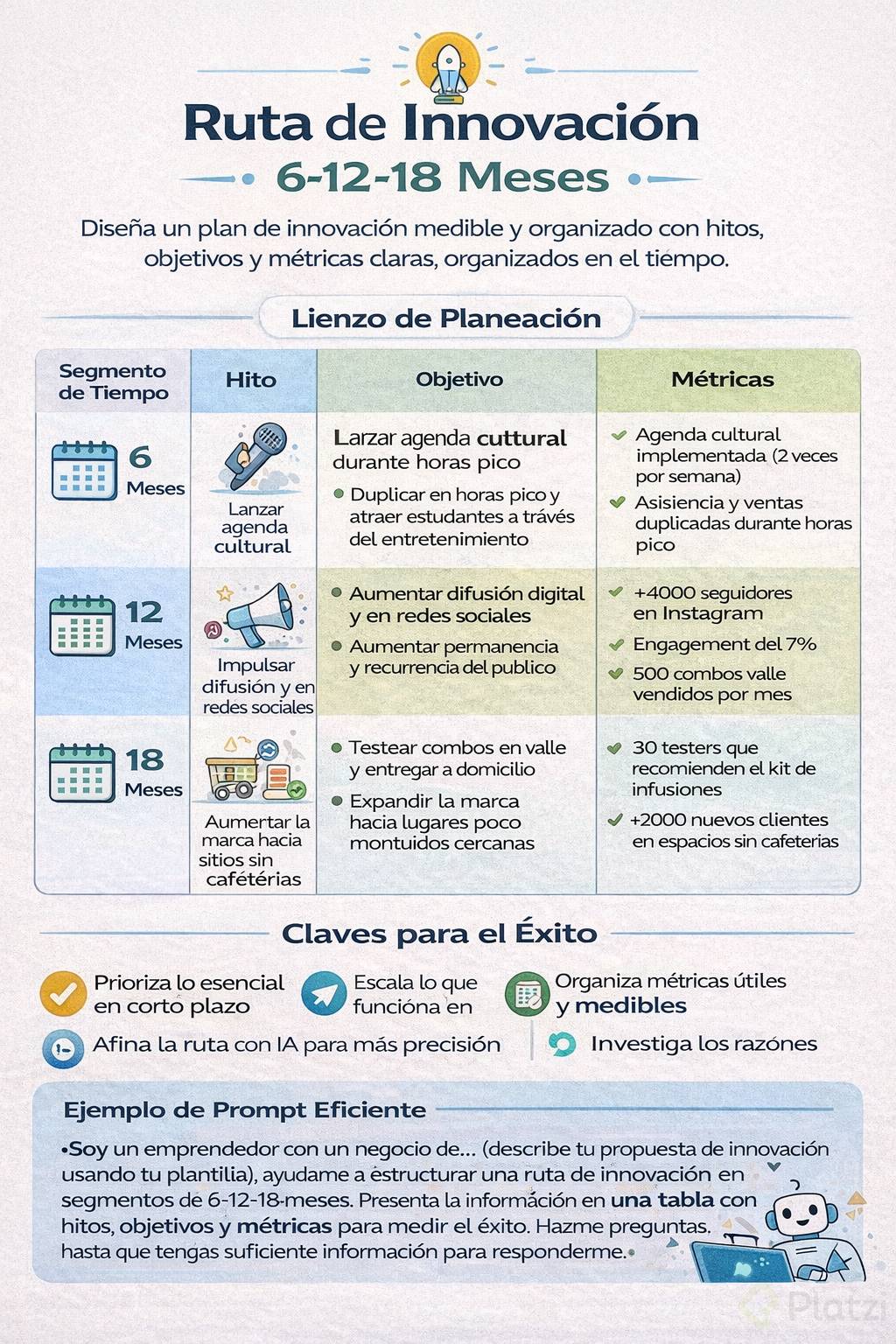
An innovation roadmap is the bridge between your value proposition and execution. It maps milestones across time segments, ties each one to an objective, and assigns metrics that tell you if you are on track.
What is an innovation roadmap? It is a time based plan that organizes the milestones, objectives, and success metrics of an innovation project so you can execute it step by step instead of leaving it as an idea.
The roadmap forces you to be honest about three things: how long each task will take, what it will cost, and how you will measure progress. Without metrics, you cannot iterate. And without iteration, innovation stalls.
How do I write a prompt to generate my innovation roadmap?
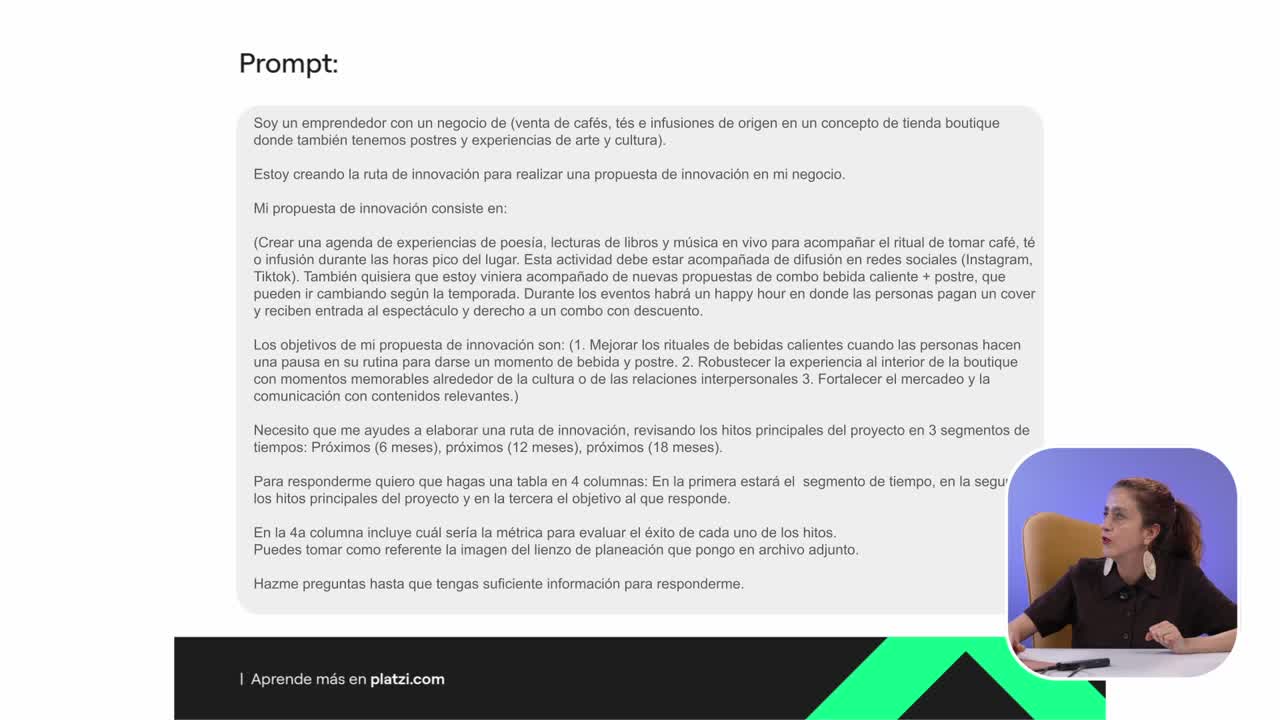
The approach shown in class uses a structured prompt you can copy from the class resources and adapt to your own project. The trick is layering context, objective, and task so the AI returns something usable [01:08].
The prompt has four parts:
- Context. Describe who you are and what your business does. Example: I am an entrepreneur with a business of...
- Innovation proposal. Paste the value proposition you defined in your previous canvas, including specific actions like social media campaigns, combos, or happy hour.
- Objectives. List what you want the proposal to achieve. In the boutique example: improve hot drink rituals, strengthen the in store experience, create memorable moments, and reinforce marketing with relevant content.
- Task. Ask for a roadmap broken into time segments. The example uses 6, 12, and 18 months, but you can adjust to quarters or years depending on your project.
Why ask the AI to make you questions?
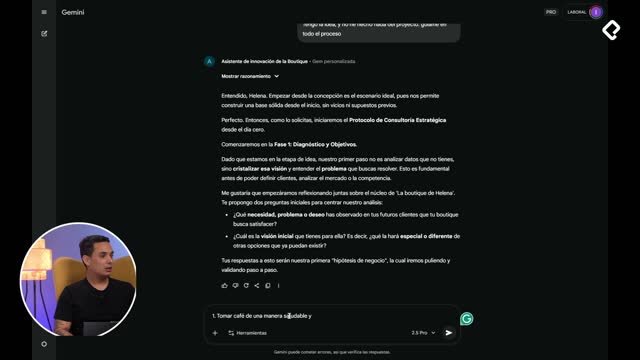
Closing the prompt with ask me questions until you have enough information to answer me is what makes the output sharp. The AI runs a sweep across every component of your proposal and exposes anything you have not defined yet [05:30].
In the boutique example, the AI asked about event frequency, artist sourcing, content style on Instagram, number of combos per season, venue capacity, expected sales increase, and budget range. Each answer tightened the proposal:
- Events twice a week, Thursday and Friday.
- Maximum capacity of 40 people per event.
- Goal of doubling sales during peak hours.
- Two combos per season to keep logistics manageable.
- Launch in two months to allow proper preparation.
What should the roadmap table include?
The output should be a table with four columns. This structure is what turns a vague plan into something you can actually manage.
- Time segment. Short, medium, and long term blocks (6, 12, 18 months).
- Main milestones. The concrete steps you need to hit in that period.
- Linked objective. Which goal each milestone supports, so nothing floats without purpose.
- Success metrics. The numbers or signals that tell you if the milestone worked.
Why include metrics in an innovation roadmap? Because metrics are the only way to know if you should keep going, iterate, or change direction. Without them, you are guessing.
The fourth column is where most plans fail. Many founders set ambitious objectives but never define how to evaluate them. Asking the AI to propose metrics gives you a starting baseline you can refine later.
How do I attach my canvas to enrich the response?
In the class, the canvas from the previous lesson is uploaded as an image so the AI has the full picture. You can write something like you can take as reference the planning canvas in the attached file [03:55]. This makes the response more aligned with your real proposal instead of generic advice.
You can run the prompt in ChatGPT, Gemini, Copilot, or Claude. The logic is the same across platforms.
How do I use the roadmap once I have it?
The roadmap is not a static document. It is a working tool that helps you:
- Schedule resources across the next 6, 12, and 18 months.
- Detect when a milestone is slipping before it becomes a crisis.
- Decide what to iterate based on metric performance.
- Communicate progress with partners, investors, or your team.
Think of it as the operating system of your innovation project. The fantasy becomes a checklist, and the checklist becomes traction.
If you already have your value proposition canvas ready, this is the moment to translate it into a timeline. Share in the comments which time segments you chose for your roadmap and which metrics you are tracking first.