
AI as Your Assistant, Not Your Replacement

Resumen

Information overload is real, and your attention has limits. That is exactly why artificial intelligence tools work best when you treat them as an assistant, not as a replacement or a passing trend. Used well, AI helps you recover energy, focus, and time so you can concentrate on what only you can do.

Why should you think of AI as an assistant and not a replacement?

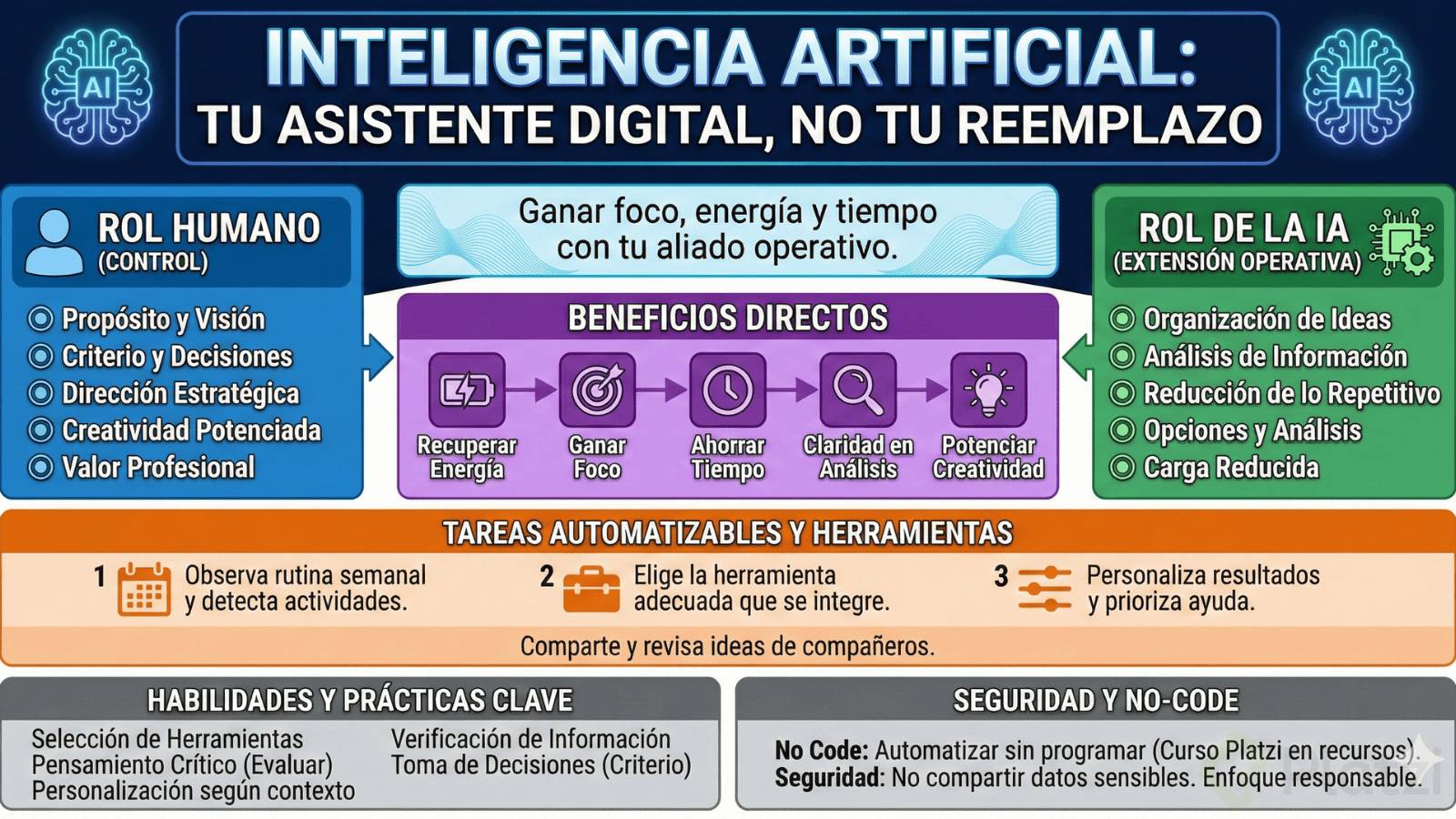
The goal is not to let AI work for you, but with you. It accompanies you to reduce mental load, analyze information faster, and optimize how you spend your energy during the day.

Think of it as a digital assistant that helps you think faster and organize ideas, while leaving room for your creativity, your decisions, and your judgment. Instead of feeling overwhelmed by technology, you start using it as an ally that frees up time and amplifies your professional value.

What does it mean to use AI as an extension of yourself? It means AI handles the operational and repetitive tasks, while you keep control of the direction and the purpose behind what you do.

How do you actually learn to use artificial intelligence well?

Real productivity does not come from collecting tools. It comes from picking the ones that truly fit your workflow. You do not need to master every platform on the market; you need to choose the one that integrates with your day to day.

Your criterion, your decisions, and your vision remain the most important element in the process. AI can hand you options, but you are the one who decides which path to take.

What habits should you keep when working with AI?

A few principles protect both the quality of your work and your data:

  • Keep your critical thinking active and question the outputs.
  • Verify the information before using it in a real decision.
  • Personalize the results so they actually match your context.
  • Avoid sharing sensitive or confidential data with the tools.

AI is powerful, but you set the course. That balance between automation and judgment is where productivity actually grows.

What tasks in your week can you automate with AI?

This is the question worth sitting with. Look at your current routine and identify the repetitive, operational, or time consuming tasks that drain your focus before you even reach the important work.

How do I know if a task is a good candidate for AI? If it is repetitive, rule based, or eats time without requiring your unique judgment, it is probably a good candidate to automate or simplify.

Once you spot those tasks, ask yourself which tools you need to implement to handle them. Share your answers in the comments and read what your classmates are doing. Together you can build a practical bank of ideas, real examples, and strategies that others can test in their own work or personal life.

Where do no-code tools fit into this picture?

If you want to integrate technology without writing a single line of code, no-code tools are the next step. They let you automate processes, connect platforms, and build custom solutions visually.

You can keep exploring them in the Platzi course linked in the resources section of the class. That is where the operational side of your work starts becoming lighter, and your creative side gets more room to breathe.