
The Bullet Journal method is a flexible system that helps you organize tasks, goals, and reflections in a single place, blending structure with creative freedom. If you struggle with scattered notes and missed priorities, this approach gives you clarity, focus, and a clear view of your progress, no matter how chaotic your week feels.
What is the Bullet Journal method and why does it work?
The beauty of this system lies in its simplicity. You don't need to be a hyper organized person to use it; you only need a few well designed sections to bring together your goals, pending tasks, reflections, and learnings.
It works because it combines two things most planners miss: a clear structure to track what you do, and the freedom to reflect on how you do it. That mix turns a notebook into a personal productivity hub.
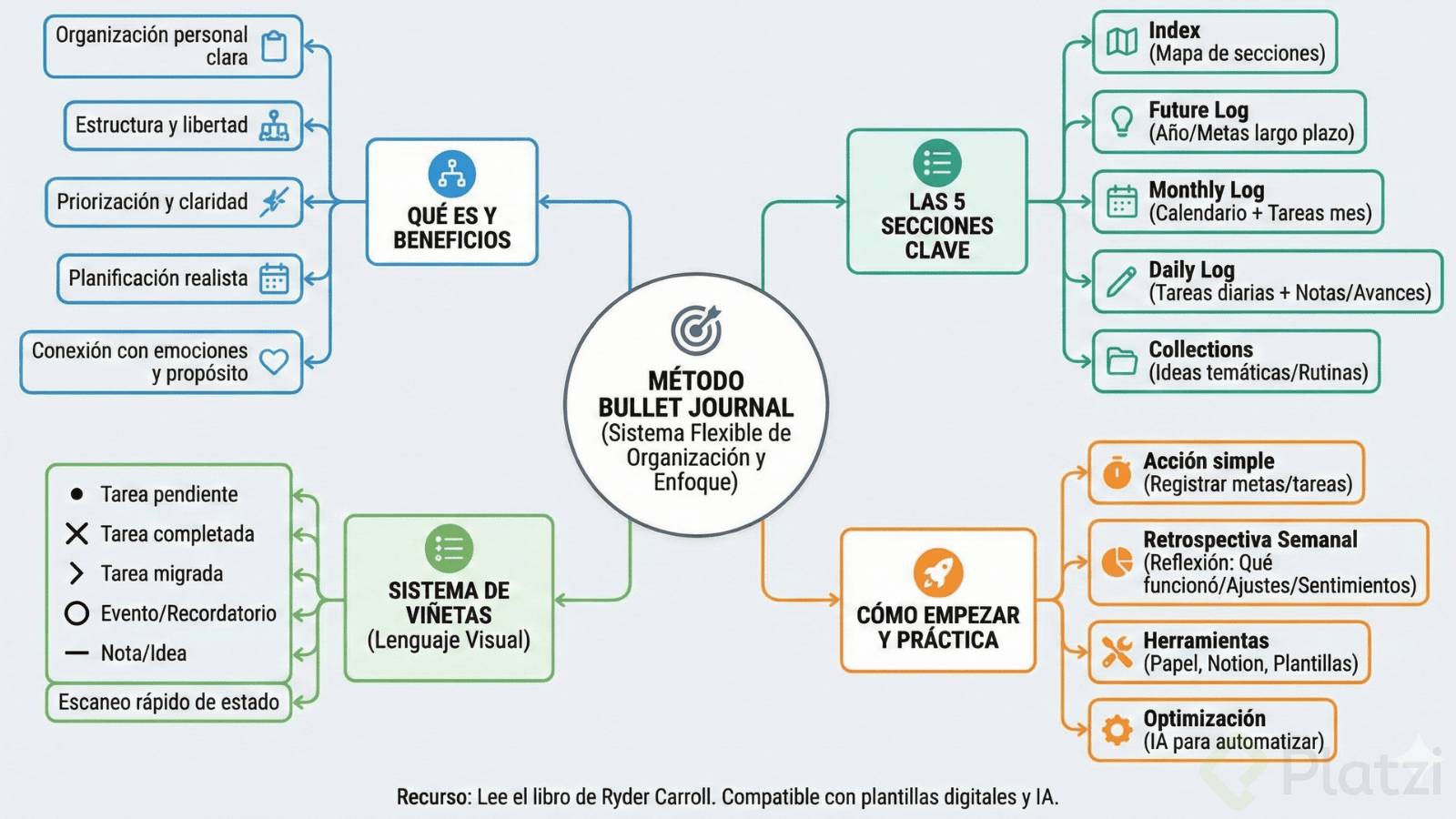
What is a Bullet Journal in simple terms? It's a customizable journaling system that mixes a planner, a to do list, and a diary. You use short bullets and symbols to log tasks, events, and notes in one place.
Which are the 5 key sections of a Bullet Journal?
The system is built on five core sections that you can adapt to your style, whether you prefer paper, Notion, or digital templates that automate the process.
- Index: the map of your journal, where you register the important sections so you can find them fast.
- Future log: a general view of the year or upcoming months, ideal for long term goals, key dates, and milestones.
- Monthly log: a monthly view that mixes calendar and task list, helping you plan realistically.
- Daily log: your daily list of tasks, notes, and reminders, where you capture what happens and your progress.
- Collections: thematic sections to group ideas, learnings, readings, routines, or habits.
Each section can be as minimal or as detailed as you want. The point is to have one place where your life and work coexist without friction.
How do bullet symbols track task status?
A distinctive feature of this method are the bullets, simple symbols that show the status of each item at a glance. You add them depending on where the task stands.
- A dot means a pending task.
- A cross or check means a completed task.
- An arrow means a task you'll migrate to another day or section.
- A circle means an event or reminder.
- A dash means a note or idea.
Over time this visual language becomes your second productivity language. You scan a page in seconds and know exactly where each task stands, without rereading anything.
How does Bullet Journal help with time management?
Here is where the method goes beyond a simple planner. It doesn't only organize what you do, it pushes you to reflect on how you do it, which is the real lever for managing your time better.
You can add sections for gratitude, healthy habits, or weekly learnings. These small additions turn your journal into a mirror of your week, not just a checklist. And if you want to push it further, you can combine your Bullet Journal with artificial intelligence tools to automate parts of the process.
Do I need to be artistic to use a Bullet Journal? No. The original method created by Ryder Carroll is minimalist. Plain bullets, short lines, and clear sections are enough to get all the benefits.
What practical exercise can you do this week?
Download the Mi Bullet Journal template from the class resources and build your own version, digital or manual. Use it for one week with a clear intention.
- Register your goals for the week in the future or monthly log.
- Track your daily tasks and learnings using the bullet symbols.
- Run a short retrospective at the end of the week.
During that retrospective, ask yourself three questions: what worked, what could I adjust, and how did I feel using this system? Those answers are what transform a notebook into a productivity practice.
For a deeper dive, the book by Ryder Carroll, creator of the method, is the reference source and a great companion to the practical guide in the resources section.
Why does having a system give you power over your time?
Having a system like the Bullet Journal lets you see your progress, and seeing progress changes how you decide. It gives you the power to choose, to prioritize, and to live with a clear sense of where you are heading.
That's the shift: you stop reacting to your days and start designing them. Tell me in the comments which of the five sections you'll try first, and how you plan to adapt it to your own week.