How AI Is Reshaping Go-To-Market Roles

Resumen

Acquiring customers is one of the toughest questions any company faces, and the answer lives inside your go-to-market strategy. With AI reshaping how small teams scale fast, your role as a marketer, founder or operator is shifting too. Here is what you need to rethink about channels, segments and skills to stay relevant.

Why is go-to-market changing with AI?

The go-to-market team defines which segments to target, which channels to use and how to win them. And right now, that playbook is being rewritten.

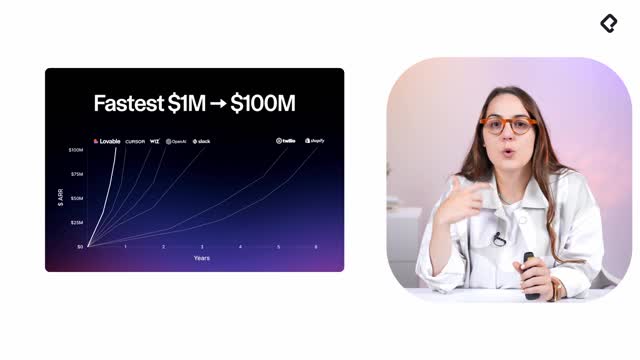
Look at Lovable, the tool used throughout this course to build interactive products. They broke a record going from 1 million to 100 million in annual recurring revenue faster than Cursor, OpenAI or Shopify, with just 35 people in 8 months [02:00]. Social channels and AI tooling made distribution less painful, but the real lesson is that teams and roles are getting smaller, faster and more leveraged.

Not every company will be Lovable. The takeaway is simpler: your go-to-market role and your team structure need to evolve.

What is a go-to-market strategy? It is the plan that defines which customer segments you target, which channels you use to reach them, and how your product, pricing and team work together to win those customers.

What 5 questions define your go-to-market strategy?

Before picking tactics, you need to answer five questions that frame every decision downstream [02:45].

  1. Motion. Decide if you grow through a product-led, marketing-led or sales-led engine.
  2. Business model. Clarify whether you are SaaS, e-commerce, fintech or something else, because that shapes how you monetize.
  3. Objective. Define your success criteria for each channel you choose.
  4. Vitamin or painkiller. Understand if your product is a nice-to-have or a critical fix.
  5. Effort. Weigh how costly and sustainable each channel is for your team.

The vitamin vs painkiller distinction matters more than people think. A vitamin improves a workflow or productivity but is not essential, which makes acquisition harder. A painkiller solves something urgent, and customers come looking for you.

Effort works the same way. Maybe your founder shines on LinkedIn and content is cheap to produce, but paid ads demand budget you do not have. Balance the effort against the return before you commit a channel as a core bet.

Vitamin or painkiller, what is the difference in B2B? A vitamin makes a process nicer but skippable. A painkiller solves a problem so urgent the customer is already searching for a solution.

How are marketing roles evolving with AI?

Emily, founder of MKT1 and former marketing lead at companies like Asana, has mapped how AI is reshaping marketing roles [05:30]. Three forces explain the shift.

  • Differentiation is harder because anyone can produce content fast.
  • Work is now a mix of people and AI, not just people.
  • Acquisition channels are saturating, making ROI harder to predict.

The consequence is clear: you need new skills and more flexibility. From this shift emerges what Emily calls the gen marketer, a profile that works with both a team of people and a stack of tools and agents to ship results.

What is a gen marketer and how is it different from a T-shape marketer?

The classic T-shape marketer had broad general knowledge plus deep expertise in one vertical. The M-shape version added a second specialty. The gen marketer keeps one or two deep specialties but operates across multiple fronts at once [07:10].

In practice, you might wear three hats:

  • Campaign manager, executing across channels and owning both the creative and the distribution.
  • Product marketer, connecting product, competitive insights and users while leading product launches.
  • AI expert, not as a machine learning engineer, but as someone who understands AI flows, builds and manages agents, and closes knowledge gaps.

The non-negotiable underneath all this: you have to keep learning, and you have to learn faster than before because everything moves faster.

What does the new marketing team structure look like?

The traditional org chart had three specialists reporting up, plus agencies or freelancers for specific tasks. The new structure looks different [08:45].

Now you have a head of marketing, then gen marketers acting as generalists with deep pockets of expertise, and underneath them a mix of full-time specialists and AI agents. The gen marketer orchestrates because they understand both the general context and the specific execution.

This is not exclusive to go-to-market. The same logic is hitting product, engineering and operations. Smaller teams with better leverage are becoming the default.

If you are in a go-to-market role, ask yourself how it is transforming and which gaps you want to close first. If you are not, the question is the same: how is your role shifting, and which skills will you build next? Tell us in the comments.