How to Read Retention Curves and Cohorts

Resumen

Reading a retention dashboard well is what separates a founder who reacts from one who decides with data. Here you'll learn how to interpret retention curves, cohort tables, engagement and churn in a subscription model, and how to turn each metric into a concrete action for your growth strategy.

What does the retention dashboard actually show you?

Before jumping into curves, you need a clear baseline: how many customers you have today versus the previous period, both in count and in monetary value.

That double reading matters because you can lose more customers than you acquire and still look stable in revenue, or the opposite. The MRR, your monthly recurring revenue, tells you the financial side of that story.

What is MRR? It's the recurring monthly revenue from your active subscriptions. If you have 100 customers paying $10 a month, your MRR is $1,000.

How do I read a cohort table step by step?

A cohort groups customers by the month you acquired them and follows what percentage stays active month after month. It's the cleanest way to see if your product retains.

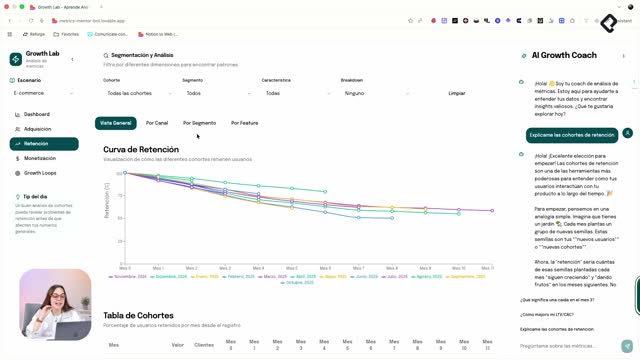
Imagine that in June 2025 you acquired 580 customers. By month four, 77% were still subscribed, which means you lost 23% in that window [01:54]. You can run the same cohort in number of customers or in monetary value, and both views answer different questions.

  • The customer view tells you about product fit and habit.
  • The monetary view tells you about revenue health and plan mix.
  • Comparing both reveals if churned customers were high or low value.

From there, the cohort becomes the foundation for everything else.

Why does the retention curve flatten over time?

Retention curves usually drop fast in the first months and then start to flatten. That flattening is the signal you're waiting for.

In the example shown, the curve stabilizes around month eight [02:30], which means the users who survive past that point tend to stay. That stable base is what lets you estimate your lifetime value, the total revenue an average customer generates while they stay with you.

Why does LTV matter against CAC? Because if your customer acquisition cost is higher than your lifetime value, your acquisition strategy isn't profitable. LTV has to clearly beat CAC.

And if you get stuck reading these numbers, you have two tools at hand: a growth coach inside the dashboard that explains any metric and analyzes your case [00:11], and the option to build your own coach in low code, feeding it your business context, as you saw in the prototyping class.

How do I measure engagement to predict who will stay?

Engagement is the early warning system of retention. It tells you if a user is forming a habit or drifting away before they actually cancel.

The core metrics are daily, weekly and monthly active users. Tracking them together shows you whether usage is growing, stabilizing or eroding, and that pattern usually arrives before the churn does.

Why should I segment retention by channel and plan?

The total number gives you a pattern, but segmentation gives you actionables. Without breaking the data down, you can't find what to optimize.

In the example, when retention is split by acquisition channel, referrals retain better than paid across every cohort, and organic sits above paid as well. That makes sense: a referred user arrives more qualified than one acquired through ads.

  • Segment by channel to compare referrals, organic and paid.
  • Segment by plan to compare enterprise, premium and premium plus.
  • Segment by behavior to find users who never built the habit.

Each cut opens a different conversation about where to invest.

How does churn connect with MRR and predictive risk?

Churn measures how many customers are leaving and how much MRR you lose with them. It's the mirror image of retention, and it has to be read together with it.

The most useful layer is predictive: identifying users who haven't logged in, haven't built a habit and are statistically at risk of canceling. With that list, you can design something concrete, like a win back campaign for the 670 inactive users flagged in the dashboard [05:10], instead of waiting for the cancellation to happen.

What's the difference between churn and retention? Retention is the percentage of customers who stay in a period; churn is the percentage who leave. They always add up to 100%.

Everything here assumes a subscription model, but the logic adapts to other growth models. Use your real data if you have it, or simulate it like in the example, and run the intellectual exercise of deciding what you would do with each insight. Share your version in the comments so we can compare models and learn from each other's numbers.