Ideas and opportunities are infinite, but your team's energy, budget, and time are not. That's why learning to prioritize growth experiments using ICE and RICE frameworks decides which bets actually move the needle and which ones drain resources without a real return.
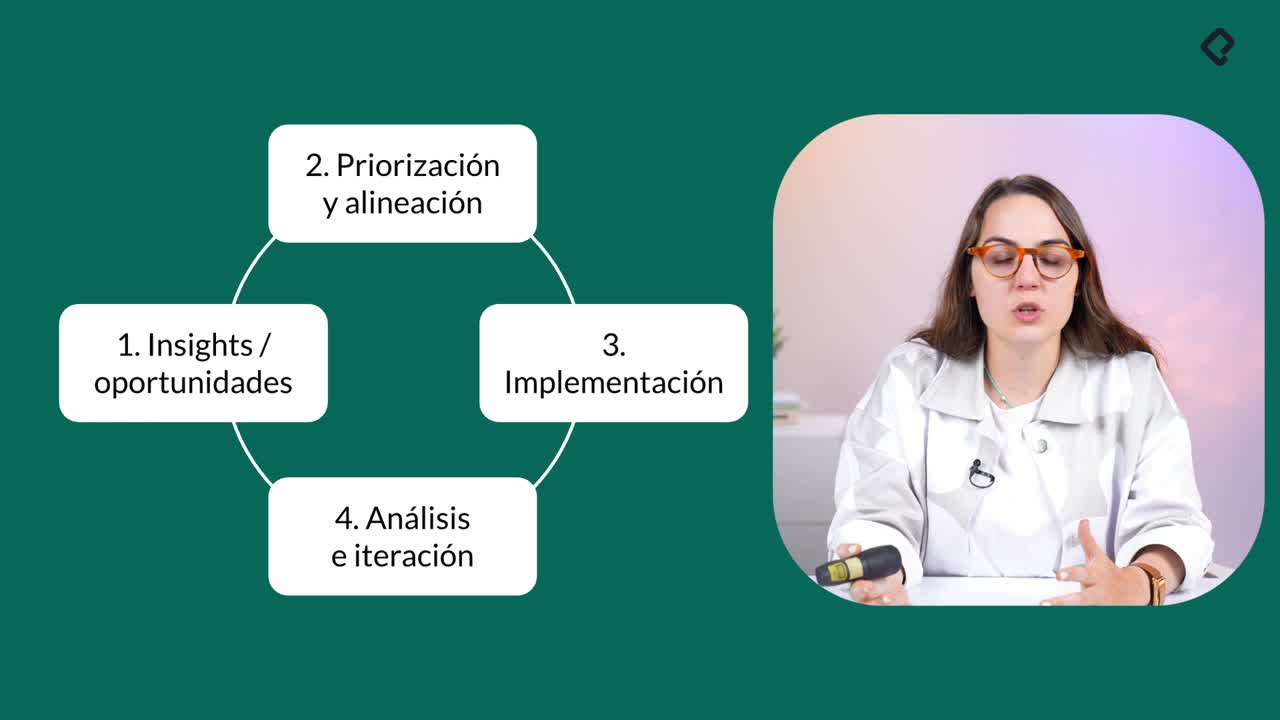
Think of growth as a system that never stops spinning: you collect insights, spot opportunities, align with your team on what deserves attention, ship the idea, and then measure what happened against the metric you wanted to impact. From there you decide whether to iterate or document the learning and walk away. The loop repeats. Forever.
Why does prioritization define the success of a growth team?
Documenting every step of that cycle is what turns scattered tests into a real knowledge base. You can even feed that documentation into an AI system later so the entire team shares context, not just the person who ran the experiment.
And here's a nuance worth keeping in mind: the stage of your company changes how you prioritize.
- Early stage with few users: pick fewer bets, but make them ambitious. Big swings move the needle faster when you have nothing to optimize.
- Mature company with high volume: small optimizations can generate huge revenue impact because the base is already large.
- Mixed stage: balance between exploration and optimization, depending on which metric your growth model says matters most.
What is a growth bet? It's a prioritized initiative your team decides to implement during a defined period to impact a specific metric, with a clear hypothesis behind it.
How does the ICE framework work for growth experiments?
ICE was created by Sean Ellis, the growth lead at Dropbox, and it's one of the simplest ways to score ideas. You rate each initiative on three dimensions from 1 to 10:
- Impact: how much you believe this idea will move the target metric.
- Confidence: how sure you are that the experiment will actually work.
- Ease: how simple it is to implement given your current resources.
The sum gives you a number between 3 and 30. Anything close to 30 jumps to the top of your backlog. Anything low gets parked.
But be careful. The score is an indicator, not a verdict. If your team is focused on retention this quarter and two ideas tie at 24, the one tied to retention wins. Context beats arithmetic.
When should I use ICE instead of RICE? Use ICE when you need a fast, lightweight scoring system and your team is small. RICE fits better when you need to compare initiatives across audiences of very different sizes.
How does the RICE framework prioritize initiatives by impact and effort?
RICE was built by the team at Intercom, one of the largest customer success platforms in the world. The formula is more granular:
- Reach: how many users or customers the initiative will touch in a given period.
- Impact: scored from 0.25 to 3, where 3 means massive impact.
- Confidence: a percentage from 0 to 100 based on the evidence you have.
- Effort: total hours or people needed to ship the idea.
You multiply reach by impact by confidence, then divide by effort. The key detail nobody talks about: always measure effort the same way. If you mix hours with sprint points, you're comparing apples to oranges and the ranking becomes useless.
RICE pairs well with teams running agile methodologies like Scrum, but don't follow the theory just for the sake of it. Pick the framework that helps your team execute faster and stay aligned. That's the only real metric.
What elements should you document beyond the score?
A numeric score alone won't run an experiment for you. Each prioritized bet should answer five questions that turn a vague idea into something executable:
- Insights and point of view: what problem are you solving and why does it matter now.
- Growth lever: which part of your funnel or model this initiative is pulling on.
- Appetite: how much time and how many resources you're willing to invest.
- Constraints and risks: what could go wrong and how you'll mitigate it.
- Scope and execution: who's on the team, how you'll ship it, and the plan behind the how.
Fill those five blocks for every idea you score with ICE or RICE. The number tells you what to work on. The five questions tell you how to actually do it without burning the team.
Which framework fits your current stage better, ICE or RICE? Drop your answer in the comments and tell us what you're prioritizing this quarter.