







Luis Francisco Montero
- Turn to = ask for help
- Get by = survive
- Put in a good word for = say something positive about someone.
- Step in = Take the place...
- Stick up for = Give a support
- Count on = Be supported by

Celeste Yamile
👏👏

Vivian Morales
👍
Aprender phrasal verbs y idioms en inglés te abre la puerta a conversaciones más naturales y fluidas. Si buscas hablar como un nativo, entender expresiones como turn to, get by o count on te ayuda a expresar apoyo, supervivencia y confianza con precisión. Esta guía es para estudiantes de inglés que quieren ir más allá del vocabulario básico.
¿Qué son los phrasal verbs y por qué cuesta entenderlos?
Un phrasal verb combina un verbo con una preposición o adverbio, y juntos forman un significado distinto al del verbo solo. Por ejemplo, turn significa girar, pero turn to cambia por completo la idea. Lo mismo pasa con get, step o count: cada partícula que les agregas reescribe el sentido.
Los idioms, por su parte, son frases hechas cuyo significado no se deduce de las palabras individuales. Mezclarlos con phrasal verbs, como hacemos en esta práctica, te entrena para reconocer patrones reales del inglés cotidiano.
¿Cuál es la diferencia entre un phrasal verb y un idiom? Un phrasal verb es un verbo más una partícula (get by, step in). Un idiom es una expresión fija con sentido figurado (put in a good word for). Ambos se aprenden en bloque, no palabra por palabra.
¿Qué significan turn to, get by y put in a good word for?
Estas tres expresiones aparecen mucho en conversaciones sobre apoyo, dinero y trabajo. Te explico cada una con el ejemplo del audio.
¿Cómo se usa turn to para pedir ayuda?
Turn to significa buscar ayuda en alguien. No es girarse físicamente, es acudir a una persona en momentos difíciles [00:13]. El ejemplo de la clase lo deja claro: We often turn to our families when we are in need. Cuando necesitas apoyo emocional o consejo, turn to es el verbo que conecta esa idea.
¿Qué quiere decir get by con el dinero?
Get by significa sobrevivir, especialmente en contexto financiero [00:24]. La frase It is difficult to get by on one paycheck when prices are so high describe esa sensación de apenas llegar a fin de mes. No hablas de prosperar, sino de mantenerte a flote.
¿Cuándo se usa put in a good word for?
Put in a good word for es un idiom que significa hablar bien de alguien, recomendarlo positivamente [00:36]. El ejemplo lo conecta con el mundo laboral: I asked my friend to put in a good word for me at their job because I hope that their boss hires me. Lo usas cuando alguien intercede por ti ante una persona con poder de decisión.
¿Cómo expresar apoyo con step in, stick up for y count on?
Estas tres expresiones giran en torno al respaldo y la confianza entre personas. Son útiles en familia, trabajo y amistades.
¿Stick up for y count on significan lo mismo? No. Stick up for es defender activamente a alguien frente a otros. Count on es saber que esa persona estará ahí cuando la necesites. Una es acción visible, la otra es confianza interna.
¿Cómo practicar phrasal verbs e idioms con un ejercicio de pareo?
La mejor forma de fijar estas expresiones es emparejar cada una con su definición. Aquí están las seis del ejercicio resueltas para que compares tus respuestas [02:05]:
Si fallaste alguna, no te preocupes. Lo importante es que ahora reconoces el patrón: el verbo solo no te dice todo, la partícula cambia el juego.
¿Cómo memorizar phrasal verbs sin traducir literalmente?
Un truco que funciona: asocia cada phrasal verb a una escena concreta, no a una palabra en español. Cuando piensas en turn to, imagina a alguien acudiendo a su mamá en un momento difícil. Cuando piensas en get by, visualiza una billetera casi vacía a fin de mes. Esa conexión visual reemplaza la traducción literal y acelera tu fluidez.
Descarga la hoja de práctica y vuelve a intentar el ejercicio sin mirar las respuestas. ¿Cuál de estas seis expresiones te costó más entender? Cuéntame en los comentarios.
Luis Francisco Montero
Celeste Yamile
👏👏
Vivian Morales
👍
Phrasal verbs and idioms to learn

Daniel Acosta Bermúdez
Class 13 Count on me!
a. I stuck up for my coworker. That means I supported him
b. If you turn to someone you're seeking their help
c. It's hard to survive on one paycheck in a family. A sinonime for "to survive" Is get by
d. My mom is going to step in for our teacher next week, while our teacher Is in the hospital. "step in " means to take the place of ...
e.. My dad likes to rely on my mom for help with the house. "Rely on" means depend on
f. My friend wants me to speak highly of her to my bos, so she can get hired. My friend wants me to put in a good word for her.

Daniel Lince
a. I stuck up for my co-worker. That means I supported him b. If you turn to someone you are seeking their help c. It is hard to survive on one paycheck in a family. A synonym for “to survive” is to get by d. My mom is going to step in for our teacher next week, while our teacher is in the hospital. “Step in” means to take the place of e. My dad likes to rely on my mom for help with the house. “Rely on” means depend on f. My friend wants me to speak highly of her to my boss, so she can get hired. My friend wants me to put in a Good word for her

Santiago Tellez Hernandez
a. I stuck up for my co-worker. That means I supported him. b. If you turn to someone you are seeking their help c. It is hard to survive on one paycheck in a family. A synonym for “to survive” is get by d. My mom is going to step in for our teacher next week, while our teacher is in the hospital. “Step in” means to take the place of e. My dad likes to rely on my mom for help with the house. “Rely on” means depend on f. My friend wants me to speak highly of her to my boss, so she can get hired. My friend wants me to put in a good word for her

Javier Velásquez
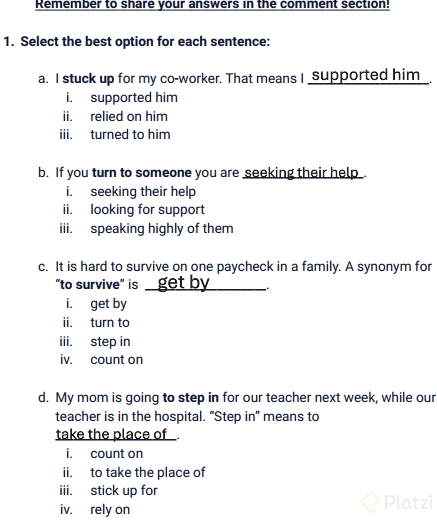
1. Select the best option for each sentence:
a. I stuck up for my co-worker. That means I
i. supported him
b. If you turn to someone you are
i. seeking their help
c. It is hard to survive on one paycheck in a family. A synonym for “to survive” is
i. get by
d. My mom is going to step in for our teacher next week… “Step in” means to
ii. to take the place of
e. “Rely on” means
i. depend on
f. My friend wants me to speak highly of her to my boss
ii. put in a good word for her

Andrés Llerena

alfredo antonio martinez albayero

Silvia Estrada
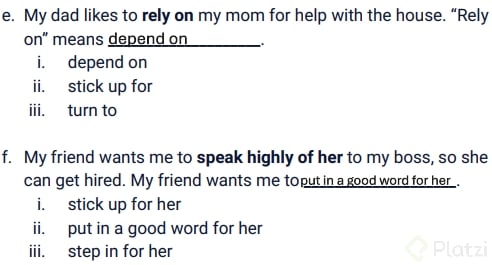
a- supported him
b- seeking their help
c- get by
d- to take the place of
e- depend on
f- put in a good word for her
f-put in a good word for her

Carolina Echeverria
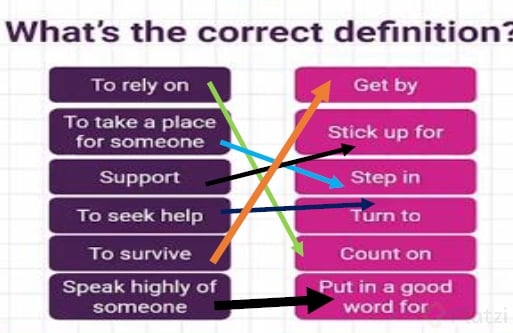
To rely on ------> Count on
To take a place for someone ----> Step in
Support. ------> Stick up for
To seek help -----> Turn to
To survive -----> Get by
Speak highly of someone ---> Put a good word for
Viridiana Contreras Martinez
Count on me
Select the best option for each sentence:

Diego Valle
a I supported him.
b Seeking for their help.
c Get by.
d To take the place of.

Natalia Vera Duran

Jenniffer Tatiana Duque Zamora
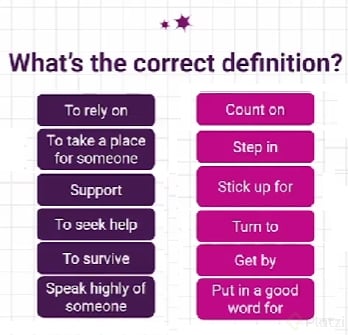
To rely on = count on To take a place of someone = Step in Support = Stick up for To seek help = turn to To survive = Get by Speak highly of someone = Put in a good word of

Eli Diaz
get by is to survive stick up for is to suport step in is to take place for someone turn too is to seek help count on is to rely on put in a worrd for is to speak highly of someone

Juan Morales
To rely on: Count on To take a place for someone: step in Support: stick up for To seek help: turn to To survive: get by Speak highly of someone: put in a good word for
Maria de los Angeles Marroquin Romero
Turn To
Get by
Put in a good word for
step in
stick up for
count on

Jackelyn Julissa
To rely on : Count on To take a place for someone: Step in Support: Stick up for To seek help:Turn to To survive: Get by Speak highly of someone: Put in a good word for
Julio Veloz
My brother always turns to us, his brothers, when he is in need. It's very difficult to get by nowadays. I wish to put in a good word for everybody but It's imposible when I know them well. My assistant allways steps in when I need it. I need my team sticks up for me everyday, that's because I hired. I know I can count on you when I need.
Celeste Yamile
👍