Handling Complaints Effectively
Clase 15 de 21 • Audiocurso de Inglés para Turismo y Hotelería
Contenido del curso

Module 2: Front Desk and Check-In Operations
Module 3: Guest Services and Amenities
Module 4: Restaurant and Dining Service


Module 5: Tourist Information and Concierge
Module 6: Handling Complaints and Issues
Module 7: Events and Special Requests

Resumen
Earn guest trust fast with proven service language. Use active listening, empathy, confirmation, and a five-part professional apology to transform frustration into loyalty. By resisting the urge to fix immediately and taking ownership, you reduce conflict and guide the conversation to a positive outcome.
Why does active listening prevent escalation?
Active listening starts with a counterintuitive rule: do not interrupt. Let guests vent fully to reveal the root cause, not just the symptom. Example: “The TV is broken” may hide the real issue—construction noise that prevents sleep. Listening completely protects trust and uncovers what truly needs solving.
What back channeling signals should you use?
- Nod, keep eye contact, and lean slightly forward.
- Maintain an open posture: arms relaxed, not crossed.
- Remain still and attentive.
- Use brief phrases: “I see.” “I understand.” “Right.” “Okay.” “Uh-huh.”
- Validate feelings without agreeing with facts yet.
How do you confirm understanding?
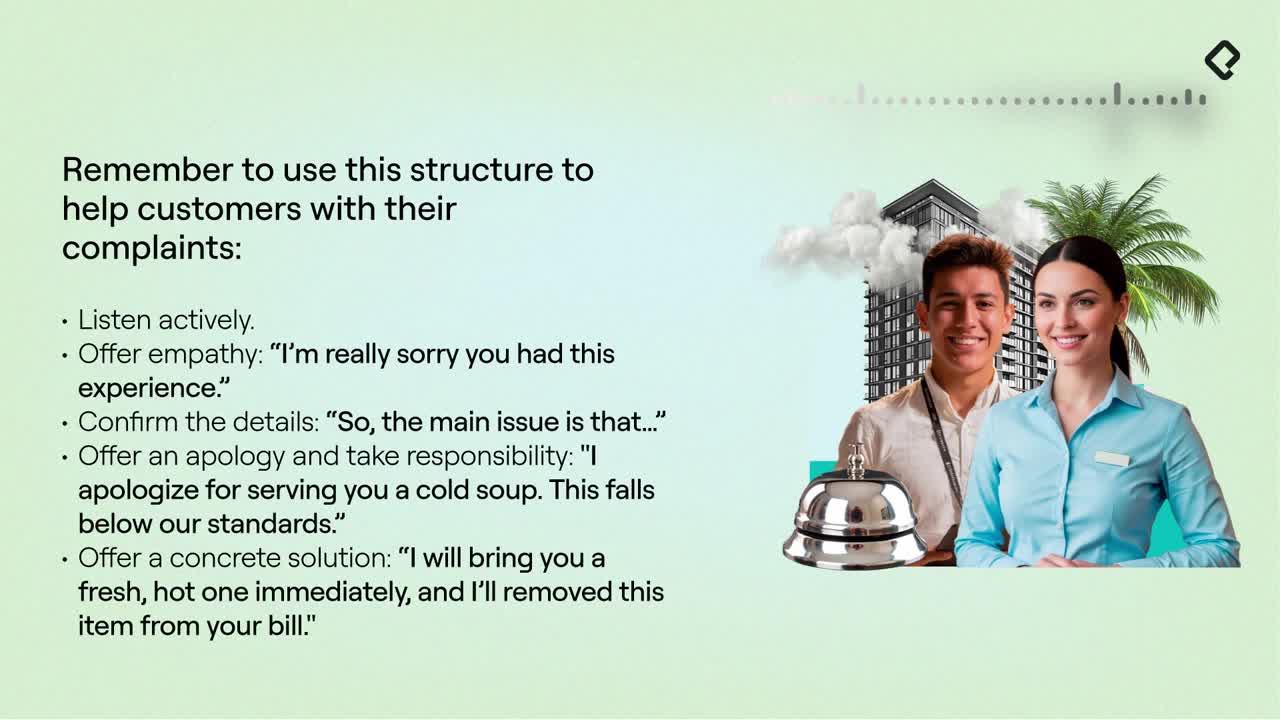
After empathy, confirm the details with a concise summary. This is checking for understanding. Avoid repeating the full story. - “So the main issue is that the air conditioning is making a rattling noise. Is that correct?” - “If I understand correctly, you need a quiet room because you have a meeting tomorrow morning.” This step prevents solving the wrong problem.
How to show empathy and take ownership?
Start your response with empathy phrases that acknowledge emotion. Then take ownership with a formal apology—no excuses. This bridges “us vs. them” and fixes the relationship.
What are effective empathy phrases?
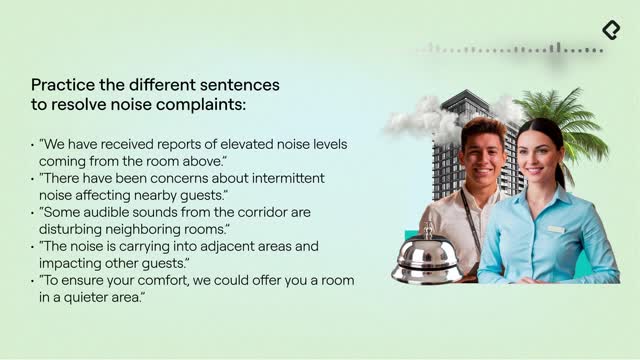
- Service delay: “I completely understand your frustration with the wait time.”
- Facility issue: “I am truly sorry about the cleanliness of your room. I can see why you are disappointed.” These phrases say: your feelings make sense.
What makes a formal apology complete?
A professional apology has five elements: acknowledgment, responsibility, immediate action, prevention, and compensation. - Weak: “Sorry. The kitchen is really busy.” (Deflects blame.) - Professional: “I apologize for serving you a cold soup. This falls below our standards. I will bring you a fresh hot one immediately, and I have removed this item from your bill.” It names the error, owns it, and tells the guest what happens next.
How do you turn mistakes into solutions?
The hardest part is taking ownership, especially with serious errors. Avoid blaming “the night shift” or “a computer glitch.” Owning the failure stops arguments and moves the talk to solutions.
When should you avoid excuses?
If a missed wake-up call makes a guest miss a flight, say: “We failed to call you at 6:00 AM as requested, and we take full responsibility.” Ownership validates anger and shifts focus from blame to fixing the issue.
How can you practice solution language?
Record yourself and role-play to build fluency. - Room not cleaned by 3:00 PM. - Vegetarian meal served with meat. - Charged twice for the same item, noticed after checking the receipt.
Which keywords should you remember?
- Active listening: listen fully before solving.
- Back channeling: nods, posture, and short phrases that keep guests talking.
- Empathy phrases: language that validates emotion.
- Checking for understanding: brief summaries to confirm the core issue.
- Formal apology: acknowledgment, responsibility, immediate action, prevention, compensation.
- Take ownership: accept fault without excuses.
- Deflect blame: weak responses that increase conflict.
- Root cause vs. symptom: solve the real problem, not the surface complaint.
Want to share your best empathy line or apology template? Comment with a phrase that has worked for you and why it helped.