Boris Turcios
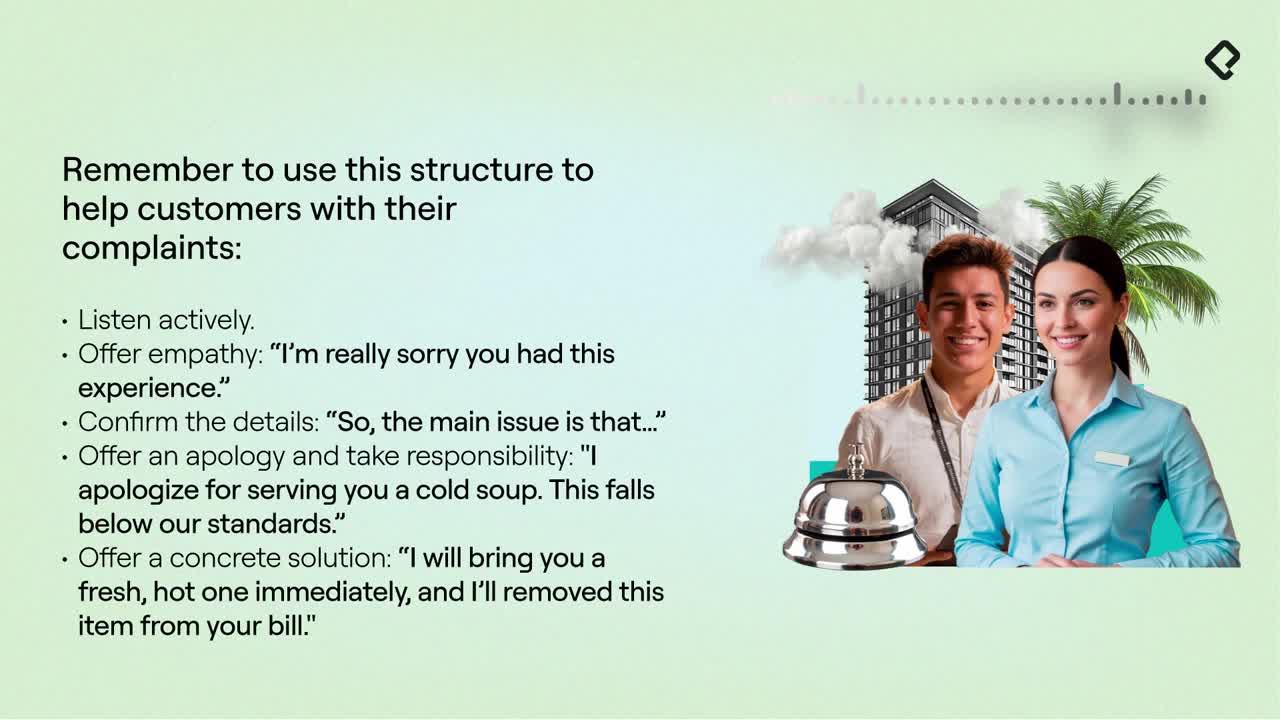
ACTIVE LISTENING & GUEST ESCALATION – VOCABULARY WITH MEANINGS CORE CONCEPTS - Active listening — Listening fully and attentively to understand the real issue - Guest escalation — When a guest’s frustration or complaint becomes more serious - De-escalation — Reducing tension and calming an emotional situation - Root cause — The actual problem, not just the surface complaint - Symptom — A visible complaint that might hide a deeper issue - Take ownership — Accept responsibility for a mistake without excuses - Service recovery — Actions taken to fix a mistake and restore trust NON-VERBAL SIGNALS - Back channeling — Small verbal or non-verbal cues that show you’re listening - Nod — A movement of the head to signal understanding or attention - Eye contact — Looking at the speaker to show you’re engaged - Open posture — Relaxed body language that shows attentiveness - Lean forward — Slight movement toward the speaker to show interest - Attentive — Fully focused and listening carefully LISTENING PHRASES - “I see.” — A short phrase indicating you’re following what the guest says - “I understand.” — A phrase that shows comprehension of the speaker’s message - “Right.” — A short word that confirms you’re listening - “Okay.” — A neutral acknowledgment of what’s being said - “Uh-huh.” — A minimal response to show you’re listening EMPATHY & CONFIRMATION - Empathy — Understanding and acknowledging someone’s feelings - Empathy phrase — A sentence that validates guest emotion - “If I understand correctly…” — A phrase to confirm understanding - Summary confirmation — A brief restatement of the main issue to check accuracy - Clarify details — Asking questions to make sure you fully understand APOLOGY & PROFESSIONAL RESPONSE - Formal apology — A structured apology that accepts fault and promises action - Acknowledgment — Naming the error or problem clearly - Responsibility — Admitting that the service failed to meet expectations - Immediate action — What will be done right away to fix the issue - Prevention — How the same mistake won’t happen again - Compensation — Something offered to make up for the inconvenience - Avoid excuses — Not blaming others or external factors COMMUNICATION SKILLS - Listen fully before solving — Hearing all concerns before offering a solution - Validate feelings — Confirming that the guest’s feelings are real and understandable - Avoid interrupting — Not cutting off the speaker mid-sentence - Confirm understanding — Restating issues briefly to ensure correct interpretation