


MAKING PERSONALIZED TOURIST RECOMMENDATIONS – VOCABULARY WITH MEANINGS

DISCOVERY & DISCOVERY QUESTIONS
- Tourist profile — The set of personal preferences, interests, and background of a traveler
- Focused questions — Specific questions that target a guest’s interests, time, and context
- Interests — What a traveler enjoys doing or learning about
- Energy level — How active or relaxed the guest prefers to be
- Time limits — The amount of time a guest has available for an activity
- Travel group — The type of people traveling together (e.g., family, couple, solo)

PREFERRED EXPERIENCES
- Culture and history — Activities related to learning about heritage and past
- Nature and relaxation — Outdoor, calm, scenic experiences
- Active — Activities that involve physical movement or action
- Easy-going — Relaxed activities with minimal effort
- Family-friendly — Suitable for all ages, including kids
- Accessible — Easy to reach and suitable for guests with mobility limits

PROFILE TYPES
- First time in the city — A guest who has never visited the location before
- Families with children — A travel group that includes kids
- Older travelers — Guests who may prefer comfort and shorter distances
- Couples — Two people traveling together, often interested in romantic or scenic options
- Solo travelers — Individual travelers looking for flexible options
- Adventure-oriented — Travelers seeking active or immersive experiences

ADJECTIVES FOR DESCRIPTIONS
- Vivid — Descriptive in a way that creates a clear mental image
- Iconic — A place or object that is representative or famous
- Historic — Related to significant events or heritage
- Stunning — Extremely impressive or beautiful
- Interactive — Encouraging active participation
- Informative — Providing useful knowledge
- Lush — Green and full of plant life
- Spacious — Large and roomy
- Peaceful — Quiet and calm
- Centrally located — Close to city center or main attractions
- Easy access — Simple to reach without difficulty
- Outdoor-based — Activities that happen outside
- Immersive — Deeply engaging or involved

STRUCTURE OF RECOMMENDATIONS
- Acknowledge interest — Recognizing what the guest wants
- Main recommendation — The primary suggestion tailored to the needs
- Personal touch — Adding a personal preference or insight
- Positive closing — A reassuring ending to the suggestion
Recursos
Resumen
Be the local expert travelers trust: ask focused discovery questions, paint experiences with vivid adjectives, and deliver a clear 3-step recommendation. This practical guide shows how to tailor suggestions to interests, limits, and context so guests feel seen and excited.
Why do great recommendations start with questions?
A brochure can list opening hours, but it cannot listen or tailor. Great recommendations begin with questions, not suggestions. First, observe the traveler’s profile. Then, clarify interests, time, experience with the destination, and companions to avoid generic picks and save time.
What discovery questions focus the options?
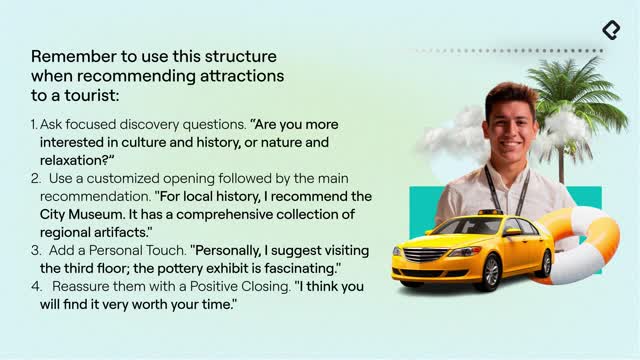
- Interests: “Are you more interested in culture and history or nature and relaxation.”
- Energy level: “Do you prefer something active or more easy-going.”
- Time limits: “How much time do you have today.”
- Experience with the city: “Is this your first time in the city.”
- Travel group: “Are you traveling with children or as a couple.”
How to adapt to traveler profiles?
- Families with children or strollers: family-friendly, interactive, spacious, easy access.
- Older travelers: comfortable, accessible, seated, shorter walking distances.
- Couples: scenic views, romantic feeling, relaxed atmosphere.
- Solo travelers: flexible, centrally located, social or cultural experiences.
- Adventure-oriented: active, outdoor-based, immersive.
How to describe experiences with vivid adjectives?
Vague words like “nice” or “good” are forgettable. Use descriptive adjectives that help guests visualize the moment and feel eager to go. Match the language to the traveler’s needs and the place.
Which descriptive adjectives create a vivid image?
- Landmark: iconic, historic.
- View: stunning.
- Museum: interactive, informative.
- Park: lush, spacious, peaceful.
What vocabulary improves clarity?
- Fit and access: family-friendly, accessible, easy access, shorter walking distances.
- Mood and pace: romantic, relaxed, easy-going.
- Location and logistics: centrally located.
- Social and culture: social, cultural experiences.
- Activity style: active, outdoor-based, immersive.
How to structure a polished recommendation in three steps?
Turn insights into action with a simple, trustworthy format. Acknowledge the interest, add a personal touch, and close positively to reassure the guest.
What is the 3-step structure with examples?
- Customized opening + main recommendation. “For authentic local history, I recommend the City Museum. It has a comprehensive collection of regional artifacts. Check other options in the additional materials section.”
- Personal touch. “Personally, I suggest visiting the third floor. The pottery exhibit is fascinating.”
- Positive closing. “I think you will find it very worth your time.”
How to apply the structure to three tourist scenarios?
- Couple, photography, sunset: “Since you love photography, I recommend a scenic viewpoint for the sunset. It offers a stunning panorama. Personally, choose the most open vantage point. I think you will find it very worth your time.”
- Family, two young children, afternoon, not too long or tiring: “Because you want something fun and manageable, I recommend an interactive museum with open spaces. It is family-friendly and informative. Personally, start with the hands-on gallery. I think you will find it very worth your time.”
- Solo traveler, local food and culture, few hours, walkable: “Since you have limited time, a walking tour nearby focused on local food and culture is practical. It is centrally located and easy to reach on foot. Personally, include a stop with a short tasting. I think you will find it very worth your time.”
Have a question or a scenario to practice. Share it and craft your three-step suggestion below.
Making Personalized Tourist Recommendations

Audiocurso de Inglés para Turismo y Hotelería
Clase 13 / 21