Clarity turns a good recommendation into a real experience. Learn to give directions like a GPS—simple, structured, and confident—using imperative verbs, sequence markers, landmarks, and precise prepositions for public transportation. With these tools, guests won’t get lost and will trust your guidance.
How to give clear directions that guests remember?
Giving excellent directions is about simplicity and structure. Think of information flowing like water in connected pipes: it needs a clear path. Use three tools: imperative verbs, sequence markers, and landmarks.
Why use imperative verbs for directions?
Imperatives are direct and helpful. Avoid soft language like “You should turn left.” Speak clearly instead.
- Use commands: “Turn left. Cross the street. Go straight. Stop.”
- Be specific with common actions: go straight, turn left/right, cross the street/road, walk past (the bank/park/cafe), continue along (4th Street), follow (this street/signs), take the first/second/third turn (right/left), stop at (the traffic lights/corner), enter (the building/park), head towards (the Washington Monument).
- Remember: direct is not rude. It’s clear and helpful.
Which sequence markers create step-by-step clarity?
Sequence markers organize the route like signposts.
- Start simple: first, then, next, finally.
- Compare: “Go out, turn left, walk two blocks.” vs “First go out, then turn left, finally walk two blocks.” The second is easier to remember.
- Add context markers: after that, at the end, when you reach (the corner/traffic lights), once you see (the Washington Monument), before you get to (the mall), until you reach your destination.
How do landmarks act as visual anchors?
Landmarks reduce guesswork when distance is hard to judge.
- Prefer visible cues over distances: “Walk until you see the big red bank.”
- Use clear anchors: the fountain, the tall glass building, the statue.
- Landmarks boost confidence that the path is correct.
How to guide public transportation with essential vocabulary?
Sometimes walking isn’t ideal. Guide guests through buses, trains, or the metro by naming the vehicle, location, payment, and movement accurately.
What vehicle and location terms prevent confusion?
Precision matters to avoid sending guests to the wrong place.
- Vehicle types: subway/metro/underground, bus, train.
- Locations: you catch a bus at a stop, and a train/subway at a station.
- Inside the station: wait on the platform.
How to explain tickets, fares, and passes?
Differentiate the object from the cost and recommend smarter options.
- Ticket: the physical card or paper used to enter.
- Fare: the cost of the trip (the “price of admission”).
- If going and coming back later: suggest a return ticket or a day pass. It’s usually cheaper and saves time queuing twice.
Which prepositions of movement map the route?
Prepositions function like arrows on a map.
- Start/end: from and to. Example: “Take the train from Central Station to Riverside.”
- Along a line: along. Example: “Go along the Blue Line for three stops.”
- Passing areas: through. Example: “The bus goes through the city center.”
- Transfers and levels: up/down (change levels). Example: “Go down the escalator to the subway.”
- Changing sides: across. Example: “Walk across the platform to catch the Red Line.”
- Be precise at transfers to avoid the wrong direction.
How to structure directions and check understanding?
A reliable set of directions has three parts: the start, the journey, and the end. Close by checking understanding so guests leave confident.
What is a complete example to the art museum?
Use this three-step model.
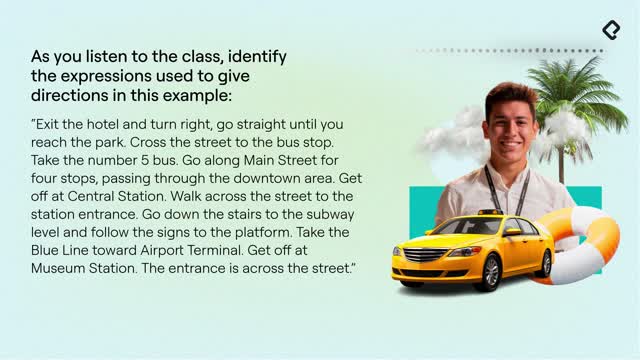
- Start: “Exit the hotel and turn right. Go straight until you reach the park. Cross the street to the Main Street bus stop.”
- Journey: “Take the number 5 bus. Go along Main Street for four stops, passing through the downtown area and central shopping district. Get off at Central Station. Walk across the street to the station entrance. Go down the stairs to the subway level and follow the signs to the platform. At Central Station, take the Blue Line toward Airport Terminal.”
- End: “Get off at Museum Station. The entrance is across the street.”
How to check for understanding before they leave?
Ask short questions and watch for confusion.
- “Does that make sense?” “Do you know where the train station is?”
- “Do you want me to show you on a map?” “Do you know where to get off?”
- Invite clarification: “Would you like me to repeat any part?” “Do you have any questions before you go?” “Is there anything you’d like me to clarify?”
What practice challenge builds this skill?
Strengthen clarity with a no-talking exercise.
- Choose a place you like to visit.
- Write directions from your home to that location.
- Give them to a friend or family member to trace the route on a map.
- Do not speak during the activity.
- If they hesitate or go the wrong way, refine your wording and structure.
Want feedback on your directions? Share your step-by-step route and key landmarks in the comments to get helpful suggestions from others.