Handling Customer Requests
Clase 8 de 21 • Audiocurso de Inglés para Turismo y Hotelería
Contenido del curso

Module 2: Front Desk and Check-In Operations
Module 3: Guest Services and Amenities
Module 4: Restaurant and Dining Service
Module 5: Tourist Information and Concierge
Module 6: Handling Complaints and Issues
Module 7: Events and Special Requests

Resumen
Deliver confident hotel service English that wins trust from the first ring. Learn phone etiquette, the repeat and verify technique, clear future-tense promises, and polite permission language so guests feel heard, respected, and supported throughout their stay.
Why does a professional phone greeting build trust?
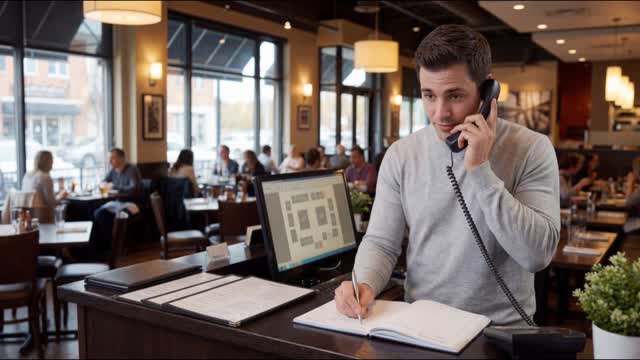
A fast, structured greeting sets the tone and prevents guests from feeling ignored. Answer within about three rings. Use a clear identity so the caller speaks to a person, not a faceless hotel, and follow with active listening.
How should the phone greeting sound for hospitality?
- Use a three-part greeting. Time-appropriate salutation, department, name.
- Example. “Good morning, front desk. This is Pablo speaking. How may I assist you today?”
- Emphasize accountability. Stating your name creates personal responsibility.
- Key vocabulary. housekeeping. front desk. guest.
What listening and clarifying steps reduce errors?
- Identify categories. toiletries like shampoo, conditioner, body lotion, razor.
- Distinguish linens. Extra sheets, pillowcases, bath towels.
- Clarify details. If a pillow is requested, ask soft, hypoallergenic, or memory foam.
- Apply the repeat and verify technique. Summarize the request back to the guest.
- Sample confirmations. “Let me repeat that to make sure I have it right. Two additional bath towels and a sewing kit for room 304.” “So I have two extra bath towels and a sewing kit scheduled for delivery to room 304. Is that correct?”
How do you set expectations with the definite future tense?
Weak language creates uncertainty. Replace might and try with strong, specific promises using I will and a clear timeframe. This shows ownership and reassures the guest the task is in motion.
Which confirmation phrases show ownership?
- Use the definite future tense. “I will bring your extra pillows within 15 minutes.”
- Offer precise timelines. “Your extra pillows will be delivered to your room shortly.”
- Signal immediate action. “I’ll arrange for the extra pillows to be sent up to your room right away.”
- In-person handoff. “Here are the extra pillows you requested. Please let us know if you need anything else.”
How do you close the call proactively?
- Add a helpful final question. “Is there anything else I can assist you with while I’m on my way?”
- Thank and confirm next step. “Thank you for calling, Mr. Smith. I will see you shortly.”
- Key vocabulary. timeframe. ownership. delivery.
How do you handle “Do you mind if...” and give or refuse permission?
Do you mind if is tricky because the logic feels reversed. To mind means to be bothered by something. Answering yes means it bothers you and refuses permission. Answering no means it does not bother you and grants permission. Service professionals avoid bare yes or no and use clear phrases instead.
What do you say to grant permission clearly?
- Combine a negative with a positive action. “No, not at all, go ahead.” “No, please do.”
- Use direct positives for can questions. “Certainly.” “Of course.” “It’s all yours.”
- Informal approval. “No worries. Go for it.”
- Example request. “Do you mind if I take this chair?” Say no to grant permission.
- Key vocabulary. grant permission. direct question.
How can you refuse permission politely?
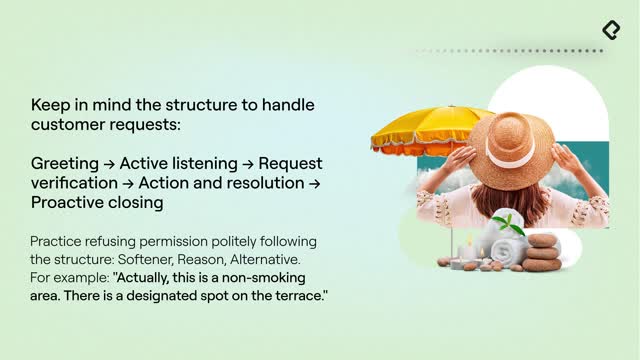
- Use a three-step structure. softener, reason, alternative when possible.
- Softeners. “Actually.” “I’m afraid.” “I’m sorry.”
- Model response. “Actually, this is a non-smoking area. There is a designated spot on the terrace.”
- Luggage cart check. If you want to allow it, say “No, not at all, go ahead.”
- Iron scenario practice. “I’m sorry, all irons are currently in use. I expect one to be available in about 20 minutes. I will send it to your room as soon as it returns.”
Have a question or a real guest phrase that trips you up? Share it and your best response below.