When a customer spots an unexpected charge, trust can crack fast. With a calm voice, clear financial explanations and precise de-escalation, you can turn tension into cooperation across hotels, retail, transportation and tourism. Use the simple three-step path to restore confidence: active listening, investigate and explain, correct and finalize.
Billing disputes: active listening, clear explanations and proof
Why do billing disputes demand calm communication?
A surprise on a bill triggers defense instincts. If a guest feels cheated, even by accident, their trust is broken. The remedy is a steady process that shows fairness and transparency.
- Follow three steps: active listening, investigate and explain, correct and finalize.
- Focus on collaboration: you and the guest versus the problem.
- Provide visible proof to close the loop.
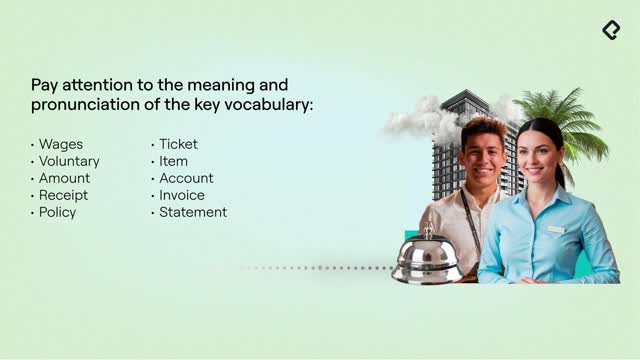
Useful vocabulary for service interactions:
- unexpected charge: a cost the guest did not anticipate.
- active listening: let the guest finish and acknowledge feelings.
- de-escalate: reduce conflict and tension.
- transaction history: records of payments and actions.
- itemized bill: a bill with each charge listed separately.
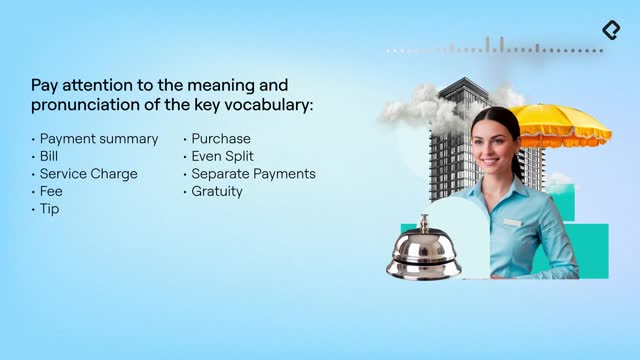
- service charge/fee: a payment for specific benefits.
- revised bill: updated document after corrections.
- ownership: admitting and fixing a mistake.
How does active listening turn conflict into collaboration?
Let the guest finish without interruption. Then validate feelings without admitting fault prematurely. The word “together” signals partnership and reduces confrontation.
Model phrases you can use:
- “I understand your concern about the final total. Let’s review the charges together.”
- “I understand why this total looks unexpected. Let’s go through the charges step by step.”
- “I can see why you would have these questions about the amount. Let me review the details with you.”
- “Thank you for bringing this to my attention. We can check each item together to clarify the total.”
Tip for ESL learners:
- Emphasize the inclusive word together to shift from blame to teamwork.
- Use verbs that acknowledge: understand, see, thank you.
How to explain charges and correct errors with proof?
Open the transaction history and the itemized bill. Many disputes come from misunderstanding terms, not actual errors. If the charge is valid, explain it factually and connect it to value. If there is an error, admit it sincerely, fix it and provide a revised bill.
How to explain a valid charge clearly?
Avoid “That’s the rule.” Link the amount to what it covers.
- “The $20 resort fee covers your high-speed WiFi, gym access and pool towels as mentioned in your booking confirmation.”
- “This charge or amount is for service or fee which includes specific benefits as noted in the confirmation email, the receipt or the policy.”
- “The additional fee covers what is provided such as [your examples], and was included in your booking, in your ticket, in your agreement.”
- “This item appears because [your reason], and it allows you to use [whatever service] during the time period.”
Language focus:
- Use precise nouns: confirmation email, receipt, policy.
- Connect charges to benefits: WiFi, gym access, pool towels.
How do you admit mistakes and provide proof?
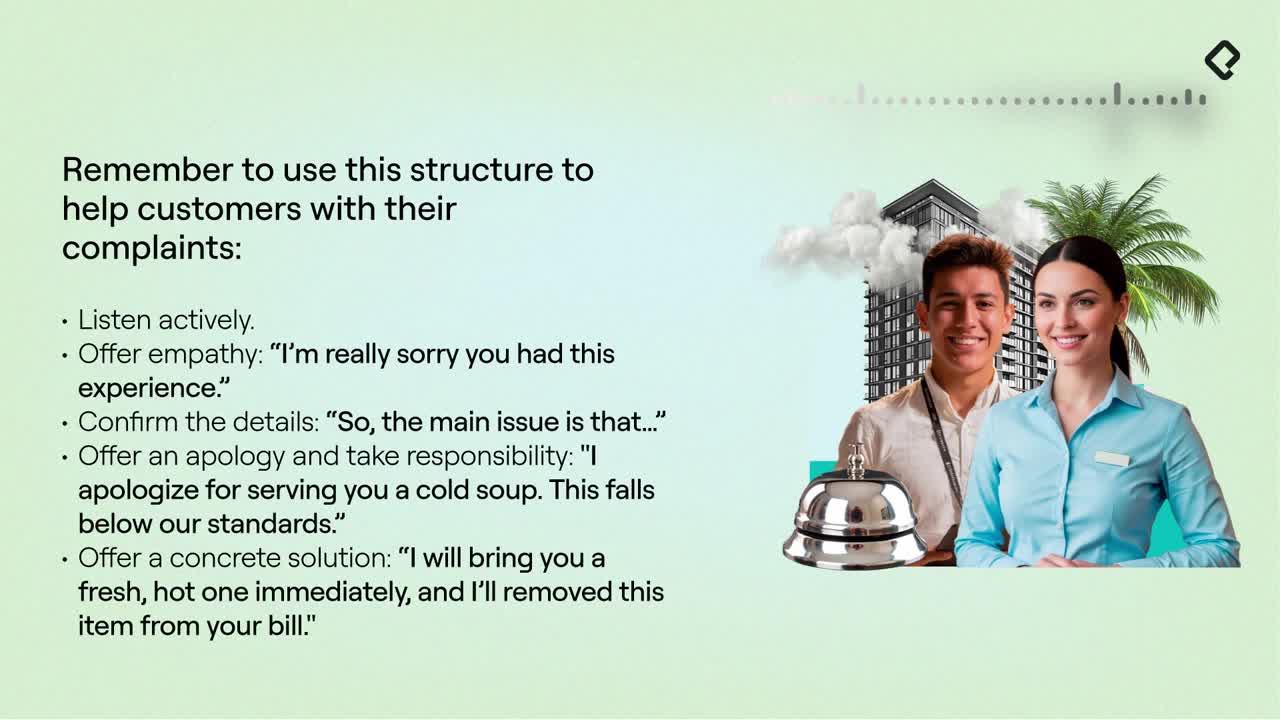
Taking ownership builds more trust than hiding the issue. Apologize clearly, then correct the bill and show evidence.
Apology models:
- “I sincerely apologize. I see that this appetizer charge is an error. It appears it was posted to your bill by mistake.”
- “I sincerely apologize. I see that the charge, the item or the service is incorrect. It seems it was added to your bill, account or invoice by mistake.”
- “My apologies, this fee, order or item was applied incorrectly. I will correct it right away.”
- “I’m very sorry. There was an error with the charge, the reservation or the service, and it should not have been posted to your bill or account or statement.”
Proof and closure:
- Delete the incorrect item in your system and print a revised bill.
- Present the new document and walk the guest through it step by step.
- Confirm understanding and end with reassurance.
Phrases for finalizing:
- “Here is your revised bill. As you can see, I have removed the incorrect breakfast charge. Your new total is $150. Does this look correct to you?”
- “Here is the updated invoice, bill or statement.”
- “This is your revised bill or account summary.”
- “I’ve adjusted your bill, receipt or invoice.”
Reassuring closers:
- “Again, I apologize for the confusion. I hope the rest of your stay is excellent.”
- “Once again, I apologize for the inconvenience. We hope the rest of your visit is enjoyable.”
- “Thank you for your patience. I hope you have a pleasant, wonderful, smooth remainder of your stay.”
- “We appreciate your understanding. Please enjoy the rest of your visit, meal or stay without further issues.”
Want to practice? Find a recent receipt from a grocery run or restaurant meal. Explain every tax, fee and item aloud as if clarifying it for a confused international guest. Share your example or questions in the comments to get feedback.